Megazone Cloud, KISTI team up on quantum AI, seek to link supercomputers and quantum computers
- Input
- 2026-10-29 10:42:02
- Updated
- 2026-10-29 10:42:02
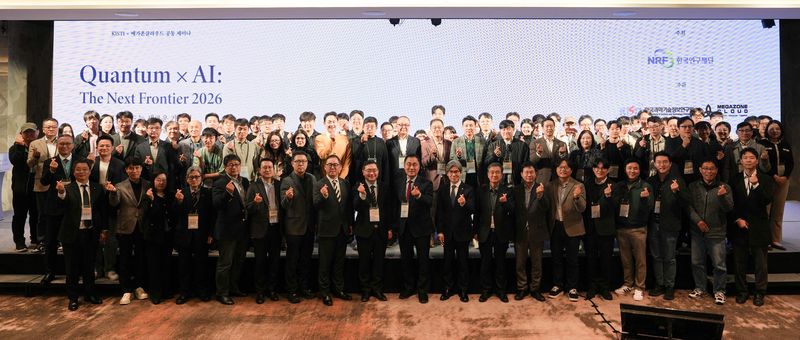
[Financial News] Megazone Cloud has joined forces with the Korea Institute of Science and Technology Information (KISTI) and decided to move ahead in earnest with efforts to put a hybrid environment combining artificial intelligence (AI), supercomputers and quantum computers to use in industry. The plan is to use a hybrid environment in which existing computing resources and quantum computers share computational tasks, helping companies apply quantum technology to complex industrial problems, including drug development and new materials design, without owning their own quantum computers.
Megazone Cloud said on the 29th that it had jointly hosted a seminar on quantum computing and AI integration, ‘Quantum × AI: The Next Frontier 2026,’ with KISTI on the 28th at Seoul Dragon City.
About 100 people attended the event, including National Assembly member Choi Hyung-du, a member of the National Assembly of South Korea’s Science, ICT, Broadcasting, and Communications Committee, as well as corporate research and development (R&D) and digital transformation (DX) managers, quantum researchers and corporate technical staff.
At the seminar, Ham Jae-gyun, head of KISTI’s Quantum Computing Service Research Division, outlined plans to build a hybrid computing environment linking the national supercomputer ‘Hangang,’ which uses about 8,500 graphics processing units (GPUs), with IonQ’s quantum computer ‘Tempo.’
In this environment, the supercomputer will handle data preprocessing and large-scale computing, while the quantum processing unit (QPU) will perform specific computations. Plans also call for a cloud-based quantum computing service platform and user support system that will enable integrated use of different computing resources.
This is expected to allow companies and research institutions to develop quantum algorithms without directly owning quantum computers, and to use actual QPUs to verify the technology’s potential applications and limitations. Industries requiring complex computations, including drug development, new materials design and logistics optimization, were cited as key areas of application.
Drawing on its expertise in cloud and AI, Megazone Cloud plans to support companies in developing industry-specific quantum algorithms and conducting proofs of concept (PoCs). Its focus is on determining whether quantum computing can be used to address real-world industrial problems by linking it with existing computing environments, rather than on adopting quantum computers themselves.
Kim Dong-ho, Megazone Cloud’s chief quantum officer (CQO), said, “We will support companies in developing quantum algorithms suited to their industry-specific challenges and verifying their effectiveness through proofs of concept.”
[email protected] Choi Hye-rim Reporter