LG Uplus Corp.'s AI Token Optimization Research Recognized at Leading Global AI Conference
- Input
- 2026-10-29 12:06:00
- Updated
- 2026-10-29 12:06:00
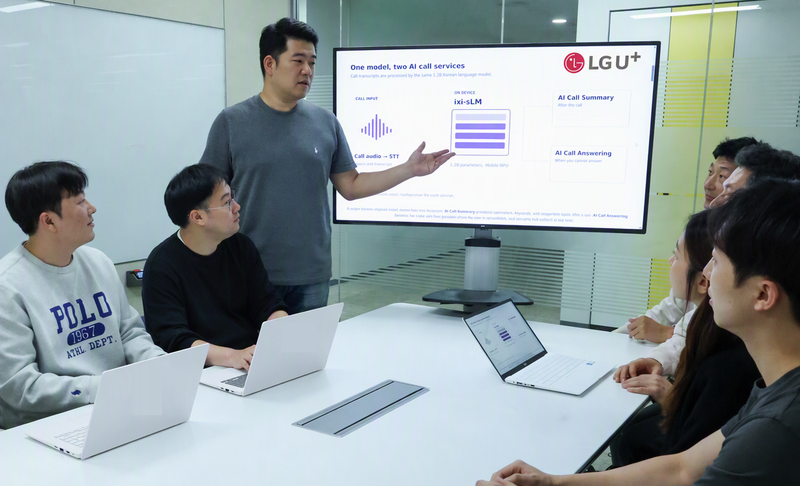
Boosting smartphone AI processing speed and reducing power consumption
LG Uplus Corp. announced on the 29th that two related papers had been accepted for a workshop in the field of on-device intelligence at NeurIPS 2026. NeurIPS is considered one of the world's three leading AI conferences, alongside ICML and ICLR, and attracts researchers from global companies such as Google, Meta and OpenAI, as well as leading universities. This year's event will be held in Sydney, Australia, from December 6 to 12.
Competition among AI services has recently expanded beyond model performance to focus on how quickly and efficiently tokens can be processed. Tokens are units of data that AI uses to understand questions and generate answers. Improving token processing speed and efficiency can reduce response times and lower power consumption and computing resource use.
LG Uplus Corp. developed a small language model (sLM) for use in calling services and optimized it for smartphones by applying model compression and inference acceleration technologies. The company said this enabled it to increase processing speed to about 4.5 times that of the existing approach while reducing battery use by about 77%, all while maintaining performance at the level of cloud-based AI. The key was enabling AI to run efficiently even with limited computing resources and battery power.
Training AI on personal data kept on the device
The company also researched technology for training AI on smartphones without sending personal data to external servers. LG Uplus Corp. said that by optimizing the computing and memory resources needed for training and conducting additional training on the device, it confirmed accuracy on a par with training on a server.LG Uplus Corp. is considering ways to apply its research findings to its own AI services. It plans to broaden its research to extend the optimization technology validated on smartphones to server environments using graphics processing units (GPUs), so customers can use AI more quickly and conveniently.
SangYup Lee, chief technology officer (CTO) at LG Uplus Corp., said, "The acceptance of this paper recognizes our research achievements in running and training AI quickly and efficiently even in constrained environments. We will apply the related technologies to actual services and, in the future, expand the scope of our research to server environments."
[email protected] Yoon Hong-jip Reporter