Additional 76,700 homes to be supplied in six areas including Gimpo and Guri; land transaction permit zones to be lifted in some areas
- Input
- 2026-10-29 10:00:00
- Updated
- 2026-10-29 10:00:00
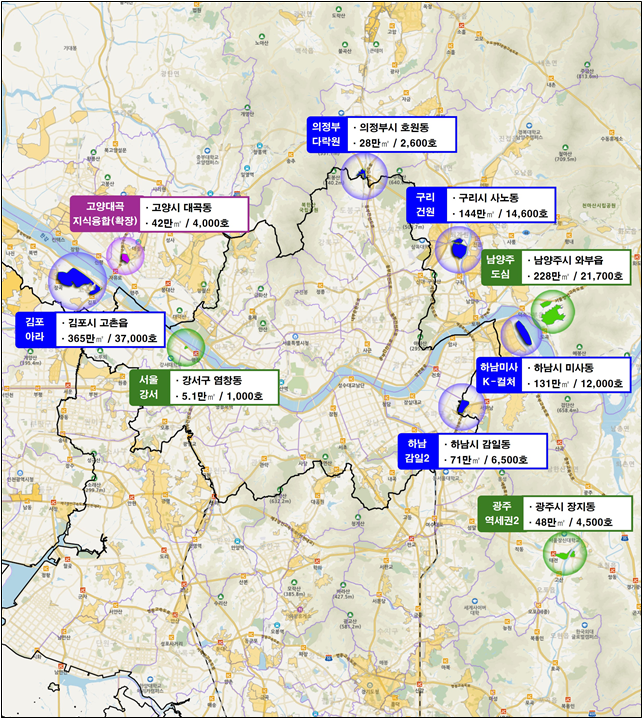
[Financial News] The government will lift greenbelt restrictions in six areas of the Seoul metropolitan area, including Gimpo and Guri, and supply 76,700 homes. Including the 27,200 homes announced in the Aug. 13 measures, a total of 104,000 homes are set to be supplied in the Seoul metropolitan area. Land transaction permit zones will be lifted in all other areas, except the candidate sites and nearby areas that will be affected.
Hong Ji-seon, minister of land, infrastructure and transport, announced the plan at a ‘second housing supply briefing’ at the Government Complex Seoul on the 29th.
Six areas in Gyeonggi Province were selected as sites in this announcement. Specifically, they are Gimpo Ara (37,000 homes), Guri Geonwon (14,600), Hanam Misa K-Culture (12,000), Hanam Gamil 2 (6,500), Uijeongbu Darakwon (2,600) and Goyang Daegok Knowledge Convergence (4,000). All of these districts are located within 5 km of Seoul’s boundary.
This announcement is a follow-up to the Aug. 13 measures and covers the remaining districts that were not announced at the time. The plan is to supply a total of 104,000 homes, including the 27,200 announced previously in areas such as Gangseo-gu, Seoul (1,000 homes), central Namyangju (21,700) and Gwangju Station Area 2 (4,500).
The government plans to proceed with the supply by lifting greenbelt restrictions. It said the districts are greenbelt areas with low environmental conservation value because they have been heavily damaged. The government explained that planned and systematic development is needed because unplanned development is already underway or is a concern in these areas.
MOLIT assessed that the Gimpo Ara district is a high-demand housing area, as it is not only adjacent to Gangseo-gu, Seoul, but also located along the Han River. It also determined that the area has transportation advantages, with the Seoul Subway Line 5 extension project—whose preliminary feasibility study it passed last March—underway, and Gimpo Hangang-ro and the Seoul Metropolitan Area First Ring Expressway also nearby. Minister Hong said, “By linking its excellent natural scenery with nearby facilities such as the Hangang Cinepolis General Industrial Complex and Gochon Logistics Complex, we will create a self-sufficient living area where jobs and housing are organically integrated.” He added, “We plan to develop it as the center of a western regional living axis connecting Gimpo and Seoul.”
The Guri Geonwon district will be developed by converting an area that had been on hold for a long time due to a lack of project feasibility into a residential development district. Its advantages include its proximity to the Seoul Metropolitan Area First Ring Expressway, high traffic volumes and the ability to reach Jamsil Station in the 30-minute range.
The Hanam Misa K-Culture district is located near Misa Island and is served by Seoul Subway Line 5. Extension projects for Seoul Subway Lines 3 and 9 are underway nearby, and access to central Seoul is expected to improve significantly once they open. The government plans to create a park of this kind and also draw up plans for a K-Culture complex, developing the area into a hub combining nature and culture in the eastern region that can offer the best of both worlds.
Hanam Gamil plans to strengthen its connections with the Seoul metropolitan area. One proposal is to build out the public transport system alongside the Seoul Subway Line 3 extension project. The government said it would create an integrated living area linked to the existing Gamil district and draw up measures to ease traffic congestion in coordination with the broader transportation improvement plan for Hanam Gyosan, a third-generation new town.
Uijeongbu Darakwon will make use of Camp Jackson, a former U.S. Forces Korea (USFK) base returned to South Korea. Its accessibility to Dobongsan Station, a transfer station for Seoul Subway Lines 1 and 7, is considered an advantage. The plan is to expand jobs and community services and create a nature-friendly city where homes and workplaces are close together.
Lastly, the Goyang Daegok Knowledge Convergence district will expand the existing area. It was designated as a district last September, and the plan reflects criticism that development was limited because it included only the northern side of Daegok Station, a five-line rail hub served by GTX-A and Seoul Subway Line 3, among others. The development will include part of the southern site and create a fully integrated station area.
Meanwhile, the government will apply its ‘shortest-possible construction-start model for public housing sites’ to begin construction by 2030. In addition, a comprehensive investigation into land ownership by employees of MOLIT, Korea Land and Housing Corporation (LH) and other personnel involved in the work found no significant issues.
In its Aug. 13 measures, the government designated all of Seoul and greenbelt areas in the adjacent Seoul metropolitan area, among others, as land transaction permit zones. Under the latest measures, it decided to lift the designation in all other areas, except those within the impact zones of the new housing site candidates.
Minister Hong said, “It is more important than anything else to continue supplying homes in excellent areas favored by people with genuine housing needs, such as young people and newlyweds.” He added, “We will do everything we can to supply homes quickly at the new sites by applying the shortest-possible construction-start model at every stage, from district designation to the start of construction.”
[email protected] Jeong Gyeong-su Reporter