The South Sea’s “timetable” has fallen out of sync ... Phytoplankton blooms are occurring later
- Input
- 2026-10-29 09:32:34
- Updated
- 2026-10-29 09:32:34
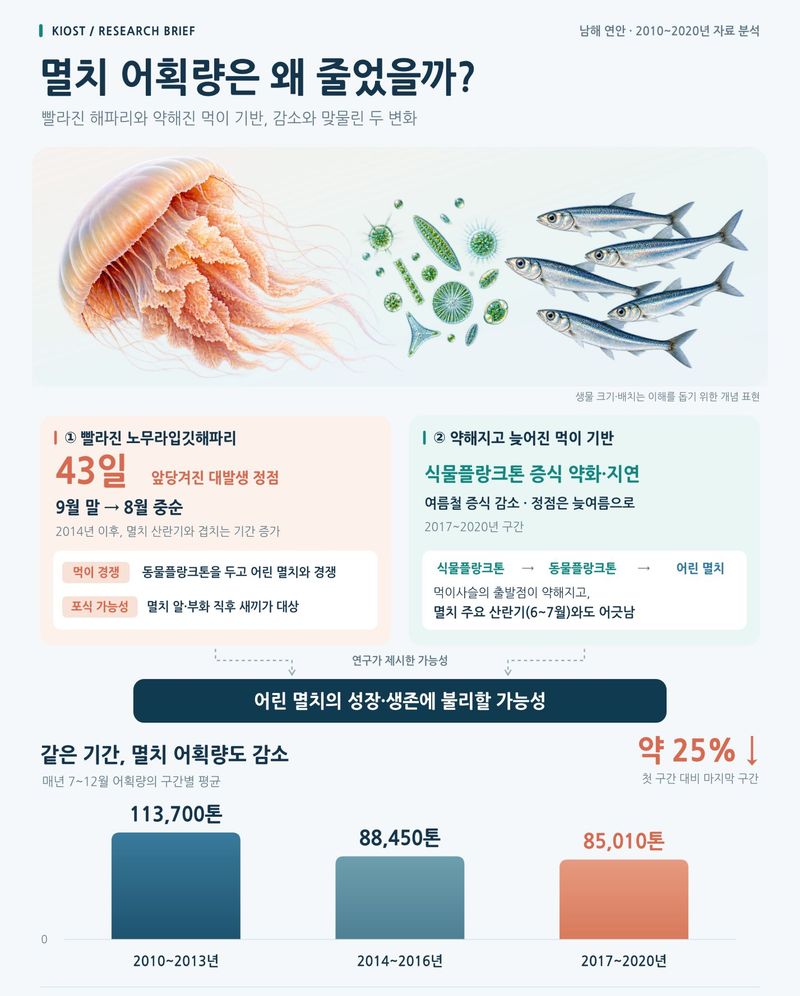
The Korea Institute of Ocean Science and Technology (KIOST) said on the 29th that a research team led by Dr. Kang Jeong-hun at its South Sea Research Institute had recently conducted a comprehensive analysis of data on coastal water temperatures, jellyfish appearances, anchovy catches and other factors in the South Sea from 2010 to 2020.
The study period was divided into three intervals based on when average water temperatures changed, and the intervals were compared. After conducting a statistical analysis that considered multiple factors simultaneously, the research team found that rising water temperatures, the early appearance of Nomura’s jellyfish and a decline in phytoplankton were closely associated with fluctuations in anchovy catches.
The peak of the Nomura’s jellyfish bloom shifted forward by about 45 days, from around late September in 2010 to mid-August. The researchers concluded that the increased inflow of the Tsushima Warm Current in spring and summer over the same period led the jellyfish to appear earlier.
Since 2014, the period when jellyfish gather has increasingly overlapped with the anchovy spawning season. Because juvenile anchovies and jellyfish both feed on zooplankton, they compete for food when they appear at the same time. Jellyfish can also swallow prey 3 mm or smaller, allowing them to eat anchovy eggs and newly hatched young.
The scale of phytoplankton blooms, which form the base of the anchovy food chain, was also found to have gradually decreased. Phytoplankton usually increase substantially in spring and summer, but from 2017 to 2020, their increase during the summer slowed markedly.
The period of peak phytoplankton growth also shifted to late summer, out of sync with June and July, when anchovy spawning is most active. As a result, food for juvenile anchovies declined and their appearance was delayed, while they encountered jellyfish—which are both competitors and predators—earlier.
Dr. Kang explained, “This study shows that not only the scale of jellyfish appearances but also their timing may be related to anchovy catches. When managing fisheries resources, it is necessary to consider together the seasonal changes in jellyfish appearances, phytoplankton blooms and anchovy spawning. These data will serve as an important basis for managing anchovy stocks in the future.”
[email protected] Byun Ok-hwan Reporter