“I want to disappear without a trace” ... From requesting a halt to debt collection to applying for basic livelihood benefits—with one phone call
- Input
- 2026-10-29 10:30:00
- Updated
- 2026-10-29 10:30:00
On the 29th, the Financial Services Commission (FSC) introduced a case handled by the 1375 in-depth counseling team. Person A, in their 60s, faced financial hardship due to debt and health problems. When A mentioned suicide, a local Administrative Welfare Center connected them with 1375 for counseling. The service contacted the card company holding A’s debt and asked it to cooperate in suspending (putting on hold) debt collection. After checking with the Administrative Welfare Center whether welfare assistance was available, it helped A visit the center and apply for basic livelihood assistance.
The FSC and the Credit Counseling and Recovery Service (CCRS) held a launch ceremony that day for 1375 (“everyday healing”), the representative number for debt counseling. The number was assigned to the CCRS so that debtors struggling with excessive debt would not lose hope without knowing about the various support programs available to them.
The comprehensive debt-counseling hotline 1375 officially begins operations today. It will be available on weekdays from 9 a.m. to 6 p.m. Call charges are paid by the receiving party, the CCRS.
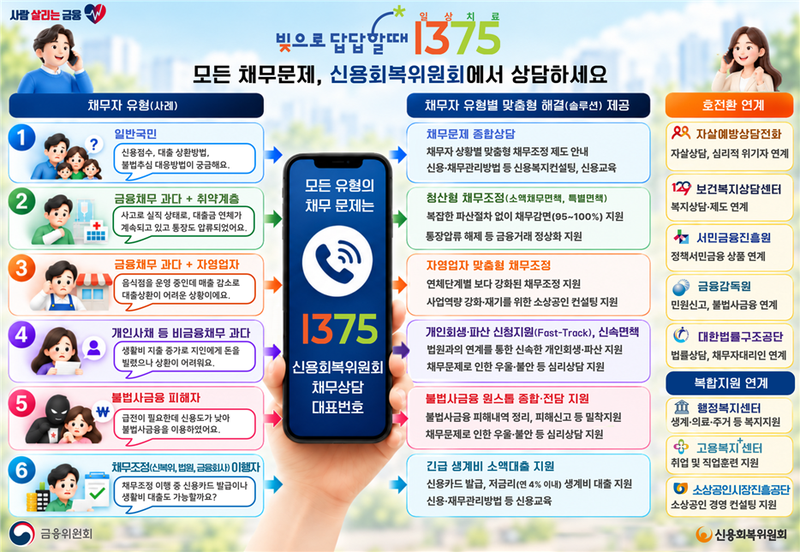
Debtors can receive comprehensive counseling on debt-related issues, including debt adjustment for financial obligations and telecommunications and electricity bills; assistance with court applications for personal rehabilitation or bankruptcy; reporting and support for victims of illegal private lending; and integrated financial, employment and welfare support. They can be connected without ending the call to the Korea Inclusive Finance Agency (1397), the Financial Supervisory Service (1332), the Korea Legal Aid Corporation (132), the Suicide Prevention Counseling Hotline (109) and the Health and Welfare Counseling Center (129), all of which receive many referrals related to debt. Clients facing overlapping crises involving their livelihood, mental health or finances can be referred to a dedicated in-depth counseling team, which develops and supports comprehensive solutions and connects them with specialist organizations when needed.
Financial Services Commission Chairman Lee Eok-won spent time personally counseling clients, taking on the role of a counselor for a day. After the launch ceremony, he heard about counseling experiences and cases from 1375 clients and call-center employees at an on-site meeting.
Last June, President Lee Jae-myung ordered an extensive public-information campaign “so that no one gives up their life because of debt, and no one is unaware that they can seek bankruptcy discharge or debt adjustment.”
At a Cabinet meeting last July, the FSC prepared and reported, jointly with public and private sectors, measures to prevent suicide among people facing economic hardship. The number 1375 means “healing (75) everyday life (13) worn down by debt.” Anyone can call 1375 for counseling when falling behind on loan payments, credit-card bills or phone bills and considering applying for debt adjustment, personal rehabilitation or bankruptcy.
The CCRS reorganized and upgraded its call-center counseling system and staffing, its referral system with relevant organizations, and its IT infrastructure in preparation for increased call volumes and demand for a wider range of counseling. Following a pilot period this month, it is moving into full operations. During the pilot, counseling figures rose by 13.9% from the same period a month earlier and by 13.2% from the same period a year earlier. Counseling through 1375 accounted for about 25% of the total.
1375 provides counseling and information on support programs for debt-related issues, from general services such as credit and financial consulting and guidance on support programs to debt-adjustment schemes for financial obligations and telecommunications and electricity bills; assistance with applications for personal rehabilitation or bankruptcy through referrals to courts and the Korea Legal Aid Corporation; a one-stop reporting and support program for victims of illegal private lending; and integrated financial, employment and welfare support.
People receiving basic livelihood assistance whose total debt principal is 5 million won or less and whose debt has been overdue for at least one year can receive support to normalize their financial transactions, including debt deferrals and reductions and the lifting of account seizures, through programs such as the debt-relief scheme for small-scale vulnerable debtors. Those who have difficulty repaying excessive non-financial debts, such as personal loans, can receive support to proceed quickly with personal rehabilitation or bankruptcy through referrals to courts and the Korea Legal Aid Corporation. Victims of illegal private lending are assigned a dedicated CCRS staff member and referred to the one-stop reporting and support program for such victims.
The CCRS established an in-depth counseling team for high-risk clients, including people showing signs of severe psychological distress, victims reporting illegal private lending, people with serious illnesses and older people who have lost their jobs. Team members spend an average of about five times as long as in regular counseling listening closely and assessing signs of crisis. Person A’s case was handled by the team. When a crisis is identified, the team quickly connects clients with relevant specialist organizations in areas such as legal services, employment, welfare, illegal private lending and mental health, and directly supports efforts to resolve their problems.
At an on-site meeting held that day, Person B, who had taken out a loan and faced financial difficulties after losing their job, said, “1375 is easy to remember, so I think I’ll be able to ask for help easily if I have concerns about debt or need additional counseling in the future. It also seems convenient that I can be connected directly to 1375 without hanging up, even while I’m speaking with another organization.”
Person C, a victim of illegal private lending, said, “At first, I thought I would only get counseling about the illegal lending I had experienced. But with one call to 1375, I was able to report what happened and learn about support programs I hadn’t known about, including integrated-support counseling. It was a great help when I felt at a loss.”
Financial Services Commission Chairman Lee Eok-won said, “What people struggling with debt need is not the despair of having to bear it alone, but the hope that help is available.” He added, “The Financial Services Commission will actively support the stable operation of 1375 so that people struggling with debt can lay the foundations for a fresh start.”
CCRS Chairman Kim Eun-kyung said, “We will strengthen 1375’s role as a comprehensive support hub for debtors, connecting them with employment and welfare services as well as debt adjustment, so that it becomes a dependable counseling service people can trust and turn to when they are struggling with debt. We will put ‘finance that saves lives’ into practice on the ground.”
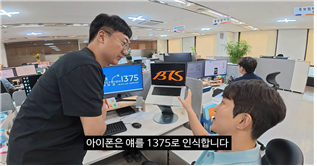
Meanwhile, the FSC has begun a promotional campaign alongside the launch of 1375, working with relevant organizations and private companies. It produced and distributed a video in collaboration with YouTube creator Kim Seon-tae and made a promotional jingle to air on the radio. In collaboration with the Ministry of Culture, Sports and Tourism and others, it will broadcast 1375 promotional videos on available media owned by the government and related organizations, private electronic billboards, subway stations, city buses and video screens in convenience stores nationwide.
[email protected] Park Mun-su Reporter