14,673 Records on the Jeju April 3 Incident... Discussion of Ways to Use Them After UNESCO Inscription
- Input
- 2026-10-29 08:59:14
- Updated
- 2026-10-29 08:59:14

【Financial News, Jeju — Jeong Yong-bok】 Jeju Province will host discussions on ways to use the 14,673 records related to the Jeju April 3 Incident, inscribed on UNESCO’s Memory of the World Register, for education and addressing historical injustices. Reconciliation after the genocide in Rwanda and ex officio retrials for the Jeju April 3 Incident will also be discussed as international examples of addressing past injustices.
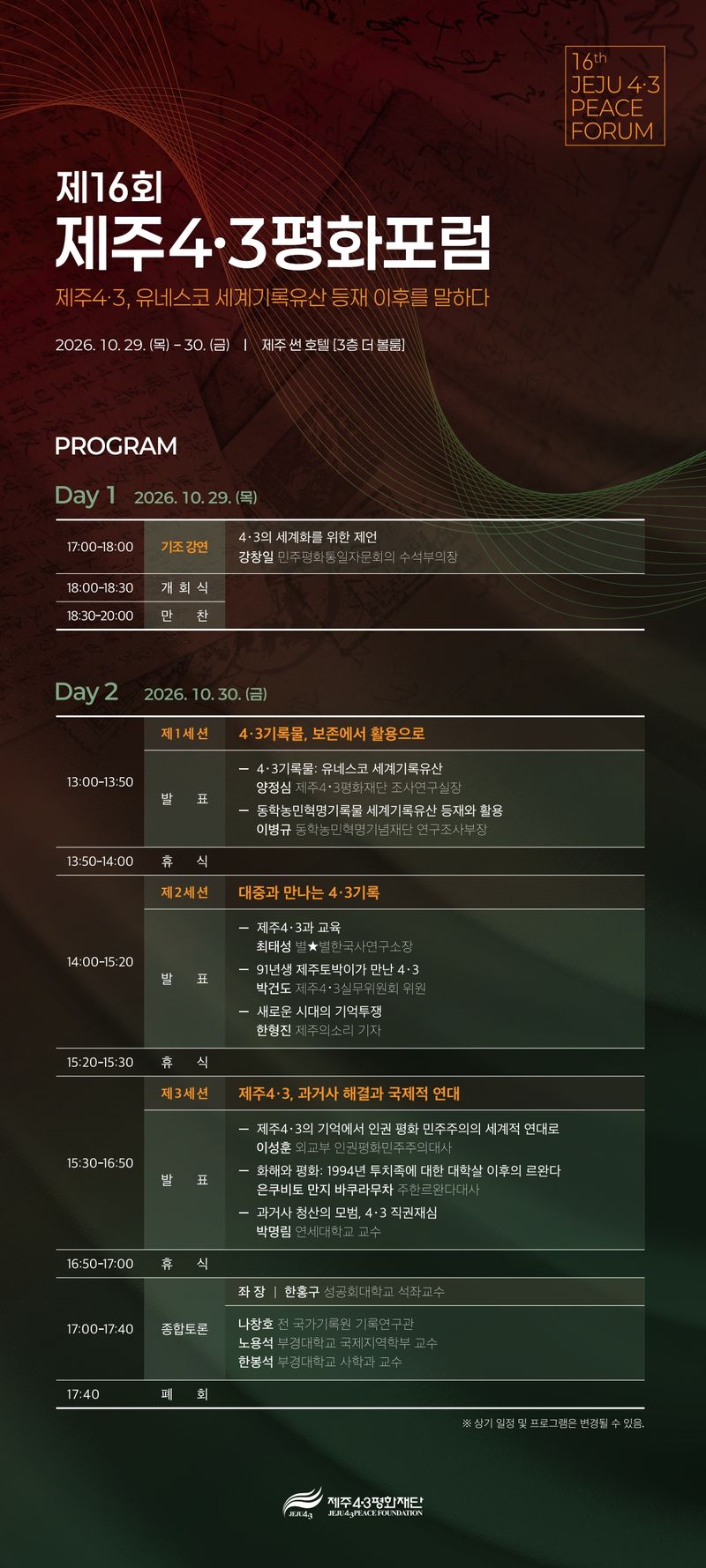
According to the Jeju 4.3 Peace Foundation on the 29th, the 16th Jeju April 3 Peace Forum will be held from the 29th to the 30th at the Jeju Sun Hotel in Jeju City under the theme “Jeju April 3: Looking Beyond Its Inscription on UNESCO’s Memory of the World Register.”
The forum will focus on how to preserve the records and share them with future generations now that their international value has been recognized. It will explore ways to use historical records in education and human rights and peace activities, and connect them with international experiences in addressing historical injustices.
The records related to the Jeju April 3 Incident were inscribed on UNESCO’s Memory of the World Register at a meeting of UNESCO’s Executive Board held in Paris, France, on April 10 last year. The 14,673 records comprise 27 military court prisoner lists and prison postcards, 14,601 testimonies from victims and bereaved families, 42 records of civil society’s truth-seeking movement, and three official government investigation reports.
UNESCO recognized the records’ global value because they document not only residents who were victims of state violence, but also the long process of truth-seeking, restoring victims’ honor, and achieving social reconciliation.
Inscription on the Memory of the World Register does not automatically ensure that records will be used or readily accessible to the public. How to interpret them, use them as educational materials, and share them with the international community remains a task for the future.
At 5 p.m. on the 29th, the forum’s first day, Kang Chang-il, senior vice-chair of the Peaceful Unification Advisory Council (PUAC), will deliver a keynote address on “Proposals for Globalizing the April 3 Incident.” Kang helped found the Jeju April 3 Research Institute and has been involved in the truth-seeking movement, serving as its director and board chair.
Three academic sessions on the use of records, education, and international solidarity will follow from 1 p.m. on the 30th.
In the first session, Yang Jeong-sim, head of the Research and Investigation Office at the Jeju 4.3 Peace Foundation, will explain the composition and significance of the inscribed records. Lee Byeong-gyu, head of the Research and Investigation Division at the Donghak Peasant Revolution Memorial Foundation, will present examples of how records of the Donghak Peasant Revolution, inscribed on the Memory of the World Register in 2023, have been used.
The second session will focus on popularizing the April 3 Incident and educating future generations. History education expert Tae-Sung Choi, director of the Byeolbyeol Korean History Research Institute; Park Geon-do, a member of the Jeju April 3 Working Committee; and Han Hyeong-jin, a reporter for Jeju Sori, will give presentations on education, how different generations remember the past, and struggles over memory in a new era.
The third session will share international experiences in addressing past injustices. Lee Seong-hun, the Ministry of Foreign Affairs’ Ambassador for Human Rights, Peace and Democracy, will discuss the memory of the April 3 Incident and international solidarity on human rights and peace, while Rwanda’s ambassador to South Korea, Nkubito Manzi Bakuramutsa, will present the process of reconciliation after the 1994 genocide of the Tutsi.
Park Myeong-rim, a professor at Yonsei University, will analyze ex officio retrials for the Jeju April 3 Incident as an example of addressing past injustices. An ex officio retrial is a procedure in which prosecutors ask a court to reopen a case after a final judgment. In the Jeju April 3 cases, it is being used to restore the honor of victims punished in unjust trials.
A general discussion will follow, chaired by Han Hong-gu, a distinguished professor at Sungkonghoe University (SKHU), with former National Archives of Korea archival researcher Na Chang-ho and Pukyong National University professors Noh Yong-seok and Han Bong-seok.
Im Mun-cheol, chair of the Jeju 4.3 Peace Foundation, said, “Inscription on UNESCO’s Memory of the World Register is not an end but a new beginning,” adding, “We will seek ways to pass on the memory of the April 3 Incident to future generations and the world.”
The forum provides a venue to discuss how to connect the preservation and use of records and education with international experiences in addressing past injustices following inscription on the Memory of the World Register. Developing concrete ways to translate international recognition of the records into education, social reconciliation, and international cooperation remains a challenge.
[email protected] Jeong Yong-bok Reporter