Pro-Netanyahu bloc projected to win 53 seats, anti-Netanyahu bloc 48; Arab parties hold 19-seat kingmaker role
- Input
- 2026-10-29 06:34:29
- Updated
- 2026-10-29 06:34:29
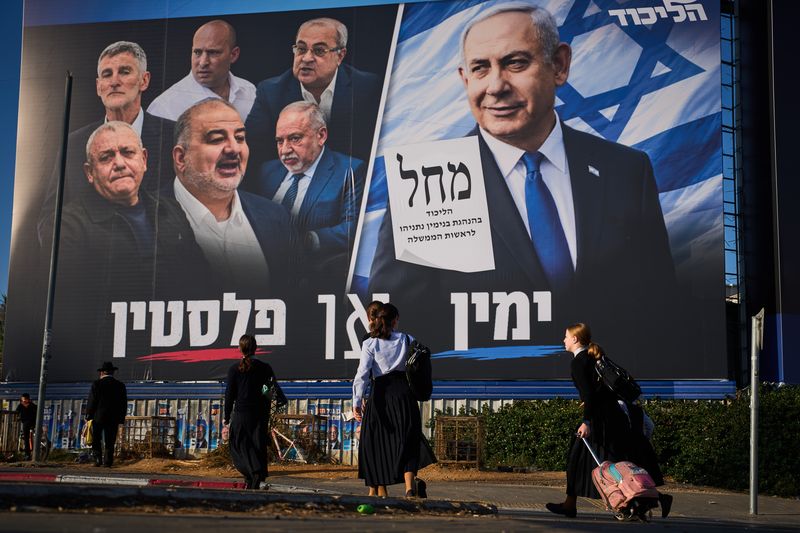
[Financial News] Prime Minister Benjamin Netanyahu’s bloc is leading as vote counting nears its end, contrary to exit polls. However, securing a majority of seats has become difficult.
As a result, Netanyahu’s fate now lies in the hands of the Arab parties.
According to the Associated Press on the 28th (local time), with 85% of the votes counted, Prime Minister Netanyahu’s Likud Party had won 20.8%, Eisenkot’s Yashar Party 16.1%, and the Arab parties 14.9%.
As vote counting in Israel’s general election, which will determine whether Netanyahu can extend his rule, entered its final stages, it became clear that neither his bloc nor the opposition bloc led by former Israeli military chief of staff Gadi Eisenkot would secure a parliamentary majority.
Unlike early broadcasters’ exit polls, which projected Eisenkot’s bloc to narrowly lead Netanyahu’s, the actual count has put Netanyahu’s bloc in the lead.
Official results to be announced on November 4... Vote count expected to wrap up on the afternoon of the 29th
The count of regular ballots is now nearly complete, but about 500,000 absentee ballots, including those cast by soldiers and diplomats and placed in double envelopes, will be tallied after a separate verification process. Official results are scheduled to be announced on the 4th of next month, but the count is expected to be effectively complete by the afternoon of the 29th.
According to the results counted so far, neither Netanyahu’s bloc nor Eisenkot’s bloc is expected to win the 61 seats needed for a majority in the 120-seat Knesset (parliament).
Local media, including The Times of Israel, projected that Likud and its allied parties would take 53 seats, Yashar and its allied parties 48, and the Arab parties Ra’am and Joint List 19.
If the seats are finalized as projected, Netanyahu’s bloc would lose 15 seats from its current 68.
The Associated Press said the results reflected concerns about Netanyahu’s alliance with far-right forces, war fatigue, and anger over military-service exemptions for ultra-Orthodox Jews, but that these factors had not translated into enough support for the opposition to decisively oust him.
With neither of the two main blocs securing majority support, the Arab parties could, numerically, hold the “casting vote” in forming a coalition government.
Netanyahu calls a coalition with Arab parties a “dangerous government”
However, there are also predictions that forming a coalition with Arab parties will be difficult for either side, government or opposition.
Prime Minister Netanyahu, who has long said he would not cooperate with Arab parties, again described a coalition that includes them as a “dangerous government” and cautioned against it.
By contrast, former Chief of Staff Eisenkot left open the possibility of cooperating with Arab parties under certain conditions, such as their recognizing Israel as a Jewish state and Hamas as an extremist organization.
However, Joint List leader Yousef Jabareen said he could not join a government led by Eisenkot, citing the former chief of staff’s support for military operations in Gaza and the occupation of southern Lebanon. Jabareen nevertheless left open the possibility of supporting Eisenkot’s bloc from outside the government in order to oust Netanyahu’s government.
Meanwhile, President Herzog wrote on X (formerly Twitter), “Next week, I will invite party leaders to consult on the mandate to form the next government,” adding, “Come with an open mind.”
However, if neither bloc can form a majority coalition government, another general election could be held early next year. Amid a similar political deadlock, Israel held five elections between April 2019 and November 2022.
[email protected] Lee Seok-woo, International Affairs Correspondent Reporter