President Lee fires off 13 social media posts in a single day, weighing in directly on sensitive issues
- Input
- 2026-10-29 07:00:00
- Updated
- 2026-10-29 07:00:00
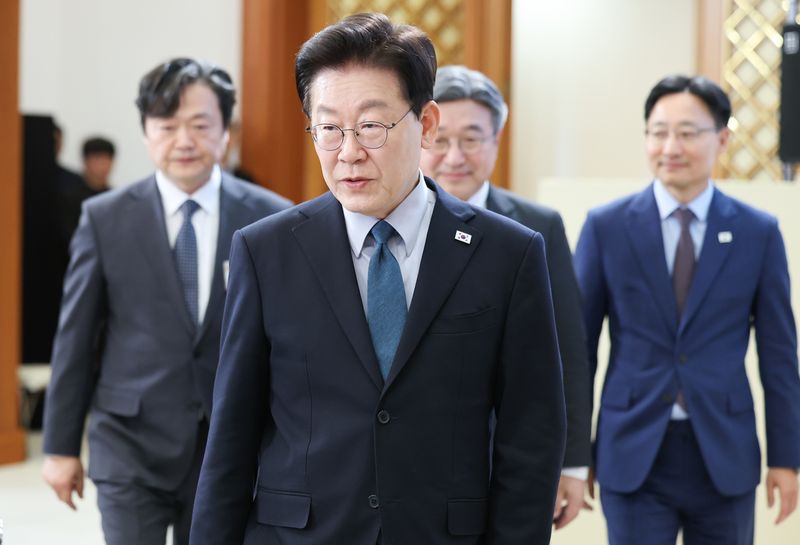
[Financial News] President Lee Jae Myung is stepping up direct communication, posting 13 times in a single day on social media (SNS). He has also spoken out actively on sensitive issues, including support for multicultural families and foreign workers. Observers say that by stating positions that differ somewhat from the conventional views of the progressive camp, he is signaling a governing approach that puts pragmatism ahead of ideology.
According to Cheong Wa Dae on the 29th, President Lee posted a total of 13 times on X (formerly Twitter) on the 28th alone. What stands out is that he is unhesitatingly stating his position even on politically contentious issues. Attention is also focused on the thinking behind his message that he will assess policies for fairness and practical effect rather than be bound by the views of his traditional support base.
President Lee wrote, “Local governments, including the Seoul Metropolitan Government, are facing questions over policies that give preferential treatment to multicultural families,” adding, “I will examine in depth, in consultation with local governments and including the possibility of revising enforcement decrees, whether there is a strong need to go beyond ensuring that multicultural families are not disadvantaged and give them preferential treatment, and whether such preferential-treatment policies should be abolished.”
Earlier, on the 27th, while discussing public-sector jobs at a State Council meeting he chaired at Cheong Wa Dae, President Lee remarked, “We need to revive every sector, from agriculture and forestry to livestock and fisheries. Even if we bring in foreign workers to do the work, they do not greatly help the national economy, because they remit all their wages.”
He also demanded a correction and an apology over a media report about his remarks on foreign workers. Taking issue with the difference between the headline and the body of the article, President Lee pointed out, “There is a big difference between saying ‘it doesn’t help’ and ‘it doesn’t help much’—the difference is the word ‘much.’” He stressed, “The context before and after my remarks clearly shows that this was a comparison: foreign workers are helpful, but not greatly so, compared with domestic workers. It is excessive to criticize me on the assumption that I said they ‘don’t help’ at all.”
Observers say these messages reflect President Lee’s governing approach, which places greater importance on the merits and effectiveness of individual policies than on political camps. It is especially noteworthy that he is directly addressing issues that could draw disagreement even among his traditional supporters.
In another post on X, President Lee said, “Political camps matter only because of their values and aspirations; whether on the left or the right, we should be wary of extreme factionalism.” He added, “If we turn a blind eye to wrongdoing when it is committed by our side and criticize even good things when they come from the other side, extreme confrontation and hostility will expand without limit in South Korea, darkening its future.”
President Lee also shared a post on X in which a user asked, “Why don’t you apologize for branding your critics ‘Mugeukpa’ (‘irresponsible extremist faction’)?”, and said, “Some people sincerely advocate prosecution reform for the sake of the country and its people, while others champion only hard-line positions or make excessive, inflammatory claims to serve their own hidden political interests, thereby effectively obstructing prosecution reform.”
He also commented on the economy. Regarding the introduction of a mandatory tender offer system, he said, “The principle of equal treatment for shareholders is important, but if excessive regulation undermines companies’ efforts to improve their fundamentals and weakens the vitality of the capital market, it may not benefit minority shareholders in the long run either.” He also sought opinions on a balanced solution.
Alongside responding to contentious issues, President Lee is actively using social media to promote policies related to people’s livelihoods and the economy. He has introduced a series of policies and events in these areas, including the Korea Grand Festival, a four-day workweek without wage cuts, and efforts to boost chestnut consumption.
He also addressed diplomatic issues. To German Chancellor Friedrich Merz, who is holding a summit with him today, President Lee said, “I sincerely welcome you to South Korea. South Korea and Germany are valued partners that have cooperated in a range of fields, including the economy, industry, science and technology, on the basis of a long-standing friendship and trust.” He added, “I hope this visit will further deepen the friendship and cooperation between our two countries, and that we will work together to build shared prosperity and a better future.”
President Lee has also repeatedly signaled that he will expand his social media activity. He published a post titled “An era is dawning when saying you like jajangmyeon is seen as disparaging jjamppong,” and directly rebutted reports that interpreted his order for a nationwide survey of farmland conditions as “shifting responsibility onto the minister,” stressing that it was “a reform measure worthy of praise.” He went on to say, “Distorting the facts like this while insisting that I stop using social media to communicate directly with the public is like saying, ‘Even if you’re hit, don’t resist—just take it.’” President Lee had also stressed, when meeting reporters at the Chunchugwan Press Center on the 19th, “Would there have been a President Lee Jae Myung if there had been no social media?”
[email protected] Choi Jong-geun Reporter