New “artificial skin” as tough as real skin overcomes shrinkage problem [Unboxing Lab]
- Input
- 2026-10-29 05:56:00
- Updated
- 2026-10-29 05:56:00
“Do you remember the excitement of opening a delivery box? Even at this very moment, university laboratories are making remarkable discoveries that could change our lives. They’re just wrapped in thick packaging called ‘research papers.’ At Unboxing Lab, instead of complex equations and theories, we’ll pick out just the key points you want to know. So, shall we open the box? Today’s discovery is this very study.”
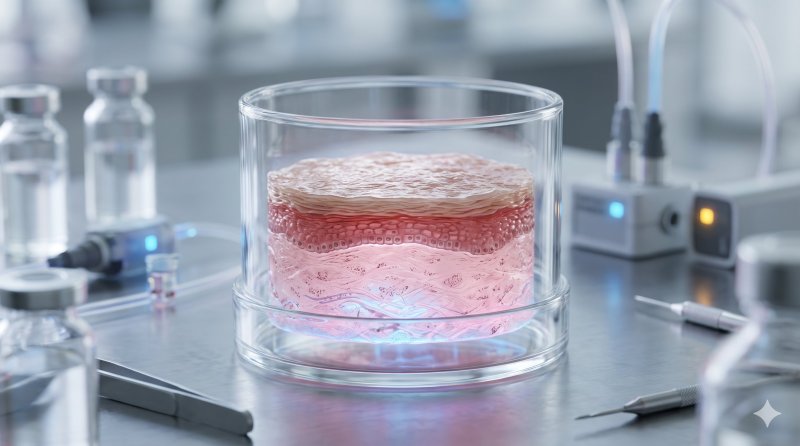
The findings are expected to be used in the future to assess the skin safety and irritation potential of cosmetics and pharmaceuticals. Artificial skin is a leading research tool for replacing animal testing. It is expected to make a significant contribution to creating experimental environments that resemble real human skin.
■ Preventing shrinkage and detachment with mussel-inspired adhesive
The researchers closely investigated what causes artificial skin to warp. When the number of fibroblasts, which make up the dermis, exceeded about 350,000 per 1 mg of collagen—the base material of the epidermis—the scaffold could not withstand the force exerted by the cells and detached from the vessel. With 300,000 fibroblasts per mL, the scaffold detached after just five days at the standard collagen concentration of 2 mg/mL. By contrast, a scaffold made with collagen at three times the concentration (6 mg/mL) maintained a stable shape for nine days.
Keratinocytes, which form the epidermis, also pulled on the vessel and caused deformation. When the researchers cultured a scaffold seeded only with keratinocytes, without fibroblasts, for six days, its edges sank by about 1.4 mm. They coated the walls of the culture vessel with polydopamine, an adhesive inspired by the sticky compounds found in mussels. As a result, the decrease in scaffold height was reduced to about 0.29 mm, and cell detachment was also suppressed.
■ Four layers recreated just like real skin
The researchers then added basement membrane components to the collagen scaffold to firmly connect the dermis and epidermis. This encouraged the epidermal cells to grow in four clearly defined, neatly arranged layers, as in real human skin: the basal layer, spinous layer, granular layer and stratum corneum.
The resulting full-thickness artificial skin retained its shape without detaching or shrinking throughout the 10-day culture period. The researchers also assessed its skin-barrier function and resistance to chemicals. After applying the toxic detergent Triton X-100, they measured ET50—the time taken for half the cells to survive after exposure to a toxic substance—and recorded 4.5 hours. This comfortably exceeds the barrier performance criterion of “more than 2 hours” in the international guideline OECD TG431.
■ Passes international-standard tests with flying colors
The model also recorded 4,557 Ω·cm2 in the TEER test, which measures the tightness of the skin barrier by assessing how well it resists the passage of electrical signals. The researchers said this indicated a much tighter barrier than those of full-thickness artificial skin models reported in previous studies, which recorded less than 400 Ω·cm2.
The model also showed promise in a skin irritation test (OECD TG439). The researchers applied five irritants and five non-irritants and observed the reactions. All five non-irritants were correctly classified as non-irritating. However, some irritants— including 1-bromohexane—were not identified as irritants because cell viability remained high. Overall, its ability to distinguish between irritants and non-irritants was comparable to that of existing reconstructed epidermis models.
Professor Jeong Seok of Korea University’s Department of Mechanical Engineering and Professor Park Seong-jin of Emory University and Georgia Tech in the United States served as co-corresponding authors. Dr. Won Ji-hee of Korea University was the first author. The research was supported by Samsung Electronics’ Samsung Future Technology Development Program and published in the international journal Materials Today Bio.
[email protected] Kim Man-gi Reporter