Army Goes Hyperconnected with 5G... Security and Interoperability Challenges for “Korean-Style JADC2”
- Input
- 2026-10-29 12:02:06
- Updated
- 2026-10-29 12:02:06
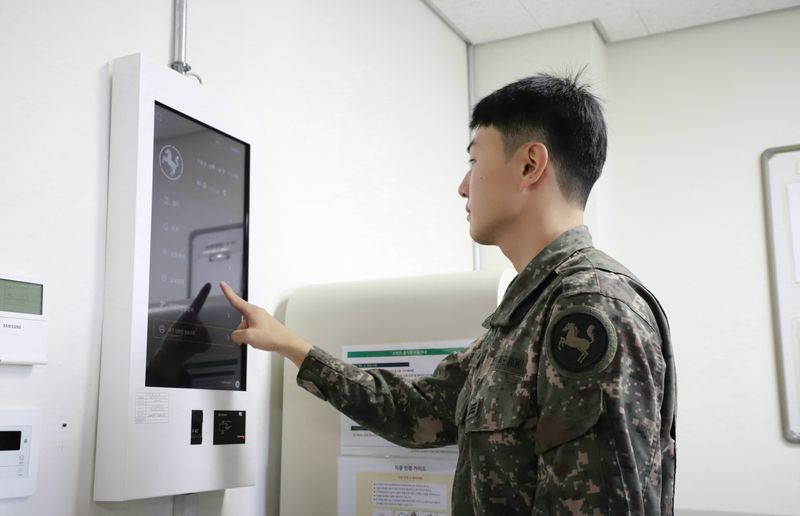
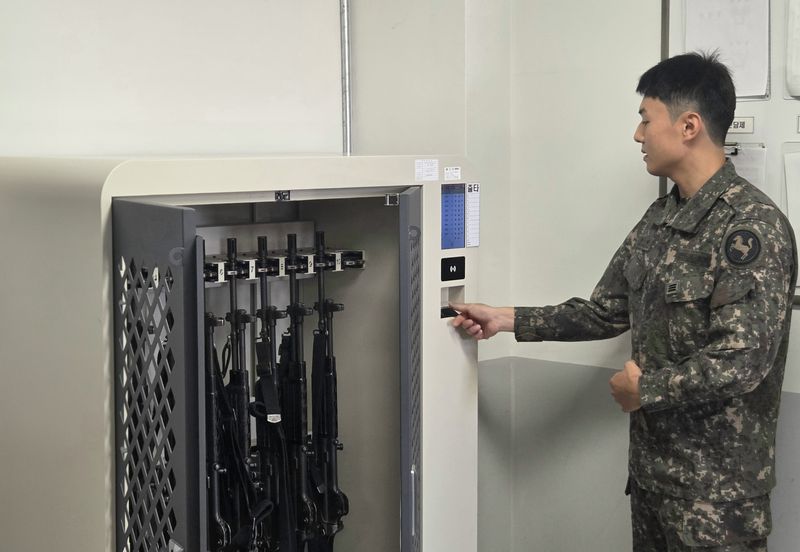
The 9th Division communications battalion showcased that day offered a vivid picture of the shift beyond digitized administration to a “data-centric military.” Soldiers can request leave using fingerprint recognition at smart-unit kiosks in their barracks, with commanders approving requests on mobile devices. Meanwhile, fingerprint-enabled smart gun lockers link information on weapons taken out to the administrative office’s computers in real time—a leading example of maximizing the efficiency of military operations.
A soldier in the unit places a finger on the “smart-unit kiosk,” verifies their identity and applies for leave. The commander then checks the leave request on a work smartphone and approves it. When the officer in charge steps up to a smart gun locker and places a finger on the reader, its dual safety mechanism unlocks. A soldier about to begin a shift scans their fingerprint, releasing the lock so that only their own firearm can be taken out. As the firearm is removed, the weapons status displayed above the fingerprint reader and on the administrative office’s computer updates automatically. This is an intelligent smart unit where AI and software (SW) handle administrative tasks automatically, while advanced surveillance systems and IoT sensors are used for perimeter security operations and unit management.
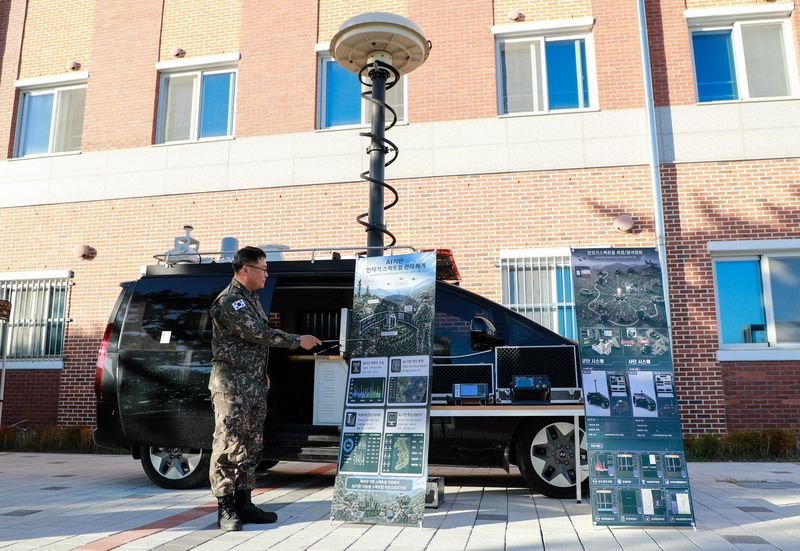
Military experts interpret the essence of this change not as a simple improvement in convenience but as a technological survival strategy in response to the “demographic cliff,” the greatest concern facing the Republic of Korea’s military. The Army’s self-developed AI platform “Arvis” and Robotic Process Automation (RPA) are being deployed for simple, repetitive tasks with clear patterns. By 2027, they are set to fully replace across all units routine administrative work that has consumed significant manpower, including managing personnel entering and leaving guard posts and preparing perimeter security operation orders and fuel logs. The plan to force a fundamental shift from a military structure that once depended on the vast human workforce characteristic of conscription to a technology-intensive force modeled on advanced countries with volunteer militaries—where a small number of elite personnel direct AI systems—is now moving ahead in earnest.■ Building “Korean-Style JADC2” to connect land, air and space—and the interoperability equationThe central highlight of the Army’s reform plan is establishing a “multilayer integrated network” that goes beyond simple unit management. To ensure the seamless flow of information for real-time detection, decision-making and strikes, the Army has placed at its center a 5G tactical mobile communications system that uses military-only networks and commercial base stations simultaneously. It is also refining a multilayer network that integrates airborne communications-relay drones and low-Earth-orbit satellite networks in layers. The foundation has now been laid for implementing Joint All-Domain Command and Control (JADC2), a key capability in modern warfare, as well as the Army’s future combat system, “Army TIGER+” (Army Tiger Plus).
Weapons-systems experts say the Army must achieve a high degree of “interoperability,” just as the U.S. Army is doing through its next-generation network validation project, “Project Convergence.”
For the hyperconnected network the Army is developing to avoid remaining a fragmented system centered on ground forces, it must be able to share data seamlessly in real time with the Navy, the Republic of Korea Air Force (ROK Air Force) and the Republic of Korea Joint Chiefs of Staff (ROK JCS) battle command and control system (KJCCS). Only if compatibility ensures the error-free, real-time integration of target information detected by airborne drones and reconnaissance data collected by low-Earth-orbit satellites with not only Army strike assets but also Navy ships, Air Force fighter jets and tactical data-link systems such as Link 16 can the network fulfill its intended role in “integrated all-domain operations.”■ The downside of hyperconnectivity: a double-edged sword of “cybersecurity” and “electromagnetic spectrum (EW) survivability”But the brighter the light, the deeper the shadow. A hyperconnected tactical network that combines military networks with civilian commercial 5G base-station infrastructure offers operational flexibility, but it also dramatically increases the risk of exposure to widespread enemy hacking or electromagnetic spectrum (EW) attacks in a contingency.
As recent conflicts around the world have demonstrated, bringing civilian satellite networks and commercial radio systems onto the battlefield can leave command-and-control networks vulnerable to momentary paralysis from intense enemy jamming or GPS spoofing attacks. A military principle has been put forward: for the Army’s intelligent smart units to maintain uninterrupted anti-jamming capabilities in wartime, defense-specific encryption modules and robust physical and logical protection systems—including protection against electromagnetic pulses (EMP)—must be fully built in from the outset of adopting advanced civilian ICT technologies.
Major General Ryu Seung-ha, head of the Army’s Informationization Planning Staff Division, said, “We will build an optimal information and communications foundation capable of uninterrupted command and control in any extreme environment by combining AI, data and hyperconnected networks.” But the vision’s ultimate success will depend less on an impressive array of technologies than on how completely it can guarantee “cybersecurity survivability.”
Officials at security research institutes said the smart Army vision is expected to become a major milestone for the Republic of Korea’s national defense, which must achieve an advanced level of modernization within the framework of conscription. Attention is focused on whether this major experiment—equipping the brain of the ground forces with AI and connecting its neural network with 5G—can take root with integrated interoperability across the military and comprehensive protection capabilities.
[email protected] Lee Jong-yoon Reporter