[Exclusive] “Even if US Democrats take control of Congress, tariff relief is unlikely... South Korea should weigh the returns on its investments” [A US think tank’s advice]
- Input
- 2026-10-28 18:13:20
- Updated
- 2026-10-28 18:13:20
Adam Posen, president of the Peterson Institute for International Economics (PIIE), made the remarks in an exclusive interview with Financial News on the afternoon of the 27th at FKI Tower in Yeouido, Seoul. “There is a possibility that investment plans in the United States will shift in a more rational direction over the next 10 years,” he said. His comments were taken to mean that although the trade environment is unlikely to change dramatically immediately after the election, investment could gradually shift away from decisions driven by political demands toward ones based on business viability and effectiveness.
■ Limited scope for sweeping tariff changes after the election
Posen predicted that US tariff policy as a whole would be difficult to change even if the Democrats won a majority in Congress after the midterm elections. “Even if a bill to change tariff policy passes, President Donald Trump could veto it,” he said, adding that “the focus will be on bilateral tariff measures targeting specific countries.” The analysis is that even if the balance of power in Congress changes, any shift is more likely to focus on measures targeting individual countries than on a sweeping overhaul of tariff policy.
South Korean companies could face two challenges at once: expanding production in the United States and maintaining their export competitiveness. That is because even if they manufacture finished goods at local plants, the cost of parts and materials sourced from abroad, including South Korea, may be affected by US trade policy.
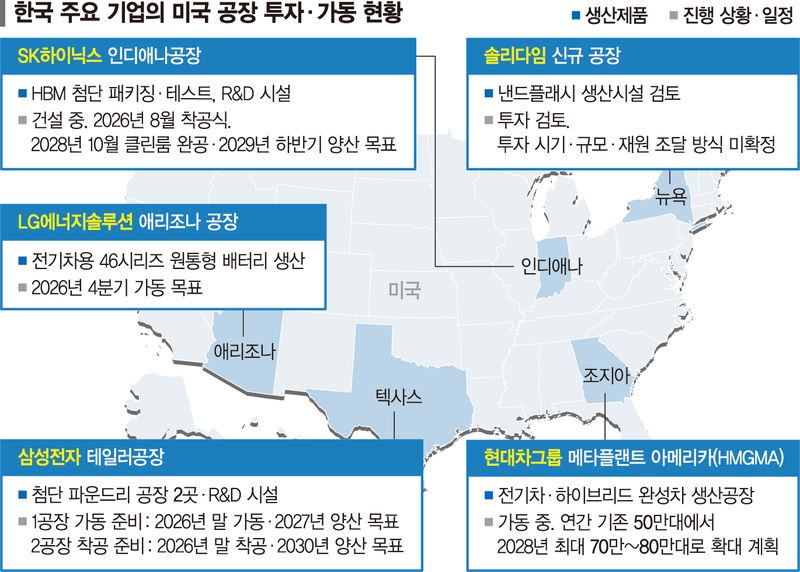
Samsung Electronics is expanding its semiconductor production base, centered on Austin and Taylor, Texas. Its announced investment plan for Texas totals at least $37 billion and includes an advanced semiconductor plant in Taylor as well as expansions of existing facilities in Austin. This is a medium- to long-term investment plan, not an amount already spent on a single plant. Hyundai Motor Group has built Hyundai Motor Group Metaplant America (HMGMA) in Georgia. Its local investment, including battery joint ventures with LG Energy Solution and others, amounts to $12.6 billion.
■ Supply-chain pressures could become a factor if efforts to counter China intensify
The possibility that the US stance toward China could actually harden after the midterm elections is another factor South Korean companies should watch. Posen predicted that, since both the Democrats and Republicans have China hawks, some Republican lawmakers could join forces with the Democrats and support new measures to counter China if President Trump’s political standing weakens.
Posen said, “President Trump could veto bills related to measures to counter China, but doing so would carry a growing political cost,” adding that “there is already a perception that President Trump is too conciliatory toward China.”
This means that even if no policies directly target South Korea, the scope and intensity of restrictions on China could affect South Korean companies’ supply chains and investment strategies. If US efforts to counter China intensify, South Korean companies may have to reconsider their strategies for sourcing raw materials and components and choosing production locations, balancing their business in China with production in the United States.
SK hynix’s US investment is also cited as an example of South Korea-US cooperation on semiconductor supply chains. SK hynix is investing at least $4 billion in Indiana to build an advanced packaging production facility and establish an R&D base. The goal is to begin mass production of next-generation high-bandwidth memory (HBM) in the second half of 2029. Under this arrangement, DRAM produced in South Korea is sent to the United States, where it is packaged and inspected before being supplied to customers.
Posen said, “If President Trump’s political influence weakens, he will devote less time and attention to South Korea and other countries,” adding that “we may simply see a quieter period than we have now.”
[email protected]
[email protected] Lim Su-bin, Park Ji-yeon and Kim Hak-jae Reporter