B-pillar removed, roof withstands 14 tons of force ... Genesis GV90’s ‘radical design’
- Input
- 2026-10-29 08:30:00
- Updated
- 2026-10-29 08:30:00
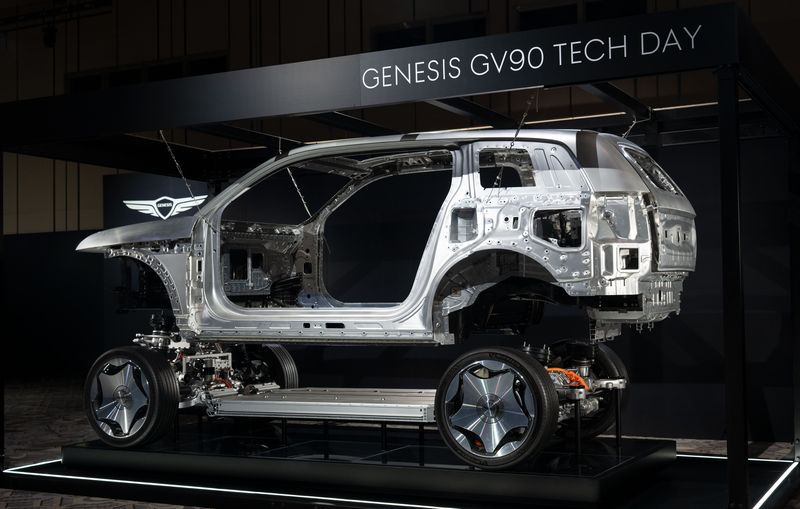
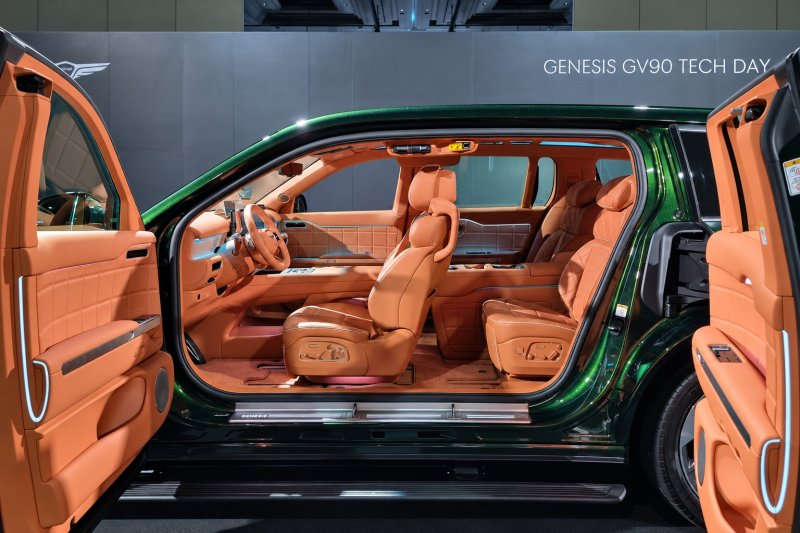
[Financial News] The Genesis GV90 has changed the design formula for full-size electric sport utility vehicles (SUVs), introducing the world’s first independently opening coach doors that eliminate the pillar (B-pillar) between the car’s doors. The body was engineered so the roof could withstand a load of at least 14 ton-force (tf) despite the absence of the pillar, and the vehicle is also the world’s first production car to feature a roof airbag that protects passengers in a rollover. The strategy is to compete in the global luxury electric vehicle market by raising design, safety and driving performance all at once.
■ B-pillar-free coach doors, with safety ensured
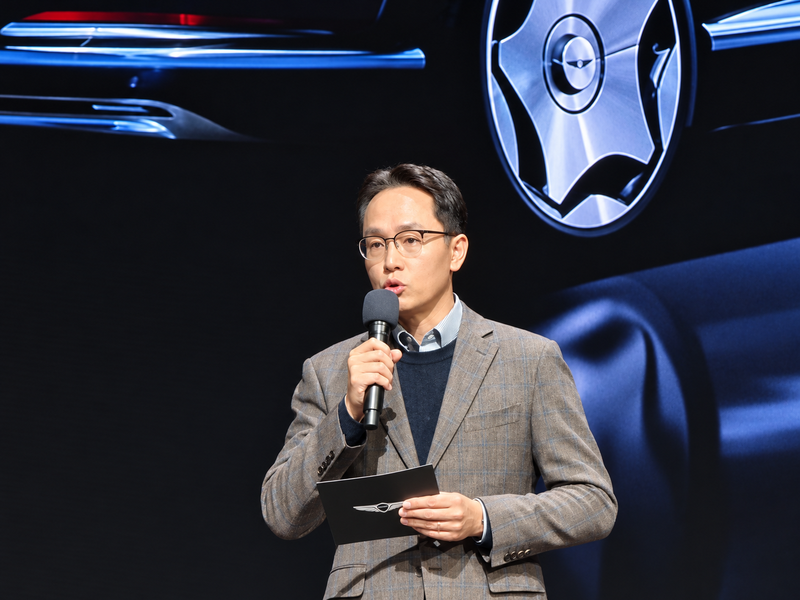
Genesis held the ‘Genesis GV90 Tech Day’ on the 28th at the Inspire Ballroom at INSPIRE Entertainment Resort in Yeongjong District, Incheon, and unveiled the core technologies and development process of the GV90, a full-size flagship electrified SUV. Twelve development leads directly introduced the vehicle’s body, design, platform and driving performance.Huh Gwang-hoon, Genesis executive director in charge of development, stressed, “Engineering is often called the art of compromise, but the GV90 reversed that order: we first set standards that could never be compromised for our customers, and upheld them to the end.” He added, “The GV90 is the sum of everything we have built up over the past 10 years and a starting point for a new future.”
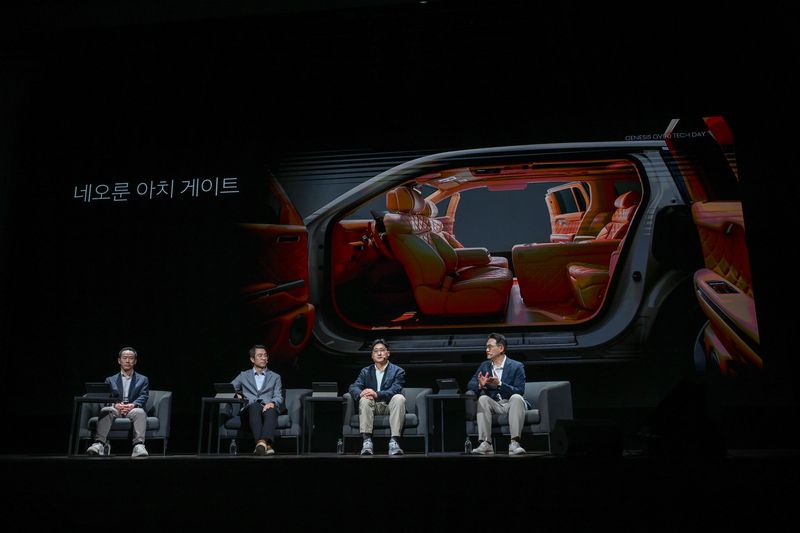
The key is the ‘Neolun Arch Gate.’ The B-pillar between the front and rear doors was removed to expand the passenger space and allow the two doors to open independently. Choi Dong-wook, team leader of Genesis’s Closure Design Team, explained that the team had prioritized a sense of openness from the beginning of development, saying, “Removing the B-pillar wasn’t our last choice; it was our first.”
The rear door, which weighs about 70 kg, first moves outward on a ‘Dual Motion Hinge’ and then rotates. Nam Jin-woo, a part leader on Genesis’s Closure Design Team, said the team found a solution in the precision linear motion guides used in industrial machinery, adding, “We looked at everything from the mechanics textbooks we studied in college to other industries.”
Safety was reinforced with a hidden roll cage made of 2.5-meter-long high-strength steel tubes, high-strength beams inside the doors, and upper and lower latches. In in-house testing, the roof withstood a load of at least 14 ton-force, and the vehicle maintained at least 320 mm of occupant survival space in a side impact at 60 km/h. Choi, the team leader, said during an on-site Q&A, “At each stage of development, we conducted evaluations at nearly three times the usual level.” The doors can also be opened manually by pulling an emergency lever even if the power is cut off.
■ Moon-jar exterior and a dedicated platform
The exterior was designed with a focus on minimizing seams, like those of a moon jar. Using a ‘cutless’ process, the headlamp lenses were given the same color as the body, and only the two lines where the light emerges were laser-machined. Yoo Gil-sang, team leader of Genesis’s Exterior Design Team, said, “We optimized the laser speed and frequency for each of the 16 exterior colors.” While reducing the thickness of the lamps, the low-beam range was extended from 105 m on the Genesis G90 to 115 m.Natural materials, including real wood, stone and wool cashmere, were used in the interior. Nam Taek-seong, team leader of Genesis’s CMF Team, explained, “For the rear-seat wood floor, we even considered the possibility of someone getting in wearing golf shoes with spikes.”
The eMP platform, designed exclusively for Genesis’s flagship models, was also used for the first time. Lightweight aluminum was used in 72% of the body structure. The integrated charging control unit and climate-control system were moved to the front, and the seat rails were placed beneath the floor to create a flat cabin floor. The world’s first roof airbag, which deploys from the ceiling in 0.08 seconds in a rollover, was designed to prevent head injuries and passengers from being ejected from the vehicle. During development, the team conducted tests using 40 actual vehicles and more than 300 tests of airbag units.
The vehicle features a multi-chamber air suspension and Hyundai Motor Group’s first mono-tube, dual-valve electronically controlled shock absorbers. Jung Seong-gi, head of the Genesis Test Lab, said, “We achieved nimble behavior and agile handling that make you wonder whether this really is a car weighing more than 3 tons.” More than 30 weeks were spent on suspension tuning alone. The force that causes motor noise in the electrified powertrain was also reduced by up to 40%, and wind noise was tested at a high speed of 240 km/h.
A parts exhibition hall covering about 320 pyeong was also set up at the event venue, showcasing the development process through physical exhibits. Executive Director Huh said, “We are showing failed tests, molds remade countless times, and even designs completely overhauled because the time spent on them is itself the value of this car.”
[email protected] Kim Dong-ho Reporter