‘Hydrogen’ emerges as a future energy source for the Army as five institutions, including KATECH, join forces
- Input
- 2026-10-28 15:44:34
- Updated
- 2026-10-28 15:44:34
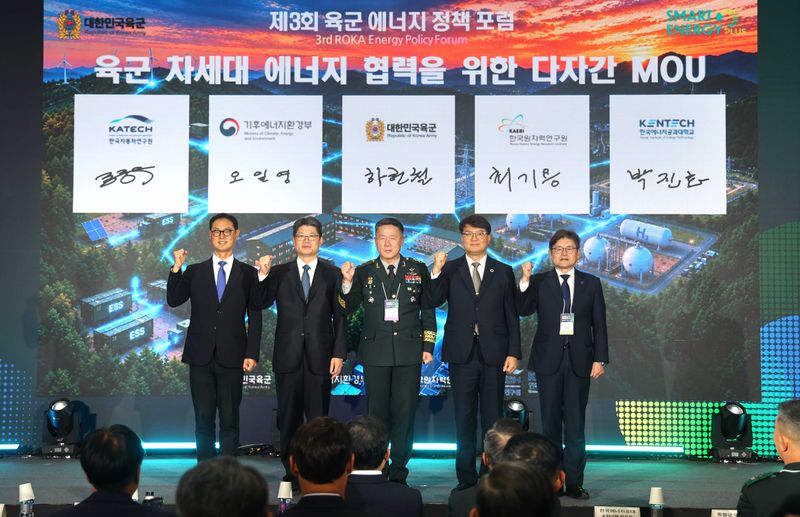
[Financial News] KATECH has embarked on civil-military cooperation to integrate hydrogen technology into the Army’s next-generation energy policy. Five institutions, including the Army, government agencies, research institutes and universities, are joining forces to pursue joint research on next-generation energy technologies, including hydrogen, and train specialized personnel. The initiative aims to support the transition to eco-friendly defense mobility through the development of hydrogen fuel cell and charging technologies linked to military energy policy.
KATECH announced that it had signed a memorandum of understanding (MOU) with the Army, the Ministry of Climate, Energy and Environment, KAERI and KENTECH at the 3rd Army Energy Policy Forum, held at COEX in Seoul on the 28th. The MOU is titled “Mutual Cooperation and Support for Advancing the Army’s Next-Generation Energy Policy.”
Attending the signing ceremony were Jin Jong-wook, president of KATECH; Ha Heon-cheol, head of the Logistics Staff Division at Republic of Korea Army Headquarters; Oh Il-Young, policy office director at the Ministry of Climate, Energy and Environment; Choi Ki-yong, vice president of KAERI; and Park Jin-ho, acting president of KENTECH.
The agreement focuses on pooling the institutions’ R&D capabilities and expertise to advance the Army’s future energy policy. The five institutions plan to jointly identify advanced technology research projects in next-generation energy and expand technical cooperation to advance military energy policy and achieve carbon neutrality. They will also promote exchanges among specialized personnel, seminars, training and information sharing.
In particular, KATECH plans to draw on its R&D capabilities in mobility, including hydrogen fuel cells and charging technologies, to support the military’s adoption of hydrogen energy. Its strategy is to link hydrogen technology with military energy policy and broaden cooperation into eco-friendly, high-efficiency defense mobility.
KATECH President Jin Jong-wook said, “Hydrogen energy is an area that can play an important role in achieving carbon neutrality and improving the efficiency of energy use, and it has great potential for use in the defense environment of the future. Drawing on the institute’s R&D capabilities in hydrogen and mobility, we will identify collaborative projects that align with the Army’s next-generation energy policy.”
He went on to stress, “I will contribute to the advancement of eco-friendly, high-efficiency defense mobility technologies and the strengthening of national security capabilities.”
The forum also addressed measures to improve the institutional framework for the military’s adoption of hydrogen energy. Kim Myeong-hwan, head of KATECH’s Hydrogen Power Research Division, gave a presentation titled “The Need to Introduce Hydrogen Energy into the Military and Measures to Overcome Challenges.”
[email protected] Kim Dong-ho Reporter