Neighborhood Clinic Initial Consultation Fees to Rise for First Time in 20 Years ... How Much More Will I Pay for Medical Care?
- Input
- 2026-10-28 16:52:13
- Updated
- 2026-10-28 16:52:13
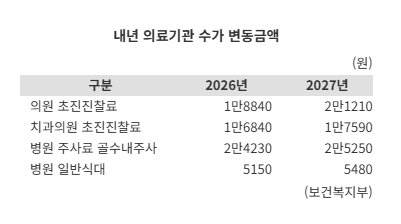
[Financial News] Starting next year, the initial consultation fee at neighborhood clinics will rise from 18,840 won to 21,210 won. Fees for consultations, which had effectively remained unchanged for 20 years, and inpatient care, whose fees had been unchanged for more than 10 years, will rise to strengthen compensation for basic care. Meanwhile, fees for blood tests and CT and MRI scans, which had generated excessive revenue, will be cut by 25–28%.
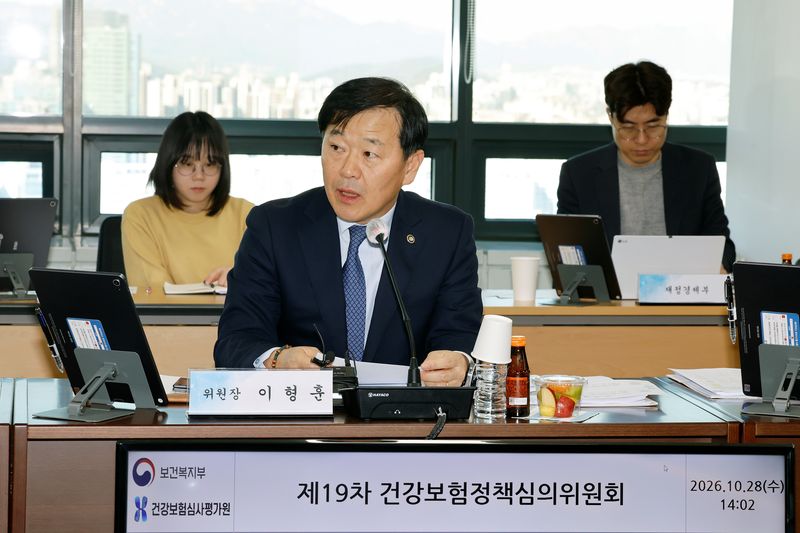
On the 28th, the Ministry of Health and Welfare held the 19th meeting of the National Health Insurance Policy Deliberation Committee (NHIPDC) for 2026 and approved measures including the “Implementation Plan for Health Insurance Fee Structure Reform” and the “Fee Adjustment Plan Linking Conversion Factors and Relative Values.” The implementation schedule has been set for 2.7 trillion won of the fee reform package, which will invest 3.6 trillion won annually in regional and essential medical care. The remaining 900 billion won will be discussed further by the committee before the end of the year, and the implementation plan will take effect following a revision to the official notice in November.
Patients’ out-of-pocket medical costs to rise by 680 won
Starting next year, relative value points for consultation fees at clinics will rise by 6% for initial visits and 4% for follow-ups. At hospitals and higher-level institutions, they will rise by 2% for both initial visits and follow-ups. The initial consultation fee at clinics will rise from 18,840 won this year to 19,980 won. If some of the increase in the conversion factor is added to the initial consultation fee, it will reach 21,210 won. Initial consultation fees at dental clinics will rise from 16,840 won to 17,590 won, while the standard meal fee at hospitals will increase from 5,150 won to 5,480 won.
Patients’ actual out-of-pocket payment for an initial consultation at a clinic is 30% of the fee. With this increase, the bill will rise by 680 won, from 5,650 won to 6,330 won. The increase is expected to be somewhat larger for people aged 65 and older. For outpatient care, they pay 1,500 won when the total bill is 15,000 won or less; 10% of the total bill when it is over 15,000 won and up to 20,000 won; 20% when it is over 20,000 won and up to 25,000 won; and 30% when it exceeds 25,000 won. Their copayment has so far been 10% of the total bill, but they may have to pay 20% if the increase moves the bill into a higher bracket.
In-depth consultations at tertiary general hospitals and in-depth consultations in pediatric primary care will move from pilot projects to regular programs. The annual number of in-depth consultations at tertiary general hospitals will increase from four to six per patient, or eight for children under 8, and patients will no longer need to book a specific day or time. Rheumatic diseases and chronic respiratory diseases will be added to the conditions covered by the chronic disease management fee.
Base inpatient fees will rise by 7% in general wards and 10% in intensive care units. The surcharge under the nursing staffing tier system will also increase, so institutions that deploy more nursing staff receive greater compensation. Inpatient fees will rise from 668,000 won to 798,000 won in intensive care units at tertiary general hospitals (nursing grade S), and from 127,000 won to 143,000 won for four-bed rooms at general hospitals (nursing grade A).
Blood test fees down 28%; CT and MRI fees down 25%
By contrast, reimbursement rates will be lowered for tests whose revenue exceeds 150% of their costs. Reducing rates for specimen tests, including blood tests, will save 1.7 trillion won a year; abolishing the management fee for outsourced tests, which had amounted to 10% of the outsourced test fee, will save 200 billion won; and cuts to CT and MRI rates will save 700 billion won, for total annual savings of 2.6 trillion won. However, rates will not be adjusted for tests that require specialist verification and interpretation, or for tests essential to severe and emergency care, such as those related to hematopoietic stem cell and organ transplants. The Ministry of Health and Welfare plans to assess the impact quarterly after implementation.
The way fees for specimen tests are paid will also change. Starting next January, the National Health Insurance Service will pay the testing fee directly to each party: the ordering institution (which requests the test) and the testing institution (which performs it). The change is intended to address price-discount competition and concerns about declining test quality that arose when ordering institutions received the full fee and later settled payments. Institutions that meet quality-management requirements will receive conditional compensation for two years.
The savings will be redirected to regional and essential medical care. A “regional preferential fee” will be introduced for the first time in non-capital regions and six underserved areas in the capital region (the Uijeongbu, Namyangju, Icheon and Pocheon areas of Gyeonggi Province, and the northwestern and central areas of Incheon). It will first apply from next January to childbirth and inpatient treatment for critically ill newborns. From March, reimbursement rates for 2,740 surgeries and procedures performed at general hospitals and higher-level institutions in these areas will receive a 10% surcharge. Healthcare institutions in 86 cities, counties and districts designated as population-decline areas will receive a 5% surcharge on consultation and inpatient fees. The government will also pursue legal revisions to ensure that patients do not face out-of-pocket costs for the increase resulting from the regional preferential fee.
Rates for 1,670 major surgeries and procedures performed at general hospitals and higher-level institutions will rise by 20%. The surcharge for emergency major surgeries performed at night or on holidays will increase from a maximum of 350% to 450%, and will reach up to 470% in regions covered by the preferential fee. General anesthesia fees will rise by 10–50%, while the nighttime and holiday surcharge for anesthesia accompanying major surgery will increase from 100% to 150%.
Compensation for care of extremely premature infants to double ... Pediatric surcharges extended to children under 8
Compensation for high-risk deliveries and neonatal intensive care will also increase substantially. If a center for severe maternal and neonatal care outside the capital region delivers a baby born before 24 weeks of gestation and provides 28 days of treatment, compensation will rise from 31 million won to 62.01 million won. Rates for 210 surgeries and procedures related to pregnancy and childbirth will also rise by 20%.
The age limit for the pediatric consultation fee surcharge will be raised from under 6 to under 8, and the inpatient surcharge will increase by 10 percentage points. A further 50% surcharge will apply to major surgery for children under 6, and a nighttime specialist management fee will be introduced at Moonlight Children’s Hospital. Fees for specialized rehabilitation therapy will rise by 10%.
At the meeting, the committee also discussed a pilot program, starting next January, to support treatment for patients with narcotics addiction at 11 regional treatment-protection institutions, as well as a three-year extension (2027–2029) of the pilot program for children’s rehabilitation medical institutions.
The Ministry of Health and Welfare said, “Health insurance fee reform is an essential step toward strengthening regional and essential medical care,” adding, “We will continue to oversee its implementation to ensure it proceeds without disruption.”
[email protected] Medical Correspondent Jeong Myeong-jin Reporter