“We must first assess the need for integration” ... Public Home Shopping union voices concern over merger with HanYuwon
- Input
- 2026-10-28 16:55:17
- Updated
- 2026-10-28 16:55:17
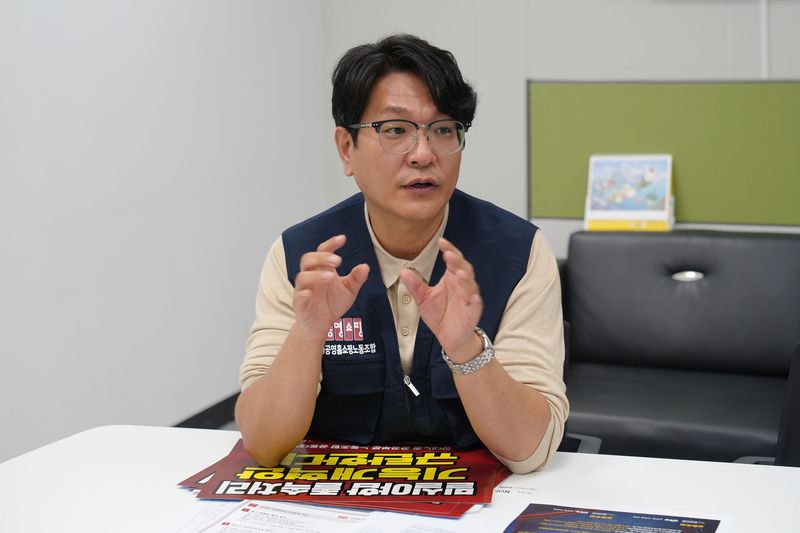
Bae Ju-hyeon, chair of the Public Home Shopping Co., Ltd. union (pictured) argued on the 28th regarding plans to integrate the Korea Small and Medium Venture Business Distribution Center (HanYuwon) and Public Home Shopping Co., Ltd., “I find it difficult to agree with an approach that decides the outcome in advance and moves ahead without sufficiently verifying the need for and effects of integration.”
The government is pursuing integration with the aim of improving the efficiency of support by linking the two organizations’ functions in helping small and medium-sized enterprises (SMEs) find sales channels. Its plan is to combine the two organizations and establish a “Small and Medium Enterprise Marketing Promotion Corporation,” with a single agency responsible for everything from identifying promising SMEs and products to commercialization, online and offline distribution, and actual sales.
The union argues that, because the two organizations have different operating structures, the benefits and costs of integration, as well as employment issues, should be examined first.
Bae cited differences in their funding structures and operations. HanYuwon receives government budget funds to carry out projects such as helping SMEs find sales channels, while Public Home Shopping Co., Ltd. generates revenue by selling products directly and uses it for public purposes, he explained.
“They share the broad framework of being public institutions, but their characteristics and operating methods are completely different,” he said. “We should first examine which functions overlap, whether integration is necessary, and whether the issues can be resolved through cooperation.”
He also pointed to the lack of a process for verifying the effects of integration. Regarding a research project being commissioned by the Ministry of SMEs and Startups (MSS), Bae said, “The focus is on drawing up an integration plan rather than verifying the need for and effects of integration,” adding, “The research must not decide the conclusion in advance and then look for justification.”
The cost of integration and how to fund it were also cited as points of contention. He said there had not been enough discussion about whether the government budget or the new integrated organization would cover the costs of combining the organizations and their systems. “Unless the costs are allocated in detail, this could also affect the funds available for helping SMEs find sales channels,” he said, expressing concern.
The union also set employment succession and guarantees of working conditions as prerequisites for integration talks. Bae said, “There needs to be an explanation and discussion about what organizations employees will be part of and what work they will do after integration, as well as how their working conditions will be maintained.”
The union has taken a step back in order to engage in dialogue with the government. According to Bae, the union had been pursuing labor dispute mediation at the Seoul Regional Labor Relations Commission but withdrew its mediation request on the 26th. The move followed Lee So-young, the MSS minister, expressing willingness to hold separate discussions during a parliamentary audit on the 23rd.
“A strike is a last resort, and we do not want to go as far as that,” Bae said. “The union has taken the initiative to begin dialogue, so now it is the government’s turn to respond.” He added, “If integration can improve the effectiveness of support for SMEs, there is no reason to oppose it. The process, just as much as the outcome of integration, must be fully explained and reflect the voices of people on the ground.”
[email protected] Lee Ju-mi Reporter