“They offer better rates than commercial banks” ... Internet-only banks wage a deposit war with rates in the 3.8% range
- Input
- 2026-10-29 16:46:36
- Updated
- 2026-10-29 16:46:36

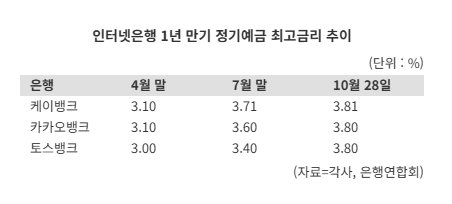
According to the Korea Federation of Banks (KFB), KakaoBank Corp raised rates on major deposit products, including term deposits, by 0.10 percentage points starting on the 29th. Following the adjustment, the rate on a one-year term deposit rose from 3.70% to 3.80% per year.
On the 22nd, K Bank raised the one-year rate on its “My Way Interest-Paying Term Deposit” by 0.10 percentage points, from 3.71% to 3.81% per year. On the 21st, Toss Bank also launched its “Term Deposit That Matures on Your Chosen Date,” offering 3.80% per year for a one-year term.
The rates offered by the three internet-only banks are higher than those of major commercial banks. The average highest rate on one-year representative term deposits at the five major banks (KB Kookmin Bank, Shinhan, Hana, Woori and NH NongHyup) is 3.61% per year. Even the highest, Nonghyup Bank’s “NH All One e-Deposit,” offers 3.65% per year, below the rates at the three internet-only banks.
Rates on internet-only banks’ term deposits have continued to rise recently. K Bank’s highest rate on a one-year term deposit climbed from 3.10% per year at the end of April to 3.71% at the end of July, and has now entered the 3.8% range. Over the same period, KakaoBank’s rate rose from 3.10% to 3.60% and then to 3.70%, while Toss Bank’s rose from 3.00% to 3.40% and then to 3.80%. The highest rates on one-year term deposits at the three internet-only banks are up 0.60–0.80 percentage points from the end of April and 0.10–0.40 percentage points from the end of July.
This is seen as a strategy by internet-only banks to secure the funds needed to grow their lending. At the end of June, the three banks had a combined loan balance of 83.6379 trillion won, up 6.3291 trillion won (8.2%) from the same period a year earlier. Over the same period, growth in their deposit balances was just 0.3%. In other words, deposit growth lagged behind loan growth.
Compared with the end of last year, funds raised through deposits and other sources had actually declined. At the end of June, the three internet-only banks had combined deposit liabilities of 120.8227 trillion won, down 6.0014 trillion won from the end of last year. Banks earn profits by deploying deposits in loans and other areas, and therefore need a deposit base to support loan growth. That is why they must not only attract new funds but also encourage customers to renew deposits as they mature.
Internet-only banks are seeking to attract deposits by emphasizing higher rates than commercial banks and greater convenience. Toss Bank’s new product lets customers set a maturity date that suits their needs, while K Bank’s new product lets them choose whether to receive interest as soon as they open the account or at maturity. By combining competitive rates with features that reflect customers’ schedules and preferences for using their money, the banks aim to attract deposits.
A financial industry official said, “For customers to move a lump sum to an internet-only bank, they need a benefit they can actually feel.” The official added, “High rates can prompt customers to move their money, but it is important to keep them doing business with the bank after maturity.”
[email protected] Ye Byung-jung Reporter