Korean Federation of Teachers' Associations: “Response to malicious school complaints now enshrined in law, but stronger accountability for education offices is key”
- Input
- 2026-10-28 15:36:22
- Updated
- 2026-10-28 15:36:22
[Financial News] The amended Elementary and Secondary Education Act takes effect on the 29th, legally defining school complaints and allowing principals to take measures such as requesting that people leave when malicious complaints arise. However, teachers' organizations say that for the system to be effective in practice, it must be backed by a response framework in which education offices take responsibility for handling complaints that schools cannot manage, as well as support for staffing and budgets.
In a statement on the 28th, the day before the law takes effect, the Korean Federation of Teachers' Associations said the amendment establishes a basis for setting up complaint-response bodies at schools and competent authorities, and for schools to request support or direct handling by the competent authority for complaints they cannot manage themselves. KFTA said, “This should be an opportunity to change a system in which individual teachers had to deal with malicious complaints alone,” and called for “establishing a ‘no-return’ principle to prevent the practice of education offices sending back to schools complaints referred to them by schools.”
The law's implementation also clarifies schools' authority to respond to complaints. Acts by parents and others that infringe on educational activities or obstruct school operations are prohibited. If a risk of infringement is deemed to exist, a principal may, after explaining the reason, take measures such as ending a phone conversation, requesting that someone leave, temporarily restricting access, or reporting the matter to or filing a complaint with investigative authorities. KFTA called for distributing a case-based immunity manual so that principals and school staff who take legitimate measures are not exposed to civil or criminal liability or audits, and for establishing a cooperation system with the National Police Agency to prepare for emergencies such as refusal to leave.
KFTA said an urgent review of the education authorities' response system was needed, alleging that, despite repeated complaints over changes to a school trip and threats to report child abuse at an elementary school in Mokpo, South Jeolla Province, an education support office with jurisdiction over the school did not classify the case as an unusual complaint and sent it back to the school.
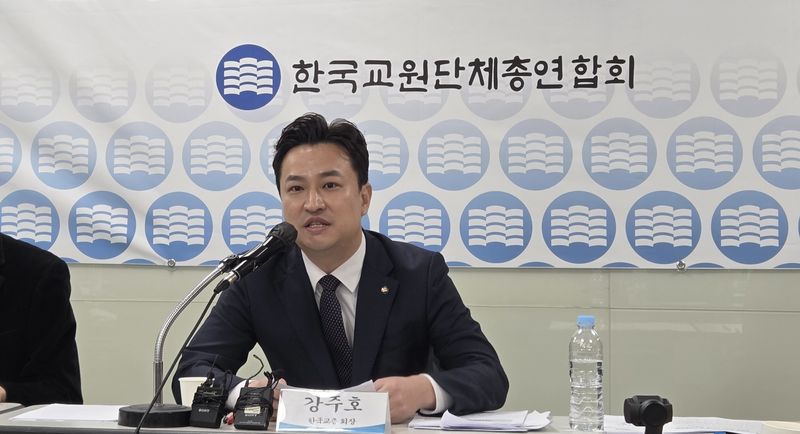
Kang Ju-ho, KFTA president, said, “This amendment is an important first step toward changing the reality in which teachers had to face malicious complaints alone, but it is the beginning, not the completion, of the system.” He stressed, “The Ministry of Education and education offices must urgently put in place a concrete operational framework—with staffing and budgets, as well as immunity and legal support—to ensure that complaint-response teams and school complaint-response support teams function effectively on the ground.”
Meanwhile, separate from the law's implementation, KFTA plans to continue pursuing additional legislative measures, including requiring superintendents of education to file complaints and counter-complaints, establishing national liability for lawsuits related to educational activities, and expanding school police.
[email protected] Kim Man-gi Reporter