Lee Hoon-gi: “The government’s proposal won’t stop stock price suppression”; Ministry of Finance and Economy: “Reviewing alternatives”
- Input
- 2026-10-28 15:37:06
- Updated
- 2026-10-28 15:37:06
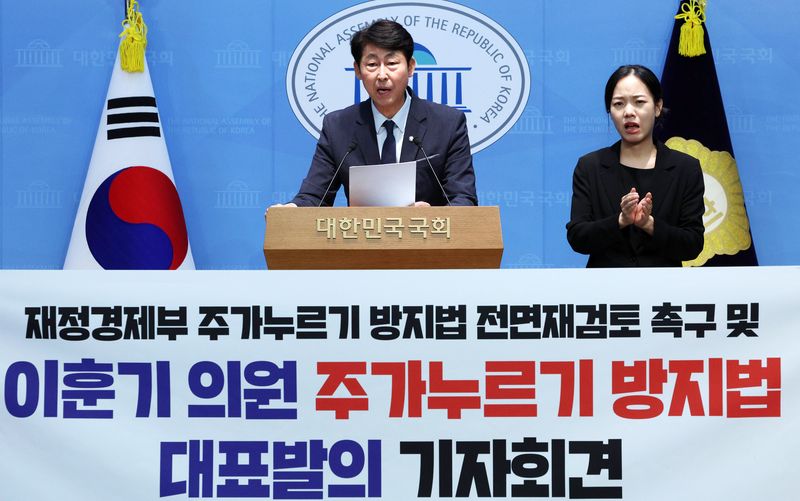
[Financial News] A divide has emerged between the ruling party and the government over a bill to prevent so-called “stock price suppression,” in which major shareholders seek to reduce their inheritance and gift tax burden. The DPK questioned the effectiveness of the government’s proposal and stressed that legislation should be passed during this regular session of the National Assembly. The government, too, said it recognized criticism that the proposal’s scope is excessively narrow and left open the possibility of considering alternatives.
At a debate titled “The Cry of K-Ants: The Stock Price Suppression Prevention Act Is Hope,” held at the National Assembly on the 28th, Democratic Party of Korea lawmaker Lee Hoon-gi criticized the government’s proposal, saying, “I have considerable questions about why these grounds and provisions were included.”
Lee said, “The tax chief came to my office recently and spoke with me for two hours, but what was said did not convince me,” adding, “The Ministry of Finance and Economy said it would follow the National Assembly’s formal discussions, but it still seems to be sticking to its unconvincing original proposal.”
“Stock price suppression” refers to the practice of major shareholders keeping share prices low to reduce their tax burden during inheritance or gift transfers. Critics have long argued that the current tax structure, under which lower share prices reduce inheritance and gift tax burdens, hinders efforts to increase corporate value and harms minority shareholders.
Lee said, “The more I listened to minority shareholders, the more I felt how desperate they were,” adding, “Because of major shareholders, ordinary shareholders suffer significant losses, and some are struggling so much that they even reject their own lives.” He continued, “This bill must pass during this regular session of the National Assembly,” and said, “Starting next week, our party will also hold in-depth discussions on tax matters, and if the debate proceeds through the standing committees, it will quickly gather momentum.”
The government supports the need to improve the system but says legal certainty and the feasibility of enforcement must also be considered.
A Ministry of Finance and Economy official explained, “The government’s proposal and the bills by lawmakers Lee Hoon-gi and Soyoung Lee share the same basic aim: to assess shares for tax purposes at a fair value rather than at a depressed market price.” The official added, “When drafting the government’s proposal, we considered legal certainty, the possibility of it being ruled unconstitutional, and the feasibility of enforcement.” However, the official said, “We are aware of criticism that the scope is too narrow and that the additional tax impact is not significant,” adding, “We are listening to views through various channels and reviewing them.”
The official also stressed, “We need to consider whether this issue can be solved with tax law alone,” adding, “We are reviewing various options for regulation under the Capital Markets Act as well, so the approaches need to go hand in hand. We will actively participate in discussions so that a reasonable proposal can be developed in the National Assembly, and present alternatives if necessary.”
At the debate, participants also raised the concern that major shareholders’ incentives to manage share prices stand in the way of increasing corporate value. Kim Woo-jin, a professor at Seoul National University’s College of Business Administration who chaired the debate, said, “In Korea, company chairmen are in a situation where they do not welcome a rise in their own company’s share price,” adding, “The first task is to normalize major shareholders’ incentives to suppress share prices.”
[email protected] Kim Kyung-min Reporter