Four decades of ties forged through tourism: Jeju and Hawaii expand cooperation on climate and energy
- Input
- 2026-10-28 16:10:05
- Updated
- 2026-10-28 16:10:05
【Financial News, Jeju = Jung Yong-bok, Staff Writer】 Exchanges between Jeju and the U.S. state of Hawaii over the past 40 years began with a visit to Jeju by Hawaii’s governor in 1985. The ties, forged around shared priorities of tourism and island development, have expanded from the preservation of volcanic heritage, water-resource management and youth exchanges to cooperation on climate-crisis response and clean energy.
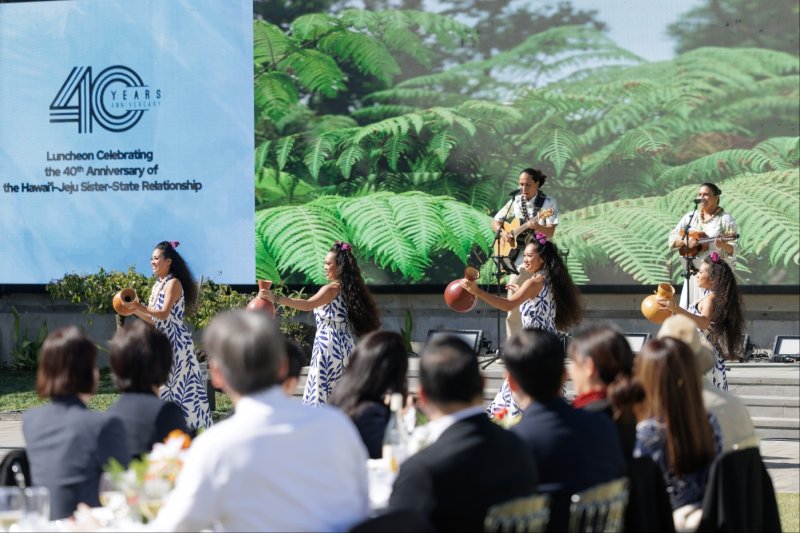
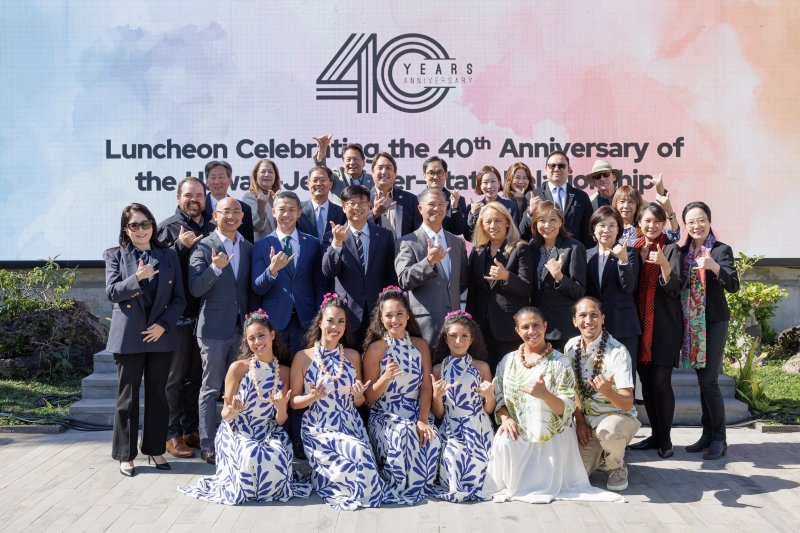
According to Jeju Special Self-Governing Province, a reception marking the 40th anniversary of sister-city ties between Jeju and Hawaii was held on the morning of the 28th at Heritique Jeju in Jeju City. Attendees included Jeju Administrative Vice Governor Park Cheon-su; James Kunane Tokioka, director of the Hawaii Department of Business, Economic Development and Tourism (DBEDT); members of Hawaii’s state House and Senate; and representatives of the Hawaii Tourism Authority. The Hawaii delegation comprised 26 members.
The sister-city ties between the two regions date back to the 1980s, when Jeju began expanding its international exchanges.
In November 1985, then-Hawaii Governor George R. Ariyoshi visited Jeju, where sister-city ties were discussed at a meeting with Jeju Governor Jang Byeong-gu. After working-level consultations, the two governors signed a sister-city declaration at the Jeju Provincial Government Office on November 25, 1986.
It was Jeju Province’s first sister-city partnership with an overseas local government. At the time, the two regions shared volcanic-island natural environments and tourism industries. They faced similar challenges in tourism development, use of marine resources and promotion of agriculture, while also taking into account the international environment, in which economic and cultural exchanges centered on the Pacific were expanding.
The sister-city declaration signed on November 25, 1986, set out goals of promoting mutual understanding and friendship among residents of the two regions and exchanging knowledge and experience in economic and social affairs.
Early exchanges began in administration and academia. From December 1994 to December 1995, four people—three Jeju public officials and one professor from Jeju National University—received training in Hawaii in areas related to exchange and cooperation.
The exchanges later expanded to the preservation of natural heritage. In July 2008, Jeju’s natural heritage management agency and Hawaii Volcanoes National Park in the United States signed a separate sister-agreement. The cooperation was launched to share experience in preserving and managing volcanic landscapes after Jeju was inscribed as a UNESCO World Natural Heritage site in 2007.
The two organizations agreed to exchange natural heritage research data, management techniques and environmental education information, and to cooperate on developing tourism programs.
On the 30th anniversary of the sister-city ties in 2016, cooperation between the two regions expanded to specific policy agendas. Then-Jeju Governor Won Hee-ryong and Hawaii Governor David Ige signed a joint declaration to promote exchanges and cooperation in Hawaii that September. They identified the preservation of world natural heritage, energy, tourism, culture and youth exchanges as key areas for cooperation.
The two sides also held discussions on water-resource management. In November that year, Jeju Development Corporation organized a “Jeju-Hawaii Water Forum” session at the 8th Jeju Water World Forum, held at International Convention Center Jeju. Experts from the two regions compared groundwater conservation and water-resource monitoring and management policies.
In 2018, four island regions—Jeju, Hawaii, Okinawa Prefecture in Japan and Hainan in China—attended the first International Green Island Summit in Jeju and adopted a joint declaration. The summit focused on sharing policy experience in ecosystem conservation, greenhouse-gas reduction and sustainable development.
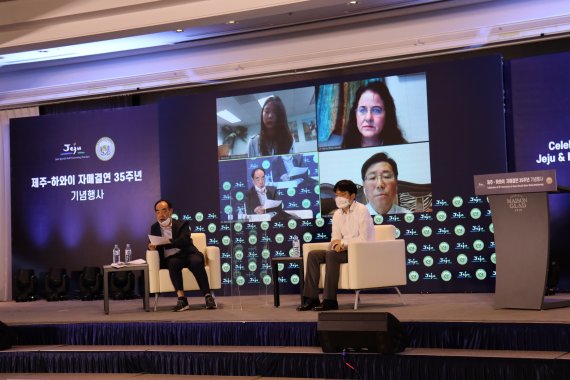
Youth and educational exchanges also continued. At an online event marking the 35th anniversary of the sister-city ties in 2021, students from Jeju and Hawaii shared their views on the theme of a “carbon-free island.” Representatives of Jeju Energy Corporation (JEC) and the Hawaii State Energy Office also discussed carbon-neutral policies and ways to cooperate.
Cooperation between educational institutions led to an official agreement last year. In October 2025, the Jeju Provincial Office of Education and the Hawaii State Department of Education signed a memorandum of understanding on student and teacher exchanges, joint research and promoting sister-school partnerships. Preservation of the Jeju language and Hawaiian, as well as cultural and linguistic exchanges, were also included as areas of cooperation.
Sustainable tourism and renewable energy have recently emerged as key agendas. In August 2024, Hawaii Lieutenant Governor Sylvia Luke visited Jeju and discussed cooperation on tourism and future industries with then-Jeju Governor Oh Young-hun.
As the 40th anniversary is marked this year, the Hawaii Tourism Authority sponsored a commemorative culinary event at the Jeju Food & Wine Festival, while the Hawaii state government also expressed interest in expanding cultural and environmental exchanges with Jeju.
At the anniversary reception, the two regions also discussed ways to broaden their existing youth, environmental and tourism exchanges to include climate-crisis response and future industries.
Jeju Administrative Vice Governor Park Cheon-su emphasized the need to expand exchanges for future generations, saying, “Jeju and Hawaii have maintained a deep friendship for 40 years, grounded in our shared identity as islands with beautiful natural environments and unique cultures.”
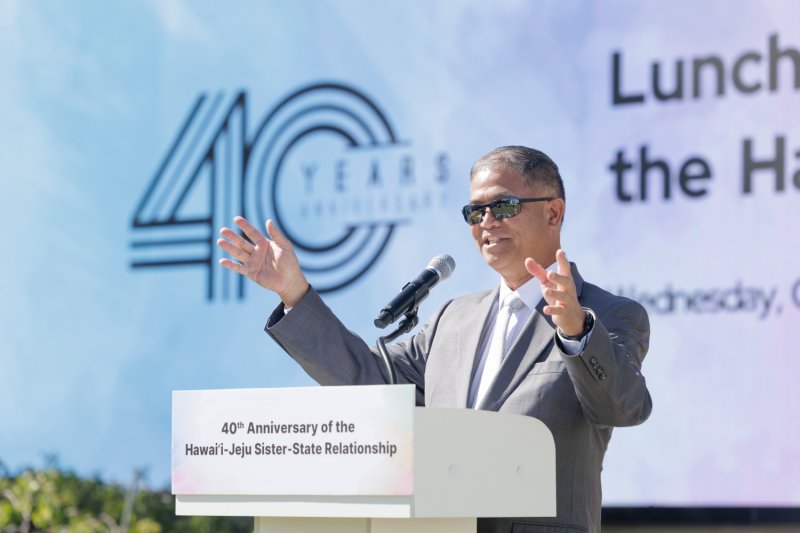
Director Tokioka expressed his hope that expanded cooperation in education, tourism, clean energy and community development would deliver tangible benefits to residents.
The Hawaii delegation will also attend the 27th Island Tourism Policy Forum, being held at Jeju Stone Park from the 28th to the 30th. The forum is a venue for discussing tourism policies and sustainable development in island regions around the world.
Over the past 40 years, exchanges have included training for public officials, natural heritage agreements, joint academic events and youth exchanges. The cooperation between the two regions, which began with a shared interest in tourism development, now faces the challenges of making tourism sustainable, transitioning to clean energy and conserving the natural environment.
[email protected] Jung Yong-bok Reporter