Ballot boxes opened after 147 days ... ‘Heated exchanges’ inside, ‘Live broadcast’ outside [Report]
- Input
- 2026-10-28 15:42:01
- Updated
- 2026-10-28 15:42:01
[Financial News] “Live broadcast! Live broadcast!”
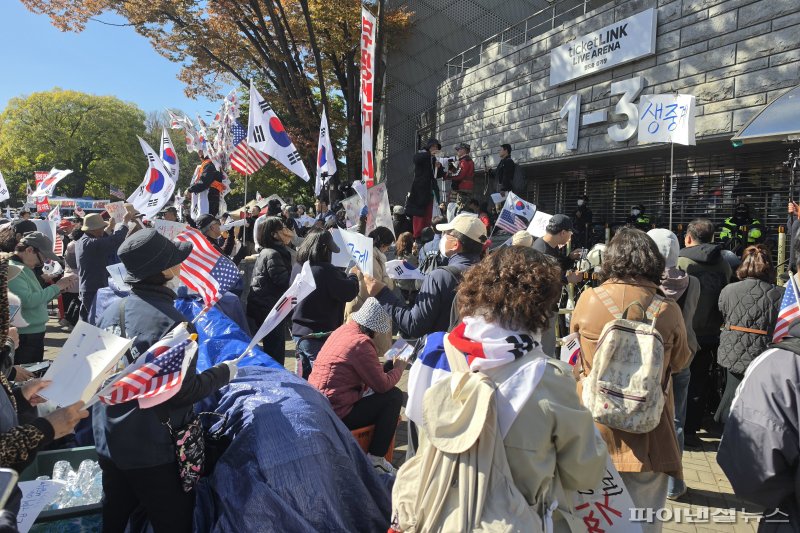
Around noon on the 28th, in front of the Handball Stadium at Olympic Park in Songpa-gu, Seoul, hundreds of protesters carrying South Korean and U.S. flags gathered before police barricades and called for the verification process to be livestreamed. At the same time, inside the stadium, observers continued to raise objections to the ballot verification procedures. On the day sealed ballot boxes were opened 147 days after the June 3 local elections, disputes over the transparency of the verification kept things busy inside and outside the stadium.
Lee Tae-han’s special prosecutor team, tasked with investigating the ballot shortage during the June 3 local elections, began a public verification that day at the Handball Stadium at Olympic Park, examining about 2.47 million ballots from Songpa-gu, Seoul.
The verification is being conducted in three stages: checking for outside intrusion by analyzing CCTV footage from the storage site; examining the seals on storage boxes, the number of ballots, marks on them and their printing condition; and checking for possible errors or hacking involving related equipment, including ballot sorting machines. The CCTV analysis is being carried out separately at the special prosecutor’s office.
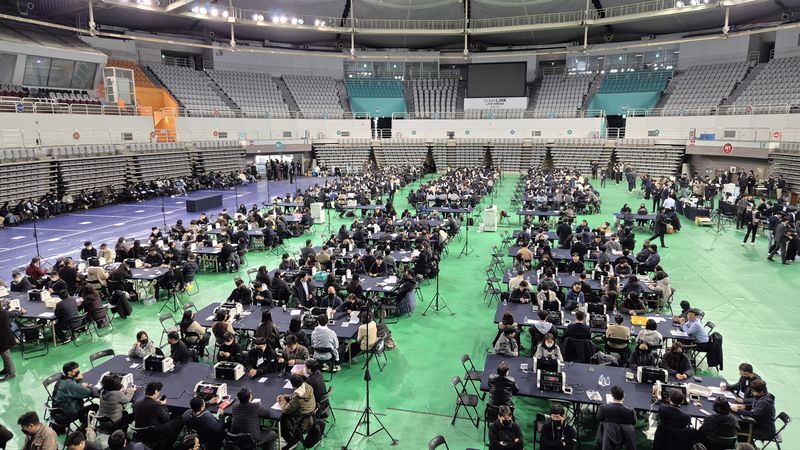
Inside the stadium, 40 tables were lined up, each holding four ballot-counting machines. Calculators, blue thimbles and white rubber gloves, among other items, were set out on each table, along with instructions showing examples of valid and invalid ballots. Verification support staff and observers wearing fluorescent vests took their places and waited for the process to begin.
Politicians from both the ruling and opposition parties also attended as observers, including People Power Party leader Jang Dong-hyuk and lawmakers from the National Assembly of the Republic of Korea’s Security and Public Administration Committee.
Before the verification got underway in earnest, however, a dispute broke out over restrictions on filming. After the special prosecutor’s team barred individuals from taking photos or videos, opposition lawmakers and some observers protested, citing the need for transparency, delaying proceedings throughout the morning.
After consultations, the special prosecutor decided to allow two TV network cameras to record the process but not to livestream it. The ban on individual observers filming was also maintained, but one person designated by each of the ruling and opposition parties was provided with filming equipment to record ballots suspected of irregularities.
At around 11:49 a.m., Special Prosecutor Lee Tae-han declared the verification underway. The ballot boxes were then brought from a storage room inside the stadium in the presence of observers, and their seals were checked. The boxes were sorted by type of election before being sent to 40 counting stations.
Around 2 p.m., the ballot boxes were distributed to each counting station and the full count began. Election Commission staff visually inspected the ballots one by one before placing them in counting machines to verify the totals. Lawmakers from both parties and observers wearing fluorescent vests watched the counting and checked for irregularities. At times, some observers and the special prosecutor’s team exchanged heated words over the verification procedures.
Ballots suspected of irregularities are set aside for further examination, while those with no unusual features are moved to the tallying section. Ballots deemed problem-free there will be resealed and stored at a secure location designated by the National Election Commission.
A man who took the megaphone and led the chants argued, “All media outlets should be allowed in to livestream the scene,” adding, “Otherwise, there is a high risk of manipulation, which would be dangerous.”
Large banners bearing messages such as “A recount is not the end, but the beginning” and “Special prosecutor, don’t leave the verification of 2.47 million votes to the National Election Commission” were displayed around the site. Funeral wreaths bearing messages including “Let’s make sure election fraud is exposed” and “We will honor the wishes of the Olgong martyrs” were also lined up.
At booths set up at the site, placards reading “Live broadcast” were made and handed out to participants. Booths offering hand warmers, water and cup noodles also stood out.
There were also YouTubers livestreaming the protest and participants wearing vests emblazoned with “Olgong Science Verification Group.” Kim, a man in his 70s wearing one of the vests, argued, “With election fraud having taken place, we have the right to know what is happening inside in real time,” adding, “If live broadcasts are blocked, more suspicions will arise, making it difficult to trust the verification process as a whole.”
[email protected] Choi Eun-sol, Seong-hyun Park Reporter