Once-shunned 'standalone' apartments stage a turnaround ... Seoul transaction volume surges 21%
- Input
- 2026-10-28 15:56:22
- Updated
- 2026-10-28 15:56:22
[Financial News] Transaction volume and prices are both rising for Seoul's 'standalone' apartments, which had been shunned because sales were sparse and prices were stagnant. Analysts say the trend reflects end users turning to relatively affordable standalone apartments as lending restrictions make it harder to buy apartments in large complexes. Experts expect this concentration of end-user demand to continue for the time being.
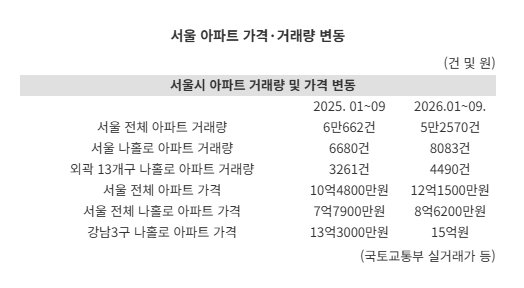
An analysis by Financial News on the 28th of the Ministry of Land, Infrastructure and Transport's Actual Transaction Price Disclosure System and the title sections of building registers found that 8,083 transactions of standalone apartments in Seoul—those with no more than three buildings and fewer than 300 households—were recorded from January to September this year, up 21% from 6,680 in the same period last year. Over the same period, transactions of all apartments in Seoul fell 13.5%, from 60,662 to 52,470. Transactions of apartments with 300 or more households also declined 20.3%, from 46,420 to 36,977.
As a result, standalone apartments' share of all apartment transactions in Seoul grew from 11% to 15.4%. Prices also rose. The average transaction price for units in the same complex and of the same size increased 8.6%, from 779 million won to 862 million won.
Until recently, standalone apartments were less popular than those in large complexes. Their drawbacks were seen as a lack of community facilities such as fitness centers and lounges, as well as limited parking. As a result, transactions were rare unless there was favorable news about a redevelopment project, and their prices stayed flat because they were less liquid.
The increase in transactions on Seoul's outskirts was a major factor in the change over the past year. Transactions of standalone apartments on the outskirts rose 37.7%, from 3,261 last year to 4,490 this year. The outskirts accounted for 88% of the overall increase in standalone apartment transactions in Seoul.
The three Gangnam districts (Gangnam, Seocho and Songpa) and the Han River Belt led the price increases. Transactions of standalone apartments in the three Gangnam districts rose only 9.2%, from 1,103 to 1,205, but the average transaction price climbed 11.9%, from 1.33 billion won to 1.5 billion won. The average price in the Han River Belt also rose from 788 million won to 896 million won, nearing 900 million won.
The average transaction price in the Yongsan and Jongno areas rose 12.2%, from 1.754 billion won to 1.986 billion won, putting it just short of 2 billion won. A 59-square-meter unit at Doosan Apartment in Haengdang-dong, Seongdong-gu, Seoul, sold for around 900 million won before lending restrictions were introduced last year, but fetched 1.3 billion won in July this year, a 400 million won increase. Shin Bo-yeon, a professor in the Real Estate AI Convergence Department at Sejong University, said, “Prices in the three Gangnam districts and the Han River Belt are rising because of proximity to workplaces and convenience.”
Experts cite concentrated end-user demand as the main reason. Since October last year, mortgage loan limits for high-priced homes have been tiered, increasing the incentive to look for relatively cheaper apartments. Park Won-gap, a senior real estate expert at KB Kookmin Bank, said, “Lending restrictions had some effect,” adding, “With gap investment impossible, demand is driven more by actual housing needs than speculation. The price increases have followed those in large complexes with a time lag.”
Some analysts say a shortage of jeonse and monthly-rental listings has led people to choose a cheaper purchase instead of renting. The argument is that as lending restrictions reduced the supply of rental homes, end users added their own funds and began buying relatively affordable standalone apartments. A licensed real estate agent who requested anonymity said, “Young couples looking for a home to live in are the ones who mostly come to view standalone apartments because of restrictions on jeonse loans,” adding, “Prices are rising, so they believe they will be able to trade up later.”
Experts expect this trend to continue for the time being. Professor Shin said, “With people having limited financial resources and few jeonse and monthly-rental listings, standalone apartments priced below 1 billion won are expected to continue rising,” adding, “It appears that lending restrictions have led end users to regard apartments priced at 1 billion won or less as affordable.”
[email protected] Jeong Gyeong-su Reporter