'A Challenge Born from Workers’ Frustrations': Iji Company Develops AI-Based Autonomous-Following Technology
- Input
- 2026-10-29 14:39:15
- Updated
- 2026-10-29 14:39:15
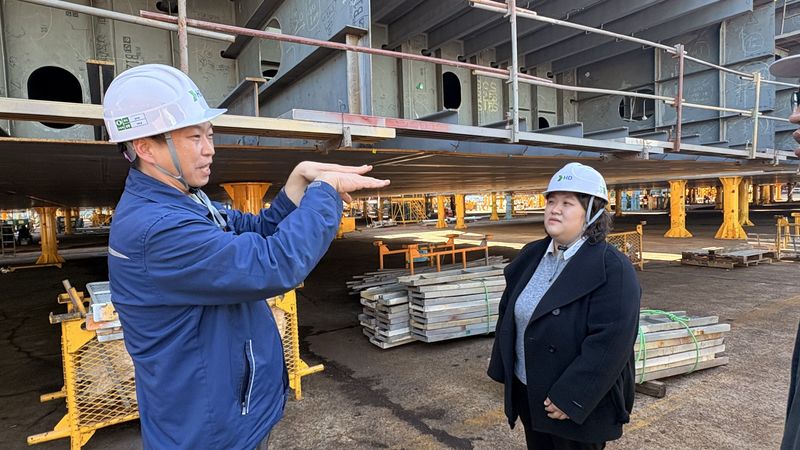
Park In-young, CEO of Iji Company, met with Financial News at HD Hyundai Samho Co., Ltd.’s Yeongam Shipyard on the 29th and said with a smile, "Although we are an early-stage startup, the Korea Industrial Complex Corporation’s Open Innovation program enabled us to receive support for a proof of concept (PoC) with a large company and develop a product as well."
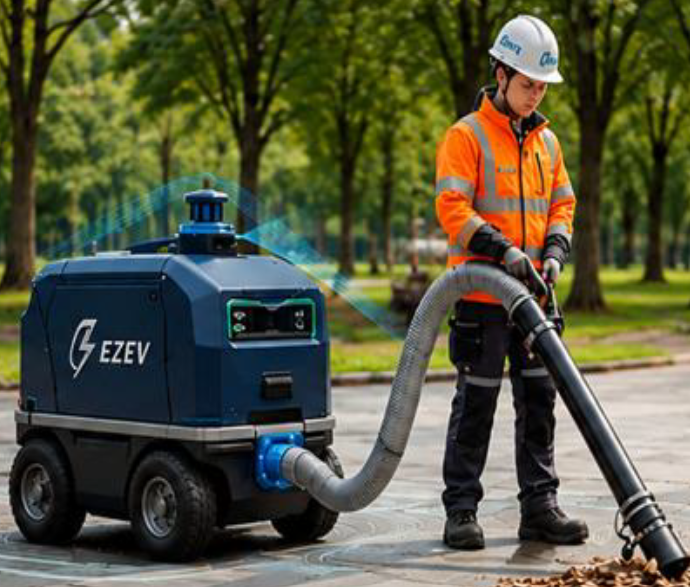
Improving shipyard working conditions with a cleaning vehicle that follows workers
Founded in November last year, Iji Company is a technology company developing an artificial intelligence (AI)-based autonomous-following smart mobile platform. The platform recognizes a worker, maintains a set distance, and follows them. Iji Company uses distance-measurement and location-recognition technologies, including LiDAR and ultra-wideband (UWB), to determine the distance between workers and equipment, and is advancing the technology so it can operate reliably in real working environments.
CEO Park made problems identified on site the starting point for product development. Rather than focusing solely on implementing the technology, she prioritizes identifying the functions workers actually need and incorporating feedback from the field into the product.
CEO Park said, "Before starting the company, I worked in safety and quality and had many opportunities to communicate with workers. Through that process, I learned about recurring inconveniences and areas that needed improvement. I decided to start the company to solve these problems with technology and create products that would be genuinely useful in the field."
Despite launching the company with high ambitions, it encountered numerous hurdles. Even with excellent technology, validating a product developed by an early-stage technology company in an actual industrial setting and confirming demand are crucial to commercializing it. But it was not easy to find a company willing to trust an early-stage startup, put its product to work at an actual site, and help validate it.
When it encountered difficulties, Iji Company connected with HD Hyundai Samho Co., Ltd. with help from the Korea Industrial Complex Corporation.
Iji Company was ultimately selected as HD Hyundai Samho Co., Ltd.’s PoC partner because of its “sensor-fusion-based autonomous-following cleaning robot” technology. HD Hyundai Samho Co., Ltd. saw the technical potential to overcome the limitations of cleaning equipment previously imported from Europe and work with Iji Company to develop a robot tailored to shipyard operations. During an actual visit, the Yeongam Shipyard—330 times the size of a soccer field—proved difficult to service with conventional large cleaning vehicles because materials and obstacles are constantly moved around. This is why HD Hyundai Samho Co., Ltd. took notice of Iji Company’s core technology, which safely recognizes and follows workers. Iji Company aims to successfully co-develop a dedicated robot that takes into account the shipyard’s confined spaces and specific hazards, and to establish an exemplary win-win model that tangibly improves workers’ safety and working environment.
CEO Park explained, "The final cleaning vehicle will be built to meet HD Hyundai Samho Co., Ltd.’s requirements, including a height and doors optimized for shipyards. We are also developing the technology so it can be applied to logistics and agriculture in the future and used in a variety of ways." She added, "We want to show that women- and youth-led companies can grow in manufacturing on the strength of their technological capabilities and ability to execute. We will continue to communicate directly with workers, reflect on-site needs in our products, and turn technology development into tangible commercial results, creating a meaningful example of a manufacturing startup."
If the PoC sufficiently verifies the robot’s suitability for the worksite, safety, and cleaning performance, HD Hyundai Samho Co., Ltd. plans to consult with the relevant site departments and consider adopting it formally. It also plans to share the results of successful, proven cases with other Open Innovation teams and affiliates within the group.
HD Hyundai Samho Co., Ltd. works with startups to improve on-site safety and process efficiency
HD Hyundai Samho Co., Ltd. is strengthening cooperation with startups as it works toward its goal of becoming a smart shipyard by 2030. At the request of site departments, it selects around 100 PoC topics to pursue with startups each year and is currently carrying out about 40. Cooperation with startups that have strong technologies is essential because there are limits to how much shipyard safety and process efficiency can be improved through the company’s efforts alone.
HD Hyundai Samho Co., Ltd. is particularly committed to working with startups because of the speed of development. Startups generally have simpler approval processes, which enables them to develop needed technologies quickly through collaboration. Developing technology in areas where the company lacks expertise can take two to three years, but working with a technologically capable startup can make it possible to see a product in as little as three to four months.
Park Gwang-yeol, senior manager on HD Hyundai Samho Co., Ltd.’s Strategic Planning Team, emphasized, "Our goal is to continue providing on-site infrastructure and opportunities for PoCs, while startups test innovative technologies in the field and grow alongside us. We will continue to work with relevant organizations, including the Korea Industrial Complex Corporation, to identify promising startups that can solve on-site problems and sustain win-win partnerships that energize the local industrial ecosystem."
[email protected] Kim Hyun-chul Reporter