“Clarify debt restructuring criteria” ... FSC overhauls bad-debt management system
- Input
- 2026-10-28 15:05:33
- Updated
- 2026-10-28 15:05:33
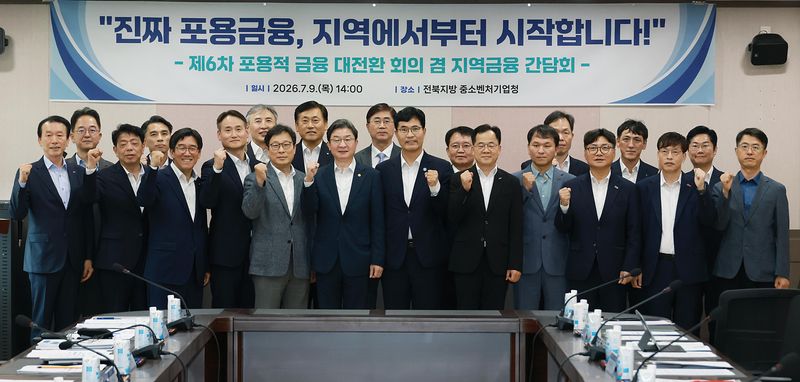
On the 28th, the Financial Services Commission held the 7th Great Transformation to Inclusive Finance Meeting at KAMCO’s Yangjae Tower in Gangnam District, Seoul. Discussions covered the introduction of a comprehensive assessment system for inclusive finance, the current state of debt restructuring policies, improvements to bad-debt management at financial public institutions, and Industrial Bank of Korea’s plans to advance inclusive finance.
The financial authorities will revise the criteria for extinguishing delinquent claims held by financial public institutions to make debt restructuring faster and smoother. The aim is to support the fresh start of people unable to repay their debts by managing limitation periods based on their ability to pay. When a debt has been delinquent for more than five years and its initial limitation period is due to expire, the borrower’s ability to pay will be assessed; if they are unable to pay, the limitation period will be deemed to have expired. In particular, people receiving basic livelihood benefits or disability pensions, as well as people of national merit receiving livelihood assistance, will have the limitation period expire without a separate review, regardless of the amount in arrears, preventing any further collection. Even when the limitation period has been extended, claims reaching a second expiration after 15 years of delinquency will be written off unless there are special circumstances, such as concealment of assets. The financial authorities will standardize claim-management criteria across financial institutions using this approach.
Other measures will include prompt debt restructuring within the critical window, stronger incentives, and improved infrastructure. Long-term nonperforming claims delinquent for 15 years or more will be resolved in stages by the second half of next year. Nonperforming claims delinquent for between five and seven years, inclusive, and amounting to 50 million won or less will also be written off or sold following a review. The measures to be introduced will also include allowing applications for debt restructuring before payment under a guarantee and permitting principal reductions before a loan is written off.
Over the past year, the financial authorities have worked to resolve delinquent debt by supporting credit recovery for borrowers who make payments faithfully and operating the New Leap Fund and the Saechulbal Fund. The five major financial holding companies reported in-house debt restructuring totaling 1.65 trillion won in the first half of 2025 and 2.66 trillion won in the second half, rising to 2.27 trillion won in the first half of 2026. Write-offs over the same periods also increased, to 407.3 billion won, 470.8 billion won, and 1.5211 trillion won, respectively.
The Financial Services Commission also announced a plan to introduce a comprehensive assessment system for inclusive finance, designed to encourage financial companies to embed inclusive finance in their management systems. Seventeen domestic banks will be assessed in five areas: governance (10%), provision of funds (35%), debt restructuring (35%), social consideration (10%), and nonfinancial services (10%). Results will be made public using grades from S to C. The system will be made more effective through incentives and penalties, including adjustments of up to 20% to contributions to the Korea Inclusive Finance Agency, reductions in surcharges under the Financial Consumer Protection Act, and consideration in management evaluations. The 2026 assessment will be run on a trial basis, with only top-performing institutions announced; incentives will take effect the following year.
Financial Services Commission Chairman Lee Eok-won said, “The financial sector must go beyond simply responding to government requests and take the initiative in providing inclusive finance.” He added, “The great transformation toward inclusive finance is both a process of seeking the true purpose of finance and a fundamental overhaul to redesign the financial paradigm.”
At the roundtable, Dr. Lee Gyu-bok of the Korea Institute of Finance (KIF) pointed out, “We must recognize that delinquent borrowers are customers too, and manage arrears and carry out collections in accordance with the principle of putting customers’ best interests first.” Yu Sun-deok, a director of Rolling Jubilee, also said, “Reviews centered on repayment capacity and the practical value of recovery, as well as the prompt closure of claims that meet the criteria for write-off, are necessary.”
Meanwhile, Industrial Bank of Korea said it would launch the HopeOn-IBK Project, providing at least 30 trillion won in support by 2030. The project includes an IBK personal credit recovery program, a 1-trillion-won good-rate inclusive finance loan with a single fixed annual interest rate of 4.9%, a maximum loan of 20 million won, and a 10-year term; contributions of up to 100 billion won to the IBK Microfinance Foundation; and the launch of the IBK Future Preparation Loan. Existing inclusive finance support will also be expanded, with a range of products to be offered, including the HopeOn Safe Fixed-Rate Loan (1 trillion won) and the IBK Small Business Owners The Dream Package (8.5 trillion won).
[email protected] Park Mun-su Reporter