Gwangju Metropolitan City, nine counties and the climate ministry join forces to build an RE100 industrial ecosystem
- Input
- 2026-10-28 14:46:57
- Updated
- 2026-10-28 14:46:57
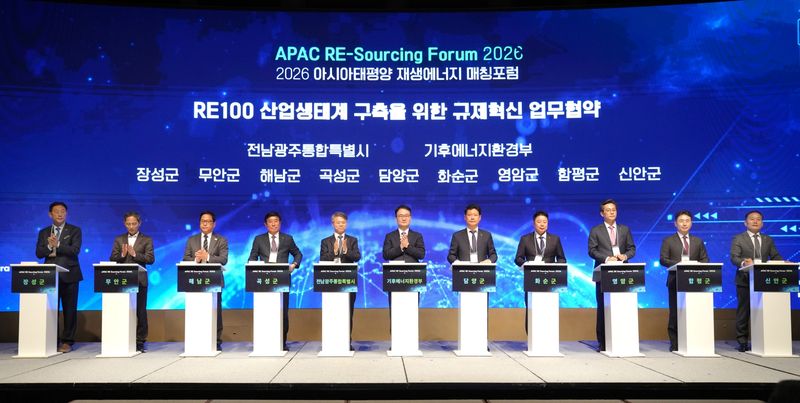
【Financial News, Jeonnam-Gwangju = Hwang Tae-jong, Reporter】Jeonnam-Gwangju Special Metropolitan City (Gwangju Metropolitan City), nine counties—Damyang, Gokseong, Hwasun, Haenam, Yeongam, Muan, Hampyeong, Jangseong and Sinan—and the Ministry of Climate, Energy and Environment have agreed to ease regulations that impede the growth of the renewable energy industry and join forces to build an RE100 industrial ecosystem.
Gwangju Metropolitan City said on the 28th that it had signed an agreement with the Ministry of Climate, Energy and Environment and the counties of Damyang, Gokseong, Hwasun, Haenam, Yeongam, Muan, Hampyeong, Jangseong and Sinan at the 2026 Asia-Pacific (APAC) Renewable Energy Matching Forum, held that day at The Westin Josun Seoul. The agreement aims to reform regulations and build an RE100 industrial ecosystem.
Those attending the signing ceremony included Gwangju Metropolitan City Mayor Min Hyung-bae; Ahn Se-jin, Director of the Energy Transition Policy Office at the Ministry of Climate, Energy and Environment; Gokseong County Governor Jo Sang-rae; Hwasun County Governor Lim Ji-rak; Yeongam County Governor Woo Seung-hee; Hampyeong County Governor Lee Nam-oh; Jangseong County Governor Kim Han-jong; Sinan County Governor Kim Tae-seong; Damyang Deputy County Governor Lee Jeong-guk; Haenam Deputy County Governor Kim Byeong-seong; and Muan Deputy County Governor Kim Byeong-jung.
A Gwangju Metropolitan City official explained, “Following the corporate RE100 agreement signed on the 27th with the Corporate Renewable Energy Foundation, the Korea Rural Community Corporation and Amkor, this agreement is intended to establish a foundation for reliably supplying the renewable energy needed for major government projects, including the Southwest Region semiconductor cluster.”
Under the agreement, the organizations will work together to: establish a foundation for supplying the renewable energy needed for the government’s three major projects; ease renewable energy regulations, including solar panel setback requirements, and address permitting obstacles such as approvals for development activities; identify suitable sites for renewable energy and develop planned sites; link power generation facilities, business locations and power infrastructure; support domestic and international companies in meeting RE100 commitments and investing locally; and promote business models that encourage resident participation and generate local income.
Under the division of responsibilities, the Ministry of Climate, Energy and Environment will support policies and systems for building the supply chain, including expanding renewable energy and linking it to power infrastructure. Gwangju Metropolitan City will lead cooperation at the metropolitan level, including support for permits, coordination between renewable energy and power infrastructure, and attracting companies to power generation complexes and industrial parks in participating counties. The nine counties plan to work on easing regulations such as solar panel setback requirements, support permitting, identify planned sites and promote cooperation that benefits local residents.
At the signing ceremony that day, Gwangju Metropolitan City Mayor Min Hyung-bae stressed, “For companies to meet their RE100 commitments, they need to be able to secure enough renewable energy when they need it. The government and Gwangju Metropolitan City’s nine counties will work together to lower regulatory and permitting barriers, support the success of the Southwest Region semiconductor cluster with renewable energy, and make Jeonnam-Gwangju an ‘RE100 industrial capital.’”
Meanwhile, in a keynote speech that day titled “RE100: A New Growth Engine for Jeonnam-Gwangju,” Mayor Min Hyung-bae announced four strategies for achieving corporate RE100: building a stable renewable electricity supply system through direct power trading (PPA) and other means; establishing governance covering the full renewable energy lifecycle; expanding infrastructure for local production and local consumption; and developing a successful RE100 model through cooperation between leading companies and public institutions.
The plan is to help companies smoothly procure the renewable energy they need through various means, including direct power trading (PPA); have the public sector systematically lead renewable energy development, centered on a provisionally named Jeonnam-Gwangju Urban Development and Energy Corporation; and overcome grid constraints by building next-generation power grids and energy storage systems (ESS) based on local production and consumption, in coordination with the expansion of the national backbone power grid.
Following the corporate RE100 agreement signed on the 27th with the Corporate Renewable Energy Foundation, the Korea Rural Community Corporation and Amkor, the city plans to use the RE100 implementation agreement signed that day with the Ministry of Climate, Energy and Environment and nine resource-rich counties in Jeonnam-Gwangju as a model for global companies to achieve RE100, and expand it to all companies based in the area.
[email protected] Hwang Tae-jong Reporter