‘Stepmother’ and ‘stepfather’ labels to disappear from resident registration certificates and abstracts ... Spouses’ children also to be listed as ‘household members’
- Input
- 2026-10-28 14:18:10
- Updated
- 2026-10-28 14:18:10
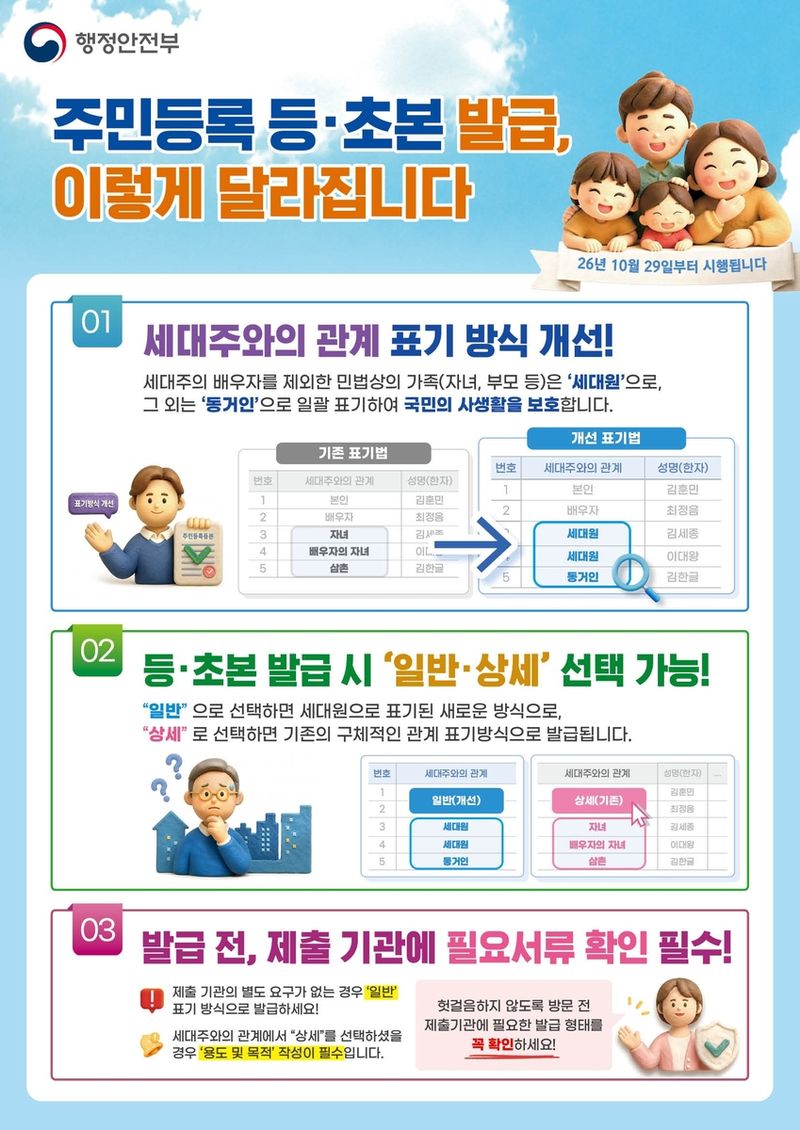
[Financial News] Starting on the 29th, family relationship labels such as ‘stepmother,’ ‘stepfather’ and ‘spouse’s child’ shown on resident registration certificates and abstracts will be changed to ‘household member.’ The measure aims to prevent a family’s remarried status from being revealed through resident registration documents. However, documents showing specific family relationships can still be issued in the existing format when needed.
The Ministry of the Interior and Safety (MOIS) said on the 28th that the revised Enforcement Decree of the Resident Registration Act and its Enforcement Rule, which contain these changes, will take effect on the 29th.
Until now, resident registration certificates distinguished relationships to the household head with labels such as ‘child,’ ‘spouse’s child,’ ‘stepfather’ and ‘stepmother.’ Concerns had been raised that this could reveal the family relationships of remarried families to others.
Going forward, family members other than the household head and their spouse will be listed as ‘household members,’ while others will be listed as ‘cohabitants.’ The order in which names appear on the certificate will also change.
Previously, the household head’s children were listed before the spouse’s children, which sometimes meant that an older child appeared later. Going forward, the direct lineal ascendants and descendants of the household head and the spouse will be grouped under the same criteria to determine the order in which they are listed. This change addresses not only the family relationship labels but also the problem of people being able to infer whether a family was remarried from the order of names.
When requesting a resident registration certificate or abstract, people can choose between a ‘general’ and a ‘detailed’ version. The general version will use the revised labeling system, while the detailed version will continue to show specific family relationships as before. MOIS plans to advise people to use the general version unless the institution receiving the document specifically requires otherwise.
Identity verification procedures for foreigners will also be improved. A resident registration certificate will be able to show a foreigner’s name in both Hangul and Roman letters.
Until now, family relationship registration documents showed names in Hangul, while resident registration certificates listed only Romanized names, making it difficult to prove that the names referred to the same person. The change is expected to make it easier to compare the names on the two documents.
The procedures for filing a change-of-address report and applying for the service that notifies people when such a report is filed will also be simplified. The burden on applicants to prepare documents that can be verified through the shared use of administrative information will be reduced.
Since the revised laws were promulgated last April, MOIS has worked to improve the resident registration system and prepare for implementation with local governments.
MOIS Vice Minister Kim Min-jae said, “I hope the enforcement of the revised Enforcement Decree of the Resident Registration Act will provide more careful protection for the privacy of remarried families and ease administrative difficulties for foreigners.” He added, “We will continue to carefully examine the inconveniences and difficulties people experience in their daily lives and make ongoing improvements to the resident registration system.”
[email protected] Lee Bomi Reporter