“900 km on a single charge” ... BMW iX3’s efficiency jumps 40% on a Seoul–Haenam drive [Gittongchan Mobility]
- Input
- 2026-10-29 06:59:00
- Updated
- 2026-10-29 06:59:00
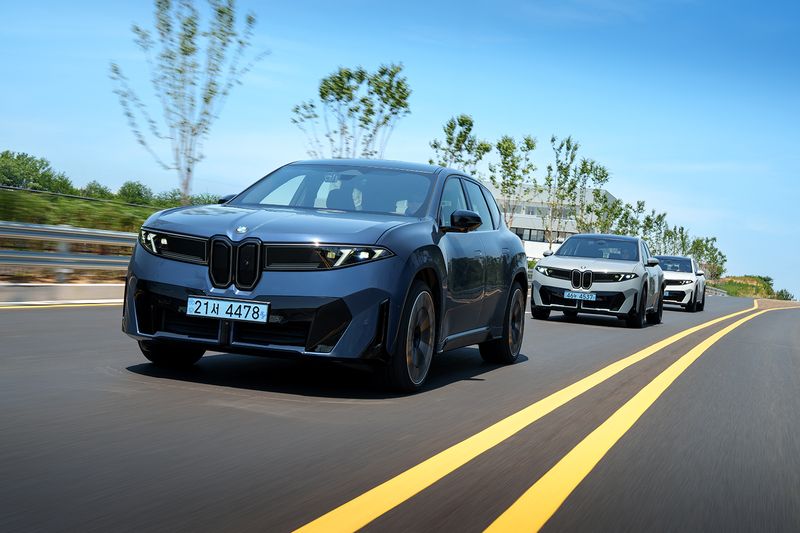
■ Europe’s “1,007 km” record put to the test in South Korea ... smooth ride, virtually no jolting
According to BMW Korea on the 29th, the “New BMW iX3 Long-Distance Efficiency Challenge,” which ran from Seoul to Haenam County, South Jeolla Province, was held on the 21st and 22nd. Efficiency refers to the distance traveled on 1 kWh of electricity, much like fuel economy for an internal-combustion vehicle. Teams of two reporters set off from Seoul, took over the wheel at Baekje Rest Area in Buyeo, South Chungcheong Province, and drove on to Pine Beach in Haenam County.The event was organized to test the European record on South Korean roads. The iX3 had previously traveled 1,007.7 km from the plant in Debrecen, Hungary, to Munich, Germany, without recharging. BMW Korea explained that while the European record was set under minimal conditions, this event focused on checking real-world efficiency on South Korean roads under ordinary driving conditions.
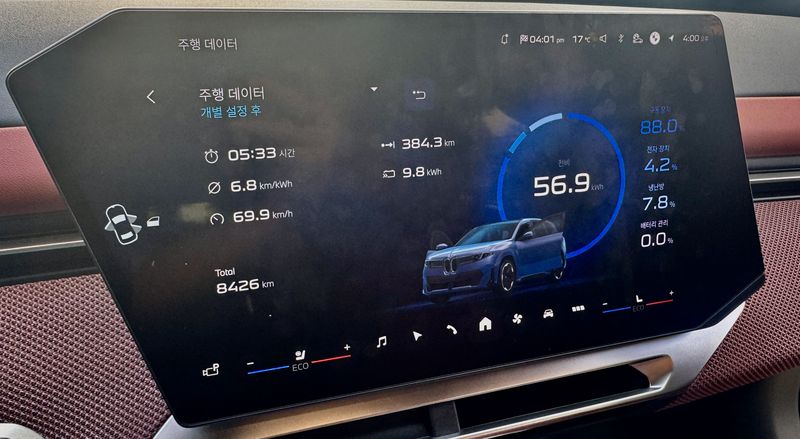
The vehicle driven by the reporter covered 384.3 km in 5 hours and 33 minutes, recording efficiency of 6.8 km/kWh. That is about 2 km farther per kWh than the certified combined efficiency figure of 4.8–4.9 km/kWh. It consumed 56.9 kWh, with just 7.8% of that used for heating and cooling.
The ride quality also passed muster. There was almost none of the jolting characteristic of electric vehicles. The driver-assistance system (ADAS) did not switch off immediately even when the brakes were applied. It disengaged the system only when the vehicle determined it was necessary.
The top result was 8.1 km/kWh. BMW Korea said that applying the winning efficiency figure to the battery’s capacity of 113 kWh would yield a range of 915.3 km on a single charge. That is about 300 km more than the certified range of 611 km. However, this is a theoretical figure based on the assumption that the entire battery is used; actual range varies depending on speed, temperature and use of the climate-control system.
■ First Neue Klasse model ... 250 km from a 10-minute charge
The iX3 is the first production model in BMW’s next-generation Neue Klasse strategy. BMW plans to apply Neue Klasse technology to 40 new and facelifted models by 2027, spanning internal-combustion, plug-in hybrid and fully electric vehicles.The battery is key to efficiency. The sixth-generation BMW eDrive system, which uses cylindrical cells, has increased energy density by 20% compared with the previous generation. Charging speed and driving range, based on the European WLTP standard, have each improved by 30%. With an 800-volt high-voltage system, the vehicle can travel about 250 km after just 10 minutes at an ultra-fast charger. Charging the battery from 10% to 80% takes about 22 minutes.
Market response has been strong. According to BMW Korea, the iX3 received 2,000 preorders in just three days, and nearly 5,000 orders over three months. In Europe, orders exceeded 100,000 within a year of the vehicle’s unveiling. The Debrecen plant in Hungary, where it is manufactured, adjusted its production plan to meet demand.
Investment in charging infrastructure is also aggressive. BMW Korea operates 546 charging stations and 3,443 chargers across all 17 metropolitan cities and provinces in South Korea. The company said this was the largest network among imported-car brands. All are public facilities that can be used regardless of brand, and the company plans to expand the network to about 4,000 chargers by year-end.
The company is also expanding its services. In June, it installed South Korea’s first 400-kW-class public ultra-fast charger. Its roaming service, which also allows drivers to use chargers installed by other companies, provides access to 95% of the country’s public charging infrastructure. BMW Korea is training high-voltage repair specialists to handle electric-vehicle breakdowns and, in cooperation with fire authorities, providing training in electric-vehicle rescue operations.
A BMW Korea official said, “Electrified models account for less than 20% of our total sales,” adding, “Even so, we are actively building charging infrastructure across the country.” The iX3 is priced in South Korea at 79.9 million to 92.8 million won, depending on the trim.
[email protected] Kim Dong-chan Reporter