Rural schools avert closure by embracing AI and aerospace
- Input
- 2026-10-28 12:00:00
- Updated
- 2026-10-28 12:00:00
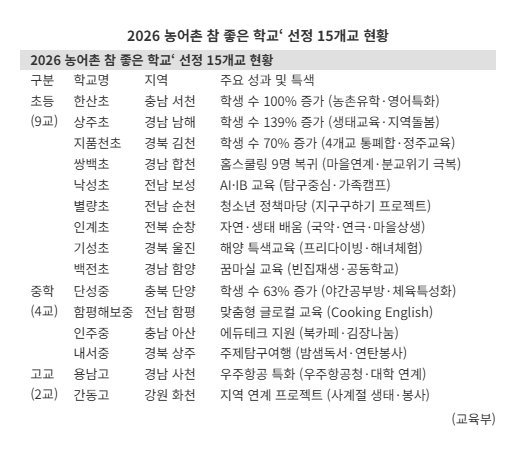
[Financial News] Hansan Elementary School in Seocheon, South Chungcheong Province, was at risk of closure as enrollment declined. After introducing a rural study program and specialized English education, enrollment doubled from 19 to 38. Rural schools that have boosted enrollment and revitalized their communities through tailored education that builds on local strengths have been designated as government best-practice cases.
The Ministry of Education announced on the 28th that it had selected 15 schools in the 2026 “Really Good Rural Schools” competition: 9 elementary schools, 4 middle schools and 2 high schools. The competition has been held since 2020 to identify best practices in which schools use the distinctive characteristics of rural areas as educational strengths to offer unique curricula, while working with local communities to improve educational conditions. Each year, 14 to 15 schools are selected.
Hansan Elementary also offers English classes with native-speaking teachers and all-day care from 7:30 a.m. to 8 p.m. Several other schools have also seen enrollment rise. At Danseong Middle School in Danyang County, North Chungcheong Province, enrollment grew 63%, from 27 in 2022 to 44. Despite having no proper competition venue, its roller sports team won triple crowns at the National Junior Sports Festival for two consecutive years, and the school has produced two national team athletes. Jipumcheon Elementary School in Gimcheon, Gyeongsangbuk-do, opened in March this year after four schools were consolidated; its enrollment has grown from 17 at opening to 29. At Sangju Elementary School in Namhae, South Gyeongsang Province, enrollment rose from 23 to 55. At Ssangbaek Elementary School in Hapcheon, South Gyeongsang Province, nine students who had been homeschooled returned, bringing enrollment to 17 across six classes.
There are also a variety of examples of schools incorporating local resources into their curricula. In response to the arrival of the Korea AeroSpace Administration (KASA) in Sacheon, Yongnam High School in Sacheon, South Gyeongsang Province, signed an agreement with Gyeongsang National University’s College of Aerospace and now jointly offers a course called “Fundamentals of Aerospace Studies.” It also holds classes that make use of local industry resources, including field trips to KAI in Sacheon. Yongnam High has spaces suited to the high school credit system and project-based learning, including terrace-style classrooms and a large open-plan library. It also continues in-person exchanges with a high school in Fukuchi, Japan.
Nakseong Elementary School in Boseong County, Jeonnam-Gwangju, has been designated an AI education-focused school and an International Baccalaureate (IB) interest school, and offers inquiry-based lessons. The school has 35 students and also runs family camps and backyard camping, with parents taking an active role in educational activities. Gandong High School in Hwacheon, Gangwon State, has been running a community-linked education project since the second semester of 2024 to turn the region’s challenge of a declining school-age population into an educational opportunity.
A total of 117 schools submitted cases to the competition, including 77 elementary schools, 30 middle schools and 10 high schools in rural areas nationwide. They underwent an initial document review, followed by on-site inspections and other steps. Among the evaluation criteria, the greatest weight was given to excellence in educational collaboration and the development of distinctive rural curricula.
Noh Jin-young, director general of student support at the Ministry of Education, said, “Rural schools provide students with opportunities to learn and grow through a range of educational activities that draw on local strengths,” adding, “We will continue to actively identify and share best practices from rural schools and work to help them grow together with their communities.”
The selected schools will receive commendations from the Minister of Education. The Ministry plans to share the schools’ educational activities and achievements with the education community by publishing and distributing a collection of best practices and promoting them online, among other means.
[email protected] Kim Man-gi Reporter