Choosing practical benefits over a Seoul-based university? More top students with Grade 1 or 2 records apply to regional flagship national universities in early admissions
- Input
- 2026-10-28 11:27:41
- Updated
- 2026-10-28 11:27:41
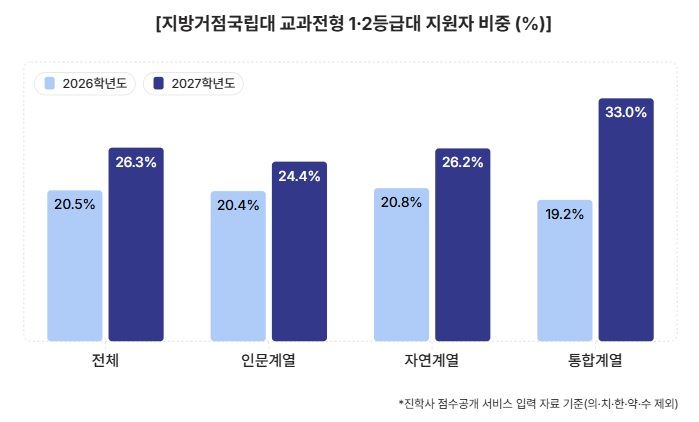
[Financial News] Applicants to the student-record-based subject-specific admissions track at regional flagship national universities had significantly higher high school grades in the 2027 college early-admissions cycle than the previous year. This is thought to reflect an increase in applications from top-performing students who, despite the preference for universities in the Seoul metropolitan area, considered practical benefits such as reduced tuition burdens and hiring of local talent.
Jinhak Co., Ltd. analyzed data entered by applicants into its “Score Disclosure Service” and released the findings on the 28th. The analysis found that at eight of the nine regional flagship national universities, excluding Jeju National University, average high school grades among applicants to humanities and natural sciences programs rose from the previous year, excluding medicine and pharmacy programs.
The share of applicants with Grade 1 or 2 records rose by 5.8 percentage points, from 20.5% the previous year to 26.3% this year. This means that at least one in four applicants had a Grade 1 or 2 record. By field, the integrated track saw the largest increase: its share of applicants with Grade 1 or 2 records rose by 13.8 percentage points, from 19.2% the previous year to 33.0% this year. The share rose by 5.4 percentage points in natural sciences, from 20.8% to 26.2%, and by 4.0 percentage points in humanities, from 20.4% to 24.4%. The integrated track is a program that selects students without distinguishing between humanities and natural sciences.
Woo Yeon-cheol, head of Jinhak Co., Ltd.'s Institute for Admissions Strategy, said that expectations surrounding government policies to foster regional universities and revitalize local industries, tuition support, and expanded hiring of local talent may have influenced some applicants' choices.
In an earlier Jinhak Co., Ltd. survey of early-admissions applicants, 41.8% of applicants to regional national universities said that the tuition support policy had influenced their applications. When asked to select multiple reasons for applying, the most common response was the chance of being admitted, at 60.5%, followed by reduced tuition and living-cost burdens at 49.6%, better employment and career prospects at 34.9%, and expectations for the policy to create 10 universities like Seoul National University at 19.2%.
Average high school grades also improved. In the Korean grading system, a lower grade number indicates better performance. Based on average grades in Korean, English, mathematics, social studies and science, humanities applicants improved by 0.17 grade points, from 3.78 the previous year to 3.61 this year, while natural sciences applicants improved by 0.15 points, from 3.83 to 3.68. Applicants in the integrated track improved by 0.33 points, from 3.88 to 3.55. At Jeju National University, humanities applicants improved by 0.05 points, while natural sciences applicants' grades worsened by 0.04 grade levels.
Woo said, “It is a meaningful change that both average high school grades and the share of applicants with top grades have risen in subject-based admissions at regional flagship national universities.” He added, “As the share of applicants with top grades has increased, it is worth paying attention to changes in the final admission cutoff as well. However, the actual cutoff may vary depending on whether applicants meet the minimum CSAT requirement and on the results of additional admissions.”
[email protected] Kim Man-gi Reporter