“AI predicts demand and gets deliveries ready before orders are placed” ... Baemin aims to build a “city that never stops”
- Input
- 2026-10-28 14:32:18
- Updated
- 2026-10-28 14:32:18
[Financial News] Baedal Minjok is using artificial intelligence (AI) to create a “city that never stops,” predicting demand before users place orders and linking food preparation with rider dispatch. The plan is to move delivery preparations—which used to begin after an order came in—to before the order is placed, minimizing users’ wait times.
AI predicts demand before orders to create a ‘Seamless City’
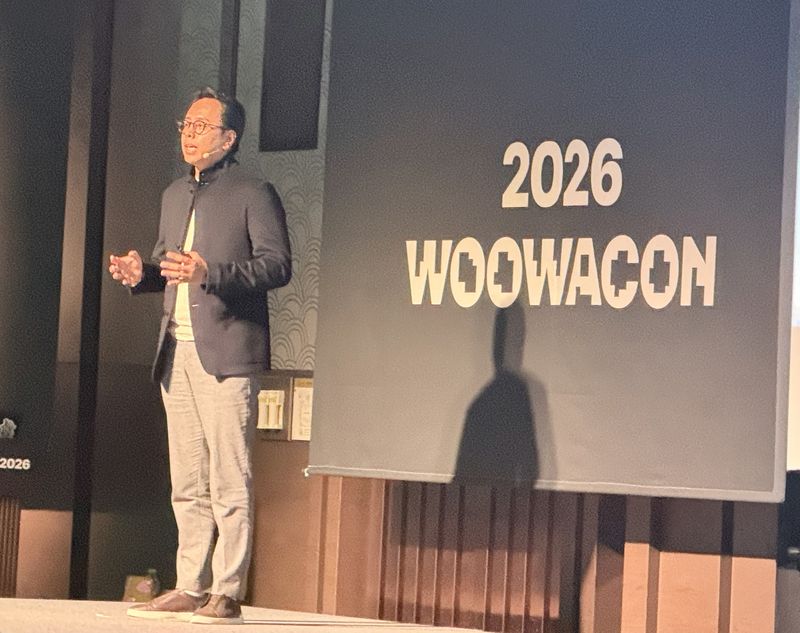
Woowa Brothers CEO Kim Beom-seok unveiled the ‘Seamless City’ vision at the technology conference ‘Wooacon 2026,’ held at Grand InterContinental Seoul Parnas in Gangnam-gu, Seoul, on the 28th.
“Until now, delivery started when customers pressed the order button, but the actual wait begins the moment they start thinking about what to eat, searching and comparing,” Kim said. “Why should delivery only start after an order comes in?”
Seamless City is a vision for a city where demand is predicted before users place orders, allowing stores and riders to prepare in advance. It offers choices tailored to users’ tastes and usage habits before they even open the app, while stores prepare food based on projected demand at different times of day. Riders move to areas where orders are likely and arrive when the food is ready.
In the long term, the company is also envisioning a service in which AI understands users’ intentions and, within permitted limits, automatically handles everything from browsing and selecting menu items to placing repeat orders. Kim identified prediction, connection and optimization as key challenges to making this a reality. The plan is to connect users, stores, riders and robots in a single system and optimize the entire delivery process by incorporating various factors in real time, including weather, traffic conditions and changes in order volume.
“Baemin’s work has already gone beyond delivery,” Kim emphasized. “It has expanded to encompass the entire process of identifying customers’ needs and meeting them.”
Using 3,000 customer variables... Doubling the accuracy of delivery-time predictions
Woowa Brothers Chief Technology Officer (CTO) Ko Myeong-seok introduced the AI technologies behind Seamless City and the results of their real-world application. Woowa Brothers is developing a hyper-personalization engine that uses at least 3,000 user variables and an ontology to provide personalized services. AI agents search for information related to users to offer suitable benefits and recommendations, then improve prediction models based on user responses.
AI is also being applied to predict food preparation and delivery times. Previously, the company used preparation times entered directly by business owners, but these differed from actual preparation times by an average of about 8 minutes. By refining its prediction models to account for order volumes by menu item and processing speeds, Woowa Brothers reduced the average error by about 50%.
Delivery-time predictions draw on 58 data points, including each store’s delivery status, local congestion and infrastructure conditions. After switching from estimates based on preparation times entered by business owners to predictions generated by AI analysis of actual delivery conditions, the accuracy of the estimates provided to customers at least doubled.
CTO Ko defined Baedal Minjok’s operational structure as a “real-time physical network.” It connects users, stores and riders in a single network, managing everything from demand forecasting and food preparation to dispatch and delivery as an integrated process. When prediction errors occur during actual operations, the system detects them and improves the models. “We see customers, stores and riders not as separate systems, but as an organism connected through a single network,” Ko said.
Next, Han Daniel, Woowa Brothers’ head of delivery, shared examples of the ‘Seamless City’ vision being applied to real-world delivery operations. By forecasting rider demand in each area before rain and securing the necessary staff in advance, Woowa Brothers cut response times during rainy weather by about 80% compared with before. The company is also optimizing delivery routes using real-world operating data and has a system that resumes order processing from the interrupted stage even if a system failure occurs.
In some areas, delivery robots bring B Mart products right to customers’ doors. The robots travel autonomously for at least 99% of their total distance, covering about 5,000 km a month. Han added, “Seamless City isn’t created through one groundbreaking innovation; it takes shape by eliminating small waits one at a time.”[email protected] Choi Hye-rim Reporter