Deputy Prime Minister Bae Kyung-hoon: “Accelerate the national AI transition ... step up efforts to secure future core technologies”
- Input
- 2026-10-28 11:29:05
- Updated
- 2026-10-28 11:29:05
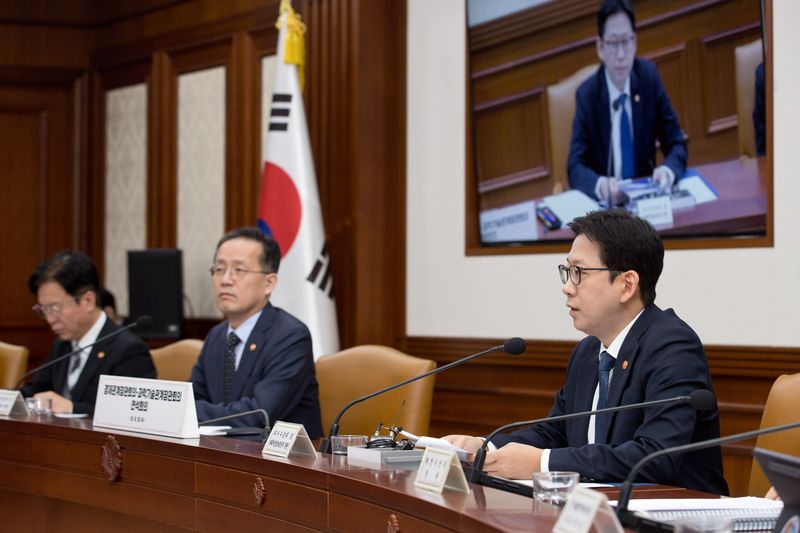
[Financial News] Deputy Prime Minister and Minister of Science and ICT Bae Kyung-hoon stressed that “we must accelerate the national AI transition and step up efforts to secure future core technologies through the seven SEED projects.”
Deputy Prime Minister Bae said this while chairing a joint meeting of the Council of Economic Ministers and the Ministerial Meeting on Science and Technology with Deputy Prime Minister and Minister of Economy and Finance Lee Hyoung-il at Government Complex Seoul on the 28th.
This was the first joint meeting held with the Council of Economic Ministers since the Ministerial Meeting on Science and Technology was launched last November. It marked the first time a forum for pan-government collaboration had been established to discuss economic and industrial policies together with science and technology policy.
Deputy Prime Minister Bae said that “the Republic of Korea has recently joined the top-tier group of ‘AI-leading countries’ alongside the United States and China, and has ranked first in Asia and fourth in the world in the Global Innovation Index for two consecutive years, among other achievements, earning high international recognition for its competitiveness in artificial intelligence and science and technology.”
He added, “This is a valuable achievement made possible by the government’s strategic investment and the private sector’s constant innovation and drive to take on challenges,” and said, “We must ensure that these achievements lead to improvements in people’s quality of life.”
He also said that “close cooperation among ministries is important for the results of technology development to lead to the creation of new industries and markets,” adding, “With today’s first joint meeting as a starting point, we will bring together our strengths in science and technology and economic policy to create new growth engines.”
At the meeting, the government said it would focus on pursuing the ‘three core social policies’—housing, jobs and financial services for ordinary people—which have the greatest impact on people’s lives among the tasks aimed at easing polarization. Cross-ministerial working groups for each task are now being fully mobilized. Following discussions at the meeting, the government plans to actively identify policies that people can see making a difference and quickly develop them into concrete measures.
In particular, the meeting discussed the ‘directions for advancing the seven SEED projects and plans for cross-ministerial collaboration,’ with the aim of speeding up efforts to secure future growth engines by strengthening cooperation among relevant ministries. To achieve the key targets for each of the seven SEED projects for 2030 and 2035, the government will move away from a focus on individual projects and establish a framework for strategically linking ministries’ projects and investments around core missions. As part of this effort, it plans to form a public-private Frontier Board platform to reflect private-sector demand, strengthen inter-ministerial cooperation from technology development through demonstration and commercialization, and jointly address major prerequisites, including regulations and permits, to build a technology and industry ecosystem. It also plans to draw up a detailed implementation plan within this year and begin full-scale implementation next year.
The government will also build a next-generation local administrative common system, replacing the aging system with an AI- and cloud-based one. It plans to integrate systems currently dispersed across 243 local governments into a cloud environment organized at the level of 16 cities and provinces, and standardize documents and data into formats suitable for AI use, laying the groundwork for the adoption of AI in local administration.
[email protected] Yeon Ji-an Reporter