'Give me back my statements': 86-year-old sits on warrant ... Supreme Court says it wasn't theft
- Input
- 2026-10-28 11:31:55
- Updated
- 2026-10-28 11:31:55
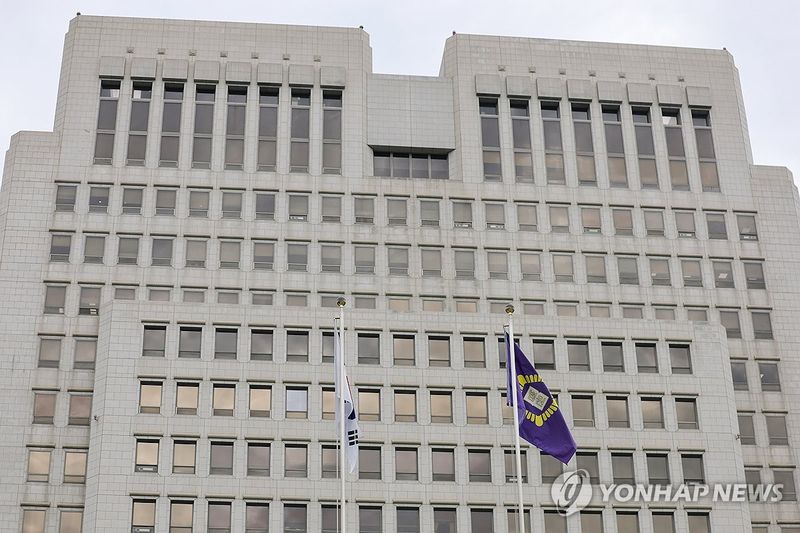
According to legal sources on the 28th, the Supreme Court of Korea’s First Division, with Justice Suh Kyeong-hwan as the justice in charge of the case, on the 1st overturned the lower court ruling that sentenced A, 86, to one year in prison, suspended for two years, for theft and obstruction of official duties, and sent the case back to Busan District Court. A was indicted for taking and refusing to return, at around 5:30 p.m. on January 8 last year from a home in Busan, two original warrants for search, seizure and inspection owned by the Republic of Korea, two copies of seizure inventory forms, and one certificate confirming the removal of an original information storage medium, as well as assaulting police officers who tried to retrieve them.
At the time, police officers were executing a warrant related to A’s spouse’s alleged violation of the Housing Act. When 30 bank and credit card statements in A’s name were seized, A took them, saying, “They aren’t items listed in the warrant as subject to seizure,” and pushed an officer who tried to retrieve them in the chest once. After the statements were recovered, A took the warrant and other documents from the table, sat on them on the living-room sofa, and said, “If you give me back the statements, I’ll return these documents too.” A struck the hand of an officer demanding their return and also hit another officer who was leaving by throwing a lump of coarse salt at the back of the officer’s head. A went to the police station on the 15th of the same month but still did not return the documents, voluntarily submitting them only on February 4 after an investigator questioned A.
The issue was whether A had the intent to unlawfully appropriate the documents required for a theft conviction. Such intent means intending to exclude the rightful owner and use or dispose of another person’s property as one’s own, in accordance with its economic function. Merely infringing on another person’s possession does not constitute theft.
The first and second trials found A guilty. The appeals court held that the conduct could not be viewed as temporary use, noting that A repeatedly refused requests to return the documents, kept them until the officers left despite knowing the statements would not be returned, and did not give them back until about a month later.
The Supreme Court of Korea found a step missing in that reasoning. The court said, “While it is acknowledged that A possessed the documents for a considerably long time, it is difficult to conclude from that circumstance alone that A had the intent to unlawfully appropriate them,” adding, “It must also be proven that A intended to use or dispose of them ‘in accordance with their economic function,’ as if they were A’s own property.” The point was that lengthy possession may show that the use was not temporary, but does not by itself establish intent to unlawfully appropriate the documents.
The court also noted that A had initially said, “If you give me back the statements, I’ll return these documents,” and had in fact submitted them voluntarily. It also considered the nature of the documents. The original warrant had already been executed and could no longer be used for a search or seizure; it was virtually impossible for a private individual, rather than an investigative agency, to use or dispose of it according to its function. The seizure inventory form, meanwhile, is issued to protect the rights of the person whose property has been seized. The court said there was also no indication that A had actually used the documents in accordance with their economic function.
The conviction for obstruction of official duties, however, was upheld. Although the parties disputed whether the seizure of the statements was lawful, the Supreme Court of Korea found no error in the lower court’s assessment of the connection between the items seized and the case, or of the admissibility of the evidence. Since theft and obstruction of official duties were treated as concurrent offenses and a single sentence was imposed, the entire lower court ruling was overturned.
[email protected] Kim Dong-kyu Reporter