“Focus and collaboration spaces instead of fixed desks”: Rsquare Design presents office trends for the AI era
- Input
- 2026-10-28 11:34:20
- Updated
- 2026-10-28 11:34:20
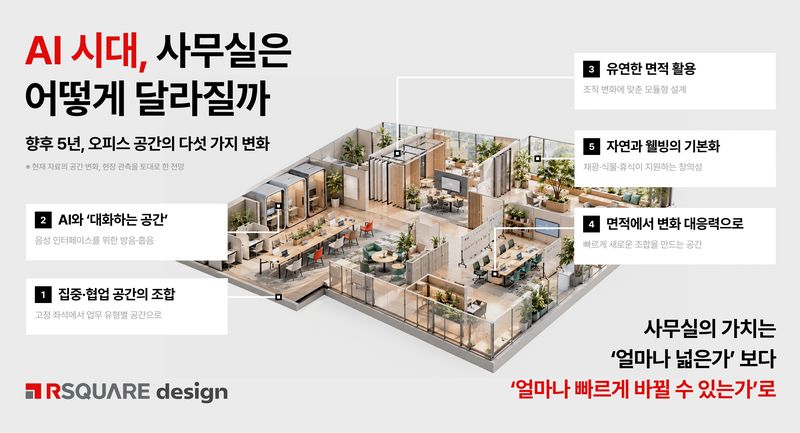
Rsquare Design, a company specializing in the design and construction of office and commercial spaces, said on the 28th that it had published a commercial interior market report titled “How Will the Office Change?” The report analyzes how office spaces have changed over the past 10 years and presents a blueprint for the work environment AI will shape over the next five years.
Rsquare Design assessed that “the automation of repetitive tasks through AI will not immediately lead to a reduction in office space.” While tasks such as drafting documents and basic data entry can be automated, the analysis finds that the importance of spaces supporting high-level human judgment and creative collaboration will instead grow. Accordingly, the starting point for design is shifting completely from the traditional “number of employees in each department” to “the work to be performed and how people will collaborate.”
Over the past 10 years, office spaces have undergone a range of changes, from the spread of coworking spaces and the shift toward lounge-style layouts to unassigned seating. More recently, in the post-endemic period, partitions have made a comeback as people place greater emphasis on focus and privacy. In particular, “biophilic design,” which brings elements of nature indoors, has drawn attention, and creating comfortable work environments that take natural light, materials, and sightlines into account has become a trend.
The report identified three key requirements for building offices in the AI era. First, it said that “flexible layouts and modular structures” are important, as spaces need to be easily reconfigured to accommodate changes in teams and project-based organizations. The second is “solutions for voice AI.” As “voice prompting”—communicating with AI by speaking—becomes more common, the use of sound-absorbing and soundproofing measures and phone booths is expected to increase substantially to reduce disturbances and maintain security. The final requirement is “a strategy centered on work reorganization.” Rather than simply reducing the number of seats, companies should carefully distinguish between tasks to be automated and those requiring people to focus and collaborate, then design the allocation of space accordingly.
Rsquare Design stressed that “space strategies in the AI era should begin with a thorough analysis of how work needs to be reorganized, not with efficient cuts to the number of seats,” adding, “Going forward, how flexibly an office can adapt to changes in teams and projects will be a key criterion for assessing its value.”
[email protected] Jeon Min-kyung Reporter