President Lee: “What would be a balanced solution for introducing a mandatory tender offer system?”
- Input
- 2026-10-28 10:54:15
- Updated
- 2026-10-28 10:54:15
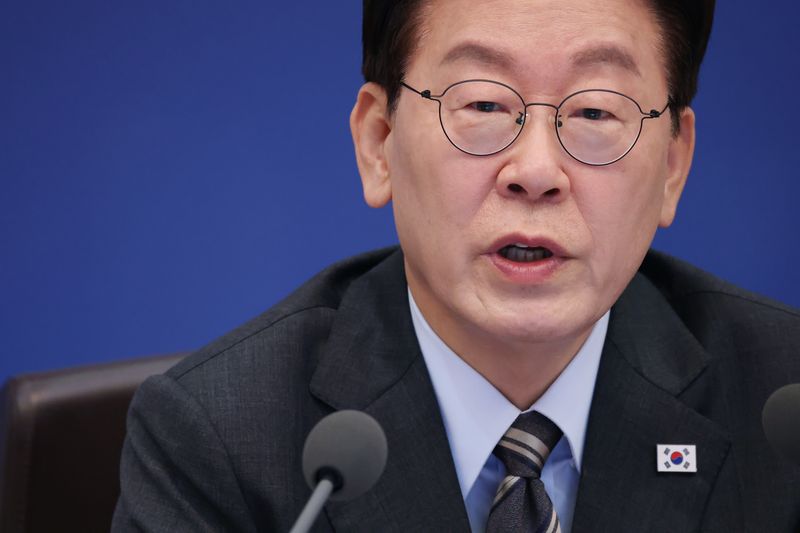
[Financial News] President Lee Jae Myung has publicly sought input on introducing a mandatory tender offer system to protect the rights of ordinary shareholders during corporate mergers and acquisitions (M&A). The aim is to design a reasonable system that safeguards minority shareholders’ rights while maintaining momentum in corporate restructuring and the M&A market.
On the 28th, President Lee posted on X (formerly Twitter) under the title “Seeking discussion and opinions on the mandatory tender offer system,” asking, “What would be a balanced solution for introducing a mandatory tender offer system?”
President Lee said, “There has been active discussion recently about a mandatory tender offer system to protect the rights of ordinary shareholders in corporate mergers and acquisitions (M&A). However, considerable concern and practical questions are being raised both inside and outside the market over the specific purchase ratio and method in the detailed legislative proposal.”
In particular, he spelled out the issues surrounding the required purchase ratio and method.
President Lee said, “Some argue that purchases of ‘50% plus one share’ should be mandatory, including the controlling shareholder’s stake, and that minority shareholders’ stakes should also be allocated fairly to guarantee their right to sell. But in that case, the controlling shareholder handing over control may be unable to sell their entire stake and would have to dispose of the remaining shares at market prices.”
He added, “That naturally reduces controlling shareholders’ incentive to sell, prompting concerns that corporate restructuring and sound M&A activity could be stifled. On the other hand, requiring the acquirer to purchase 100% of the shares would impose an excessive financial burden, creating a dilemma in which the rate of deals that are successfully completed would fall significantly.”
He also stressed the importance of finding a balance.
President Lee expressed concern, saying, “The principle of equal treatment of shareholders is important, but if excessive regulation undermines efforts to improve companies’ fundamentals and the vitality of the capital market, it may not benefit minority shareholders in the long run.”
He also noted, “There is a middle-ground proposal to require the purchase of 50% plus one share to promote M&A, while having the acquirer purchase the controlling shareholder’s entire stake and allowing minority shareholders to request the purchase of only the remaining shares on a pro rata basis.”
President Lee stressed, “This is a time when we need the wisdom of people from all walks of life to determine how high to set the required purchase ratio and how to meaningfully reconcile the interests of controlling and minority shareholders.”
He added, “What do you think would be the most reasonable balance—one that genuinely protects minority shareholders’ rights without sapping momentum from the M&A market? I would like to hear your considered views.”
The mandatory tender offer system was introduced to protect the interests of minority shareholders. Its purpose is to ensure that ordinary shareholders also have the opportunity to sell their shares during a corporate takeover.
An amendment to the Financial Investment Services and Capital Markets Act, which previously passed the National Assembly’s National Policy Committee, requires anyone who acquires at least 25% of a listed company’s shares and becomes its largest shareholder to purchase up to ‘50% plus one share’ of all shares, including the stake already acquired.
However, backlash is growing over the provision allowing an acquirer to first buy the controlling shareholder’s stake off-market, a practice known as a ‘prior purchase.’ Critics say it will create unequal opportunities to sell between controlling shareholders and ordinary shareholders.
[email protected] Choi Jong-geun Reporter