Deepnoid builds foundation for advancing medical AI by training on lesion locations from radiology reports
- Input
- 2026-10-28 10:17:36
- Updated
- 2026-10-28 10:17:36
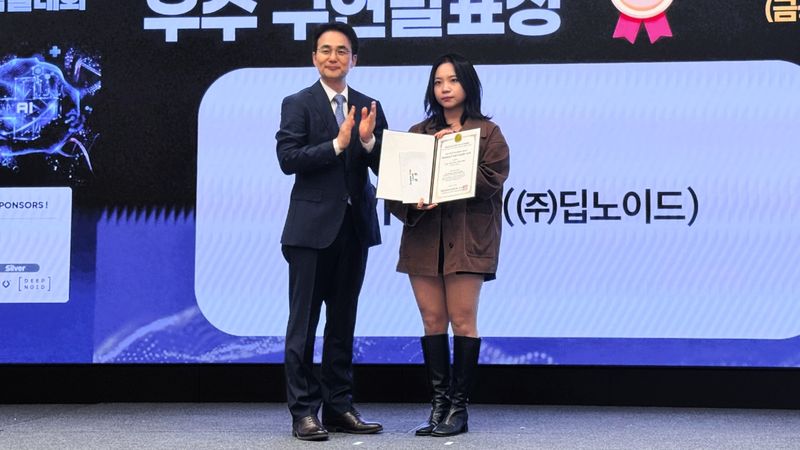
[Financial News] Deepnoid, a company specializing in medical AI, has laid the groundwork for advancing its diagnostic solutions with AI technology that connects radiology reports to medical images and identifies the locations of abnormal findings. The technology can be trained without data in which lesion locations have been individually annotated on images. The company aims to improve the diagnostic accuracy of its medical AI and its ability to show the basis for its decisions.
According to Deepnoid on the 28th, its research on the vision-language AI technology ‘GLINT’ won the Best Oral Presentation Award at KoSAIM 2026, the annual conference of the Korean Society of Artificial Intelligence in Medicine, which concluded on the 24th. Research in brain magnetic resonance imaging (MRI) and pathology also received Excellence Poster Awards.
The key is a training method that connects sentences in radiology reports to the corresponding areas in images. GLINT learns both whether a finding is present and where it is located using only radiology reports. It can then detect abnormal findings in chest X-rays and computed tomography (CT) images and highlight the areas that support its decisions.
A key feature is that medical professionals can check the relevant areas in an image alongside the AI’s diagnostic results. Deepnoid said GLINT outperformed existing models across comparative evaluation tasks and also demonstrated strong performance as a foundation model for a range of medical imaging AI tasks.
The company believes GLINT can be used as a foundational technology to improve the diagnostic accuracy and explainability of ‘M4CXR’ and ‘M4CT.’ It is focused on translating performance demonstrated at the research stage into functional improvements to real-world diagnostic solutions.
Lee Seong-eun, a researcher at Deepnoid’s AI Research Institute who presented the research, said, “When AI shows the areas underlying its decisions, medical professionals can trust and use it more. We will continue research to develop medical imaging-based models that improve diagnostic accuracy and technologies that show the basis for decisions, and apply them to real-world diagnostic solutions.”
Meanwhile, Deepnoid also made progress in brain MRI and pathology. A study that used a foundation model to improve the segmentation of white matter hyperintensity (WMH) lesions in brain MRI, and ‘STREAM,’ a technology for generating high-quality pathology images, received Excellence Poster Awards. Deepnoid presented a total of seven research abstracts in chest imaging, brain MRI and pathology at the conference.
Deepnoid CEO Choi Woo-sik emphasized, “We will connect research achievements validated by academia to services used in real-world diagnostic settings and strengthen our competitiveness as an agentic AI-based healthcare services company.”
An industry source in medical AI added, “For medical AI, it is important not only to be accurate but also to let medical professionals see the basis for its decisions. The key will be whether Deepnoid can implement its future research achievements in actual products.”
[email protected] Kim Gyeong-a Reporter