Bonghwa County plans to build a “Vietnamese village” with 347.6 billion won in taxpayer money... Petition calls for scrapping project: “Is that the right way to spend the money?”
- Input
- 2026-10-28 11:12:31
- Updated
- 2026-10-28 11:12:31
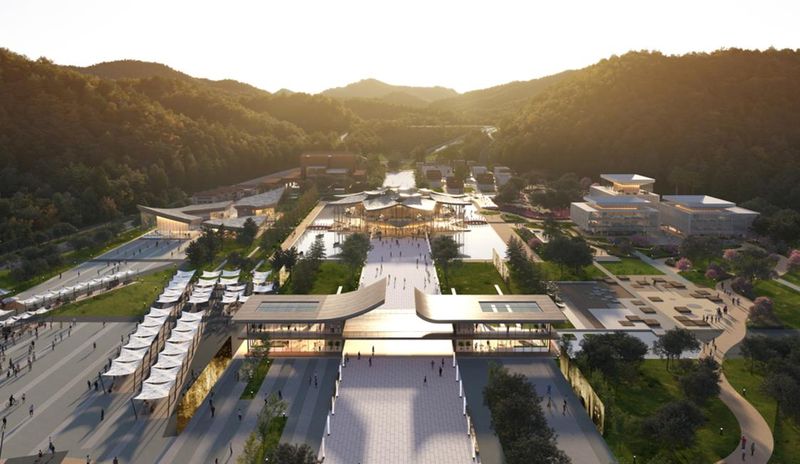
[Financial News] Gyeongbuk Province’s Bonghwa County, facing population decline and the risk of regional extinction, is moving ahead with a 347.6 billion won project to create the “Bonghwa K-Vietnam Valley Special Zone,” prompting expected controversy over the appropriateness of such large-scale public spending. Although the project aims to boost the local economy and attract tourists, critics say it needs close scrutiny to determine whether it is appropriate for a local government in poor fiscal condition to spend a huge budget on a development project centered on the history and culture of a particular foreign country.
National petition follows Ministry of SMEs and Startups’ designation of “Bonghwa K-Vietnam Valley Special Zone”
On August 6, the Ministry of SMEs and Startups held the 60th Regional Special Development Zone Committee meeting and newly designated Bonghwa County’s “Bonghwa K-Vietnam Valley Special Zone.” The zone is a project to create an international-exchange tourism hub by drawing on the historical background of Prince Lee Yong-sang of Vietnam’s Ly dynasty, who came to the Korean Peninsula during the Goryeo period, and whose descendants later settled in Bonghwa. The plan is to respond to the threat of regional extinction by increasing the number of tourists and people staying in the area.
In connection with the designation, a petition calling for the revocation of the Bonghwa K-Vietnam Valley Special Development Zone designation and the scrapping of related projects was posted on the National Assembly of the Republic of Korea’s e-Petition board on the 1st.
Petitioner A began by saying of the project, “It is creating facilities centered on the history and culture of a particular foreign country while also applying regulatory exemptions related to the residence of foreign workers and the provision of housing, among other things.”
He stressed, “I am not opposed to foreigners or Vietnamese culture itself,” and said forcefully, “If a project is funded with taxpayers’ money and local government finances, it must be rigorously assessed whether large-scale development targeting a particular country and support for settlement are really fundamental solutions to regional decline, and whether the project is sufficiently necessary and economically viable to warrant such massive spending.”
A first raised concerns about the appropriateness of large-scale public spending and the resulting fiscal burden. He explained, “Bonghwa County plans to invest a total of 347.6 billion won from 2026 to 2030 to build the ‘K-Vietnam Valley.’ This is a large-scale project funded by 105.1 billion won from the national government, 27.7 billion won from the provincial government, 170.1 billion won from the county, and 44.7 billion won in private investment. A total of 112.7 billion won has already been spent.”
He continued, “The question is why, of all things, a large-scale regional development project centered on the history and culture of a particular foreign country lies at the heart of a project receiving such enormous funding,” adding, “There needs to be a thorough assessment of whether spending local government funds amounting to 170.1 billion won from the county alone is consistent with residents’ needs and budgetary priorities in a local government facing population decline and difficult fiscal conditions.”
Second, he raised the issue of responding to regional depopulation and the distortion of spending priorities.
He said, “The most urgent task in depopulating areas like Bonghwa is to keep existing residents from leaving and create the conditions for young people to work and live in the area,” adding, “Taxpayers’ money is limited. If 347.6 billion won can be invested, the first thing to consider should be ways to use it to directly improve the lives of Bonghwa residents, including jobs and housing for local young people, support for childbirth and child-rearing, development of local industries, and improvements to healthcare and transport infrastructure.”
Third, he pointed to the granting of special exemptions to foreigners and the lack of policy justification.
A said, “This project includes not only education on the history of the Ly dynasty and Korean-Vietnamese cultural exchanges, but also support for Vietnamese migrants settling in the area and regulatory exemptions related to foreign workers’ residence and housing provision. This is not simply a tourism project introducing Vietnamese history and culture; it is a policy under which the national and local governments use public funds to establish a basis for residence and settlement for nationals of a particular foreign country.” He questioned, “Has public consent been obtained for developing a region centered on a particular foreign culture using public funds and for supporting residence and settlement?”
Citing the collapse of Gangwon Province’s “Korea-China Cultural Town” project, petitioner calls for rigorous scrutiny
Finally, he expressed concern about uncertain tourism demand and the long-term fiscal burden.
He criticized the project, saying, “Given that 347.6 billion won is being invested, it is also necessary to examine whether there will actually be demand from tourists. There has been insufficient objective assessment of how many domestic and international tourists will visit the Vietnam-related facilities built in Bonghwa, or whether they can generate steady operating revenue.”
He continued, “In the past, Gangwon Province’s ‘Korea-China Cultural Town’ project was described by the province as being pursued with 100% private capital. Nevertheless, it failed to gain public support and was scrapped after 670,000 people backed the ‘Petition Against Gangwon Province’s Chinatown.’ All the more, this project, which involves at least 300 billion won in public funds, must undergo even more rigorous scrutiny. Once built, large-scale facilities incur ongoing maintenance and management costs, and if they fall short of expectations, the entire fiscal burden will ultimately fall on local government finances, local residents, and the public,” he pointed out.
The petition will remain open until the 31st, and as of the morning of the 28th, 24,782 people had signed it.
Domestic reactions to the project have generally been negative. The reason is clear: according to crime-rate figures for foreign nationals residing in South Korea published on the National Police Agency’s statistics website last year, Vietnamese nationals ranked second at 11.5% (305,936 people), behind Chinese nationals at 36.2% (958,959 people). The prevailing reaction is to question whether it is appropriate to spend huge sums of taxpayers’ money to build a village for nationals of a particular foreign country and provide special support for their settlement.
A minority, however, argued that “the very attempt to develop new tourism resources in areas with declining populations should be viewed positively” and that “new approaches that break from conventional methods are also needed to prevent regional depopulation.”
[email protected] Ahn Gaeul Reporter