“Winter in the morning, fall by day” ... a 15°C day-night temperature gap, with rain expected tomorrow
- Input
- 2026-10-28 09:20:21
- Updated
- 2026-10-28 09:20:21
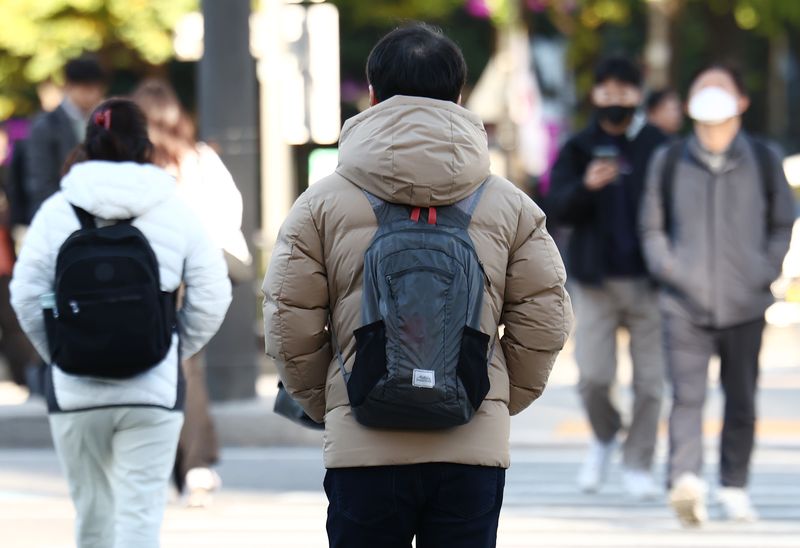
On the 28th, morning temperatures in most parts of the country fell by around 10°C from the previous day, bringing early-winter cold. Temperatures dropped below freezing in northern Gyeonggi and the inland and mountainous areas of Gangwon State, among other places, while ice and frost were observed in some central inland areas. Temperatures are expected to rise to 11–17°C during the day, but the day-night temperature gap is forecast to widen to as much as 15°C, particularly inland.
According to weather information issued by the Korean Meteorological Administration at 6:20 a.m. that day, the minimum temperature by 6 a.m. was -6.4°C at Seoraksan, -5.0°C in Dunnae, Hoengseong County, Gangwon State, and -3.4°C in Baekhak, Yeoncheon County, Gyeonggi. The temperature at Seoul’s official observation station also fell to 3.8°C, while -1.1°C was recorded in Eunpyeong, Seoul.
With cold wave advisories in effect in most parts of the country, the Korean Meteorological Administration forecast that they would be lifted during the morning. However, it expected below-freezing cold to continue in some inland areas on the 29th.
Skies will be mostly clear nationwide that day. Daytime highs in major cities are forecast to be 13°C in Seoul, 12°C in Incheon, 13°C in Suwon, 14°C in Chuncheon, 13°C in Gangneung, 13°C in Cheongju, 14°C in Daejeon and 12°C in Seosan.
In the southern regions, temperatures will rise to 14°C in Jeonju, 15°C in Gwangju, 14°C in Mokpo, 16°C in Yeosu, 15°C in Daegu, 14°C in Andong, 17°C in Busan, 16°C in Ulsan and 16°C in Changwon. Jeju and Seogwipo are forecast to reach 17°C and 18°C, respectively.
Daytime temperatures will be lower than the seasonal average highs of 16–21°C. In particular, the day-night temperature gap is expected to widen to 10–15°C through the 29th, especially in inland areas nationwide.
The Korean Meteorological Administration urged people to take care of their health amid sharp temperature changes and to prevent cold damage to crops. Caution is also needed to prevent fires caused by the use of heating appliances such as heaters and electric heating pads.
Rain is expected in places across the country starting on the 29th. It will begin that afternoon in the capital region, the inland and mountainous areas of Gangwon State, and South Chungcheong, then spread at night to the rest of the Chungcheong region, northwestern North Jeolla and Jeju.
The rain will spread to most parts of the country on the 30th, then mostly stop by dawn in the central regions and by morning in the southern regions and Jeju.
Expected precipitation for the 29th and 30th is 5–20 mm in Incheon, northern Gyeonggi and the Five West Sea Islands, and 5–10 mm in Seoul, southern Gyeonggi, the inland and mountainous areas of Gangwon State, Daejeon, Sejong, South Chungcheong, North Jeolla, Gwangju, South Jeolla and Jeju. Around 5 mm is expected in North Chungcheong, and less than 5 mm in Daegu, North Gyeongsang, Busan, Ulsan and South Gyeongsang.
Caution is also advised because of strong winds and high waves. The Korean Meteorological Administration forecast strong winds in most parts of the country and high waves in most seas through the 28th.
[email protected] Lee Bomi Reporter