Nationwide agricultural employment fell by 87,000, but Jeju added 6,000
- Input
- 2026-10-28 09:14:14
- Updated
- 2026-10-28 09:14:14
【Financial News Jeju = Reporter Jeong Yong-bok】 Nationwide agricultural employment fell by 87,000 in April this year, while Jeju saw an increase of 6,000. A total of 29.5% of employed people in Jeju worked in agriculture, social welfare services, and restaurants and bars, 10.5 percentage points higher than the nationwide share in those same industries, at 19.0%.
According to the “Characteristics of Employed People by Industry and Occupation in the 2026 First-Half Regional Employment Survey,” released the previous day by the National Data Agency, 414,000 people were employed in Jeju, up 14,000 (3.6%) from April last year. Nationwide employment totaled 28.961 million, an increase of 74,000 over the same period.
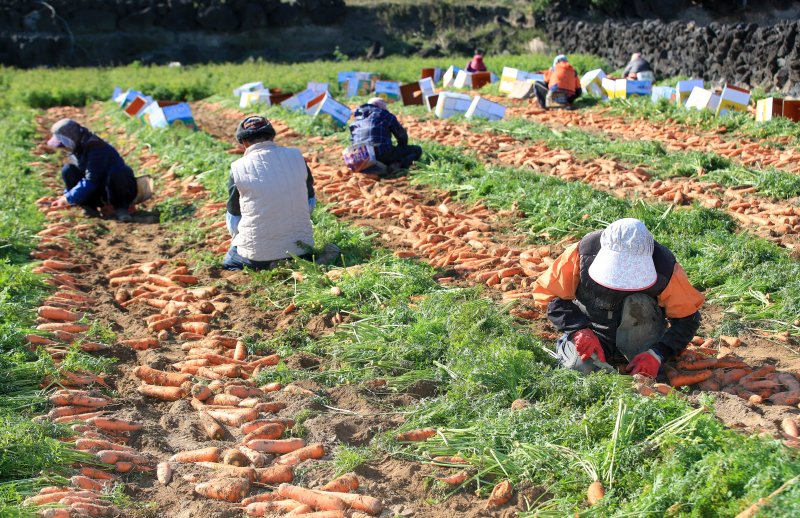
By industry, agriculture had the largest number of employed people in Jeju, at 46,000, accounting for 11.2% of total employment. This was up 6,000 from the same period last year, while agriculture’s share of employment also rose by 1.1 percentage points.
Nationwide agricultural employment stood at 1.27 million, down 87,000 from a year earlier. Agriculture accounted for 4.4% of total nationwide employment, 6.8 percentage points lower than in Jeju. Jeju’s industrial structure, where the share of people working in agriculture is 2.5 times the national average, was also clearly reflected in employment changes.
Social welfare services employed 38,000 people in Jeju, up 8,000 from a year earlier. The industry accounted for 9.2% of total employment, a rise of 1.8 percentage points in a year. Its employment increase exceeded that of agriculture, making it the industry with the largest gain among Jeju’s major industries.
Nationwide, employment in social welfare services also rose by 172,000 to 2.102 million. In particular, employment in the operation of non-residential social welfare facilities—which includes workers at home-visit care services and day-care facilities—increased by 155,000. As employment in health and care continued to expand nationwide, the share of social welfare services employment also grew in Jeju.
Employment in restaurants and bars in Jeju totaled 38,000, up 2,000 from a year earlier. The industry’s share of total employment rose by 0.3 percentage points to 9.1%. Nationwide, employment in the same industry fell by 23,000 to 2.121 million, a different trend from Jeju.

Agriculture, social welfare services, and restaurants and bars are industries that employ about three out of every 10 people in Jeju. Their higher share than the national average can be seen as reflecting a combination of Jeju’s agricultural base, its tourism- and food-service-centered industrial structure, and expanding employment in social welfare.
Similar characteristics emerged in the occupational analysis. The most common occupation in Jeju was skilled agricultural and livestock work, with 44,000 people (10.6%). The number rose by 7,000 from a year earlier, and its share increased by 1.3 percentage points. This contrasts with a nationwide decline of 84,000 in employment in skilled agricultural and livestock work. Next came cooks and food service workers, numbering 34,000 (8.3%), up 3,000. Sales and rental of goods in stores employed 31,000 people (7.5%), an increase of 2,000.
Industry statistics classify employed people by the type of business establishment where they work, while occupation statistics are based on the work they actually perform. People who may fall into both categories, such as agricultural workers and skilled agricultural and livestock workers, should not be added together.
However, whether the increase in employment in Jeju translated into an expansion of stable wage-paying jobs requires separate consideration. In employment trends for Jeju based on the same April, released by the National Data Agency in May, the number of regular employees was 187,000, down 7,000 from a year earlier. By contrast, temporary workers numbered 81,000, up 13,000, while the number of self-employed people also rose by 10,000 to 110,000.
Regular employees are workers whose employment contracts last at least one year or who work continuously without a fixed contract period. Temporary workers generally have contracts lasting at least one month but less than one year. The number of employed people increased, but changes differed by employment status. That is why it is necessary to examine the actual employment conditions of the additional workers in agriculture, care, and food service.
[email protected] Jeong Yong-bok Reporter