“I Lost My Life, Not Money” ... Psychiatrist’s Confession After Losing 300 Million Won Saved Over 15 Years [Health Talk]
- Input
- 2026-10-28 09:31:55
- Updated
- 2026-10-28 09:31:55
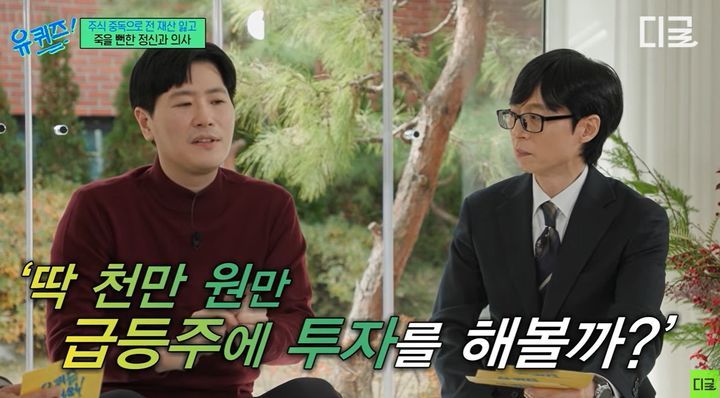
[Financial News] As volatility in the stock market has intensified recently, more people are reporting distress over asset losses from buying at market peaks and subsequent sharp drops. Cases are surging of people swept up in so-called “FOMO (fear of missing out) syndrome” who take on excessive debt to invest and trade with leverage, then experience depression and addictive symptoms so severe that they cannot manage daily life. Amid this trend, a psychiatrist’s account of his own harrowing struggle and recovery is drawing attention.
According to Newsis on the 28th, psychiatrist Park Jong-seok, who works in South Korea as a specialist in treating stock trading addiction, recently spoke on TV and through YouTube channels about how he once lost his entire fortune of more than 300 million won in stocks and even had suicidal thoughts. He also warned of the destructive mechanisms through which stock addiction affects the brain.
Dr. Park’s suffering began with “beginner’s luck.” Shortly after qualifying as a specialist, he invested 30 million won in Samsung Electronics and made an 80% return in just five months—a success that proved to be his undoing. Intoxicated by the thrill of success, he increased his investments by drawing on an overdraft credit line and loans for doctors. Later, after going all in on SK Innovation and suffering a plunge amid bad news, he also lost money on failed investments in U.S. presidential election stocks and delistings, ultimately losing 79% of his assets (about 320 million won). When the money he had scrimped and saved for 15 years vanished, he experienced trembling so severe that he could not even hold a computer mouse, along with symptoms of panic disorder that he had seen in his patients.
He recalled suffering profound depression and a crisis so severe that he sat on the window ledge of his officetel and called acquaintances in the early hours of the morning, saying, “I was tormented by a sense of deprivation and self-reproach, feeling that I had lost not money but my entire life.” He added, “Thanks to a friend who came by every day, knocked on my door and made sure I ate, I was just barely able to hold on.”
Medically, the mental distress caused by stock market losses goes beyond simple psychological discouragement. Dr. Park explained that falling share prices and sharp fluctuations continually stimulate the brain’s amygdala, causing excessive secretion of the stress hormones cortisol and catecholamines. When this process becomes chronic, the sympathetic nervous system becomes overactive, leading to insomnia, chronic indigestion and weakened immunity. It also becomes harder to regulate emotions, resulting in aggressive behavior toward people nearby. This ultimately creates a vicious cycle in which both personal relationships and concentration at work break down.
Dr. Park emphasized in particular that “stock market depression” and “stock addiction” should be distinguished. Depression is a state of depleted energy and listlessness, he explained, whereas stock addiction is a “dysfunction in the dopamine reward circuit” that drives people to keep watching stock price screens and repeatedly placing bets in an attempt to escape anxiety and a painful reality. People with adult ADHD traits, or those who are dopamine-sensitive and generally enjoy instant stimulation and betting, are more susceptible to addiction.
Physical separation from trading is considered the first step toward escaping the grip of stock addiction and depression. Dr. Park advised, “Delete brokerage apps from your smartphone without hesitation, and deliberately make your login password complicated and enter it incorrectly so that you block access to trading.”
It is also essential to keep a household ledger and an emotion journal to help the brain regain a normal reward system, and to build small, tangible sources of satisfaction in everyday life through one’s main job and regular meals and sleep.
Dr. Park emphasized, “Life does not suddenly turn around with a single trade,” adding, “Rather than hoping for a windfall in an uncertain market, remember that the most reliable blue-chip stock with the greatest growth potential in the world is ‘yourself,’ and invest in yourself first.”
[email protected] Moon Young-jin Reporter