“Israeli opposition to form coalition with Arab party” ... What are the scenarios for forming a government after Israel’s razor-thin election?
- Input
- 2026-10-28 08:22:56
- Updated
- 2026-10-28 08:22:56

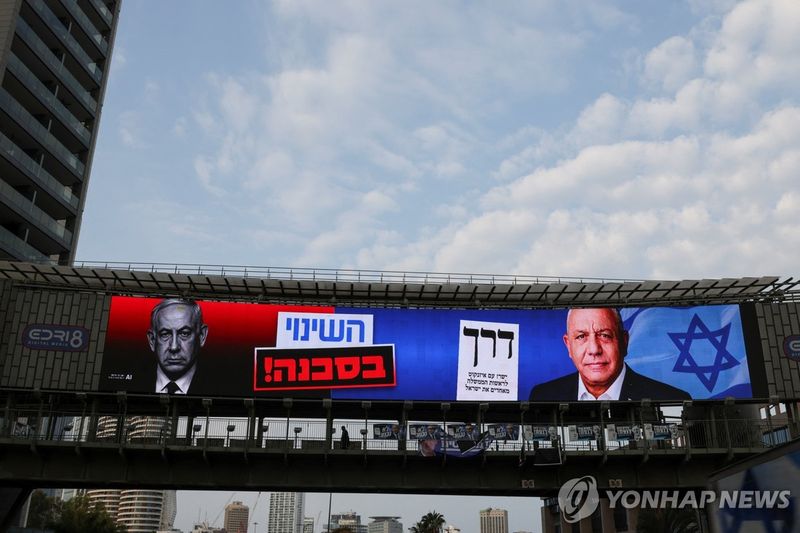
[Financial News] Exit polls in Israel’s general election on the 27th (local time) forecast an extremely close race between the right-wing bloc led by Prime Minister Benjamin Netanyahu and the opposition camp of former military chief of staff Gadi Eisenkot. The anti-Netanyahu camp was shown narrowly ahead in the exit polls.
Major broadcasters said, “Anti-Netanyahu parties are expected to win 52–53 seats, while pro-Netanyahu parties are expected to win 50.” This means neither camp has a majority.
As a result, intense negotiations to form a coalition government are set to begin as the parties seek to form a new government. Several scenarios are emerging. One possibility is that four Jewish opposition parties join with Arab parties to form a coalition, giving them a clear majority of 66–72 seats and defeating the Netanyahu camp.
The key variable is whether conservative-leaning opposition leaders will accept a coalition with Arab parties.
Even if the opposition secures a majority, deep ideological differences within the bloc could result in a short-lived government, like the Naftali Bennett–Yair Lapid coalition in 2021.
An Eisenkot-led “minority government” takes shape
Even if the opposition falls short of the 61 seats needed for a majority, it could form a minority government with “external support” from Arab parties if it wins more seats than the Netanyahu camp.
This scenario is based on the legal provision that allows a government to take office as long as it receives more votes in favor than against in a parliamentary confidence vote. Arab support would also be essential in this case.
There was a precedent under the governments of Yitzhak Rabin and Shimon Peres in the 1990s, but the challenge would be overcoming fierce opposition from right-wing lawmakers.
The unstable arrangement’s reliance on outside forces could also lead to defections to the Netanyahu camp.
Formation of a broad-based, neutral cabinet
Concerned about political paralysis, the president could also mediate the formation of a broad-based unity government between the two camps while assigning the mandate to form a government.
Eisenkot is currently firmly opposed to forming a coalition with Netanyahu, making a voluntary agreement highly unlikely.
There is also the painful precedent of 2020, when Benny Gantz, then defense minister, formed a rotating government with Netanyahu, only for the coalition to collapse before Gantz could take over as prime minister.
However, if a national security crisis—such as an armed conflict with Iran—escalates before or after the election, mounting pressure to form a broad-based cabinet in the name of national security could rapidly change the political landscape.
If coalition government talks fail ... Parliament dissolved, new election follows
If the parties fail to reconcile their differences and all legally prescribed deadlines for forming a government expire, parliament will be dissolved and a new election campaign will begin. This is the scenario most favorable to Prime Minister Netanyahu and a major concern for the opposition, which polls show holding a narrow lead.
Even if he fails to secure a majority, Prime Minister Netanyahu can extend his tenure by remaining prime minister of a caretaker government until a new government is formed.
Israel also held four elections over two years starting in 2019, as repeated attempts to form a coalition failed, and Netanyahu remained in office as caretaker prime minister.
Political maneuvering to form a coalition ... The president assigns the mandate to form a government
Israel’s general election uses a fully proportional representation system: voters cast ballots for parties rather than directly electing the prime minister. Once the official count is complete, President Isaac Herzog consults the leaders of the parties that won seats in parliament and gives the mandate to form a government to the lawmaker most likely to succeed.
The leader of the party with the most seats may be given the first opportunity to form a coalition. But a leader whose party has fewer seats may get the first chance if they can secure greater support from other parties.
The first candidate designated to become prime minister must form a coalition government within 28 days, with the option of a 14-day extension.
If that attempt fails, the president gives another candidate 28 days. If that effort also fails, at least 61 lawmakers can, submit their signatures to ask the president within 21 days to nominate a third person.
Under Israeli law, a parliamentary confidence vote does not require an absolute majority of 61 votes in favor; a government can take office as long as it receives more votes in favor than against. If no government wins a confidence vote by the set deadline, parliament is automatically dissolved.
[email protected] Lee Seok-woo, International Affairs Correspondent Reporter