Guryong Village fire fully extinguished after 13 hours; 107 affected
- Input
- 2026-10-28 07:19:11
- Updated
- 2026-10-28 07:19:11
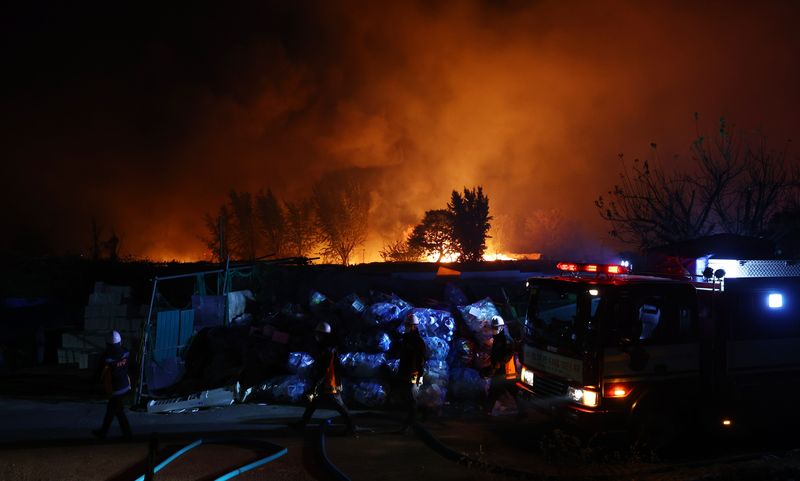
[Financial News] A large fire that broke out in Guryong Village, Gaepo-dong, Gangnam District, Seoul, was fully extinguished after about 13 hours of overnight firefighting. Fanned by strong winds, the fire spread to several zones in the village and nearby Guryongsan Mountain, affecting 107 residents and injuring one woman in her 30s.
Fire authorities said on the 28th that the blaze, which started in a makeshift building in Zone 2 of Guryong Village at around 3:50 p.m. the previous day, was fully extinguished at around 4:39 a.m. that day. It took 12 hours and 49 minutes from the outbreak of the fire. After fully extinguishing it, fire authorities lifted the Level 1 response and began clearing the scene.
From the previous afternoon, strong winds quickly spread the flames to the adjacent Zones 1, 3 and 7. The fire also spread to Guryongsan Mountain behind the village, widening the area where firefighters had to work. After containing the main blaze at around 2:21 a.m. that day, fire authorities focused on extinguishing remaining hotspots and put out all the flames that had spread to Guryongsan Mountain.
A total of 110 pieces of equipment, including six helicopters, and 232 firefighting personnel were deployed to the scene. However, as night fell, the use of helicopters for firefighting was limited, and strong winds and a shortage of firefighting water made the work more difficult. As the flames spread in several directions, firefighters had to battle the blaze through the night.
Fire authorities issued a Level 1 response at 3:59 p.m. the previous day, shortly after receiving the fire report. When the flames later spread to the surrounding area, they raised the alert to Level 2 at 4:29 p.m. At around 10:05 p.m., they judged the risk of further spread to be low and lowered the response level to Level 1.
Fortunately, casualties were limited. One woman in her 30s sustained a minor leg injury, and no other injuries or deaths have been confirmed so far. Thirty-nine residents evacuated on their own to escape the fire.
Damage to homes was concentrated in Zones 1, 2 and 3 of the village. A total of 107 people from 77 households were affected. Gangnam District authorities set up temporary shelters for residents unable to return home at the gymnasiums of Gaepo Middle School and Guryong Middle School, as well as at nearby lodging facilities.
During the fire, large plumes of black smoke billowed from the scene and could be seen even in distant areas such as Dobong-gu in Seoul and Anyang, Gyeonggi Province. Residents near the village said they heard several loud noises, like gas cylinders exploding, as the fire spread. However, the exact cause of the loud noises has not been determined.
After being briefed on the fire the previous day, President Lee Jae-myung ordered that all available firefighting resources be mobilized to battle the blaze. He specifically called for every effort to be made to rescue residents living in the village and ensure their safety.
Guryong Village is an informal settlement formed in the 1970s and 1980s as people displaced by demolitions and others who lost their homes amid development in Seoul's Gangnam area moved there. As urban development across Gangnam gathered pace ahead of the Seoul Olympics, people flocked to the area, which later became a sprawling shantytown. The village covers an area equivalent to about 40 soccer fields and is divided into eight zones.
The village is densely packed with homes built from combustible materials such as plastic sheeting, plywood and so-called “tteoksom,” insulating cotton. The buildings are close together and the passageways are narrow, making it easy for flames to spread to neighboring homes if a fire breaks out. In some areas, even fire engines have difficulty getting in, hampering initial firefighting efforts.
Liquefied petroleum gas (LPG) cylinders and tangled electrical wires are also considered factors that make fires harder to fight. In residential areas densely packed with combustible building materials, strong winds can cause a fire to spread to multiple homes in a short time. The previous day's fire likewise spread to several zones on the wind, prompting authorities to raise the response to Level 2.
A major fire also broke out in Guryong Village early this year. On January 16, a fire that started in Zone 4 spread to nearby Zones 5 and 6, forcing 258 residents to evacuate. The flames also spread to surrounding areas then because of the village's structural characteristics, with homes packed closely together.
[email protected] Jeong Ji-woo Reporter