Likud’s Netanyahu expected to get first chance to form government ... Coalition formation within six weeks
- Input
- 2026-10-28 07:07:53
- Updated
- 2026-10-28 07:07:53
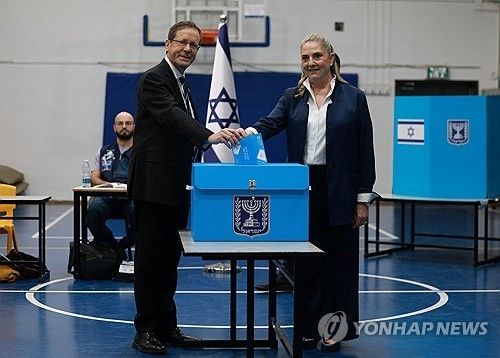
[Financial News] Israel’s general election was held on the 27th (local time), more than three years after the previous one. With exit polls showing that no party had secured a majority, it is expected to take anywhere from a month to more than six weeks to determine whether power will change hands.
The election to form the 26th Knesset (Israel’s parliament) concluded that day, but exit polls showed that the anti-Netanyahu and pro-Netanyahu camps had won nearly even shares of the vote, making it difficult to tell which was ahead.
Exit polls generally showed Likud winning the most seats, but neither camp secured a majority (61 seats) in the 120-seat parliament, raising the prospect of difficulty in forming a government.
Under Israeli law, the next prime minister and cabinet must win a parliamentary vote to take office, and a majority of all seats must vote in their favor.
After the election, President Isaac Herzog consults with the leaders of all the parties and asks the candidate most likely to form a coalition government to form a government.
Netanyahu of Likud, which is expected to become the largest party, is expected to get the first chance to form a government. However, if he fails to secure a majority within up to six weeks, another candidate will get a chance.
In the process, smaller parties that help secure a majority will be offered cabinet posts, budget support or specific policy backing.
Coalition with the largest party and Arab parties also emerges as a possibility
The Associated Press noted that, in theory, the Arab parties’ choices could determine the coalition. Both Prime Minister Benjamin Netanyahu and Gadi Eisenkot, the leader of Yashar, have ruled out the possibility of an alliance with them.
However, the Associated Press said the Arab parties could allow Eisenkot to form a minority government by supporting him from outside a coalition or abstaining in the Knesset vote to form the next government.
Analysts say that, as a result, it could take considerable time to determine whether Netanyahu will serve another term as prime minister or be replaced.
Meanwhile, according to The Times of Israel, a Channel 12 exit poll conducted just after voting ended showed that Likud, led by Prime Minister Benjamin Netanyahu, won 24 of the 120 seats, while Yashar, led by Netanyahu’s main rival, former military chief of staff Gadi Eisenkot, won 22. The anti-Netanyahu camp had 52 seats in total, compared with 50 for the pro-Netanyahu camp.
An exit poll by Israel’s public broadcaster Kan 11 showed the anti-Netanyahu camp with 53 seats and the pro-Netanyahu camp with 50. By party, Likud was projected to win 25 seats and Yashar 21.
Arab parties that oppose Netanyahu but do not belong to the Zionist “anti-Netanyahu” camp were expected to win 17 seats.
Likud’s lead over Yashar, contrary to polling over the past several months, could be considered an upset. But it had already been expected that there would be no clear winner.
If neither side secures a majority, a new election could be held within months
Israel has many smaller parties, making negotiations to form a complex coalition necessary after the election.
Moreover, some pre-election polls suggested that the Islamic alliance Joint List and the Ra’am party could win up to 9 and 6 seats, respectively, for a combined total of 15.
Neither Likud nor Yashar has so far been willing to form a coalition government with Islamic parties. This could make it even harder to assemble a majority of 61 seats in the 120-seat Knesset (parliament).
In Israel, which uses nationwide proportional representation, 38 groups submitted candidate lists for this election, including 37 parties and the Joint List.
Parties must receive more than 3.25% of the nationwide vote to enter parliament, so many will fail to win seats. However, both political camps are made up of a considerable number of parties.
If neither side secures a majority in negotiations, a new election could be held within a few months.
In any case, if a new coalition government is not formed following the election, Prime Minister Netanyahu can lead a caretaker government. However, he would not have the authority to implement major policy changes.
Arab parties representing 20% of the population could hold the balance of power
Palestinians who remained in Israel after the 1948 war surrounding the country’s founding, and their descendants, make up about 20% of Israel’s population.
They hold citizenship, including the right to vote. Because of their close family ties and support for Palestinians in the Gaza Strip and the West Bank, many Jewish Israelis view them with suspicion, the Associated Press reported.
The pro-Netanyahu and anti-Netanyahu camps are now expected to begin negotiations to form a coalition government. Netanyahu of Likud, which is expected to become the largest party, is likely to get the first chance to form a government. But if both sides fail to reach an agreement, Israelis may have to return to the polls in just a few months. Israel had to hold elections five times from 2019 to 2022 because of situations like this.
[email protected] Lee Seok-woo, international affairs correspondent Reporter