“Was D&A Not Enough?” Why Was Oh Se-hoon Acquitted on Appeal After Lee & Ko Joined?
- Input
- 2026-10-29 07:00:00
- Updated
- 2026-10-29 07:00:00
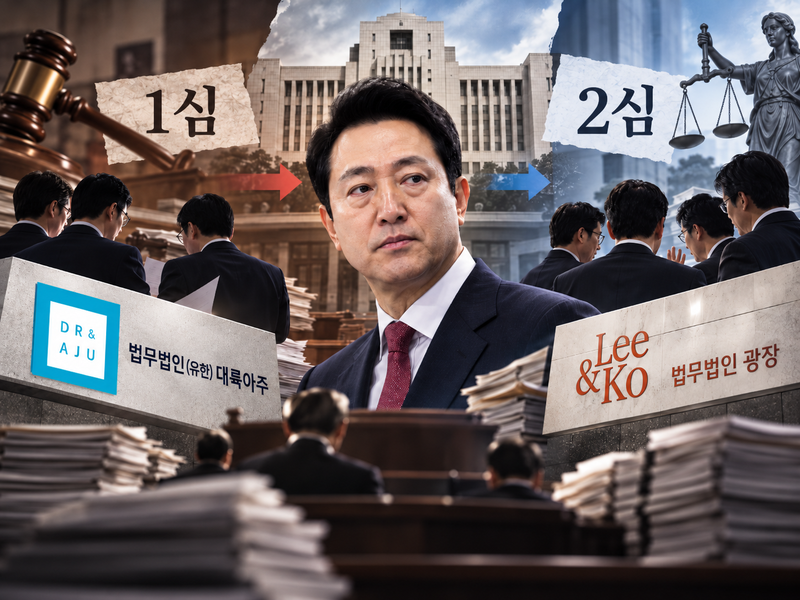
[Financial News] Attention is focused on the defense team’s expansion ahead of the appeal, after Seoul Mayor Oh Se-hoon’s case involving alleged violations of the Political Funds Act was overturned from a conviction in the first trial to an acquittal on appeal. Lee & Ko joined the case after the first-trial conviction, although D&A LLC had been involved from the investigation stage, and the appeal ended in the opposite result.
D&A involved in first trial that ended in conviction; Lee & Ko added to team; acquittal on appeal
According to legal sources on the 29th, the Seoul High Court’s Criminal Division 7, presided over by Judge Koo Hoe-geun, acquitted Mayor Oh and others on the 23rd in their appeal against charges of violating the Political Funds Act. Former Seoul Deputy Mayor for Political Affairs Kang Cheol-won and Kim Han-jeong, who were indicted alongside them, were also acquitted.
Earlier, on July 22, the Seoul Central District Court sentenced Mayor Oh and others to a fine of 10 million won and ordered the forfeiture of 21 million won in the first trial. It found some of the allegations that polling costs had been paid on his behalf to be proven.
The defense team changed after the first-trial ruling. D&A’s existing team remained in place, while lawyers from Lee & Ko joined the appeal as additional counsel.
The appeal ruling lists Lee & Ko lawyers Sung Chang-ho, Jang Jun-a, Ha Tae-han, Seo Dong-min, Yoon Byung-seo, Kim Jae-hwan, In Jae-seong and Park In-seo, as well as D&A lawyers Kim Dong-joo, Lee Yoon-jae and Hong Ki-young, as counsel for Mayor Oh.
With an acquittal following the addition of a major law firm to a case that had resulted in a conviction at the first trial, the reasons for expanding the defense team and any changes to its actual legal strategy have drawn attention.
D&A, however, said there had been no major changes to the core of the case or the direction of the defense after Lee & Ko joined. A D&A partner said, “There was not much difference between the defense strategies at the first trial and on appeal,” adding, “The substance was the same apart from the emergence of a new recording transcript.” The partner also said that the appeal’s different outcome hinged on how the court assessed the credibility of Myeong Tae-gyun’s testimony.
Regarding Lee & Ko’s addition to the team, the partner said it is not unusual on appeal to retain lawyers familiar with the case while bringing in additional personnel. “Sometimes new counsel are appointed to suit the panel. Since we [the D&A defense team] know the case so far, we move forward in a way that suits the panel,” the partner said, adding, “Then we add just a few new things.” The partner emphasized that “D&A had been involved in the case from the investigation stage,” but added, “I don’t know the specific reasons Lee & Ko was brought on.”
The partner also responded negatively when asked whether the atmosphere inside D&A had soured after the first-trial conviction. The point was that, based on the existing arguments, there had been reason to expect a different ruling on appeal.
Lee & Ko declined to explain its specific legal strategy in the case or the reasons it was brought on. After checking internally in response to this newspaper’s inquiry, a Lee & Ko representative said, “We ask for your understanding that we are unable to comment because the case is pending before the Supreme Court.”
Court’s finding that Myeong’s testimony was “unreliable” proved decisive
Indeed, the appeal ruling shows that the biggest difference between the first trial and the appeal lay in how the key evidence was assessed.
The first-trial court considered Myeong’s testimony, records of the transfer of polling data and circumstances surrounding Kim’s payments, among other things, and found part of the allegation that Mayor Oh had received polling costs paid on his behalf to be proven.
The appeals court, by contrast, found Myeong’s testimony difficult to accept at face value. It said Myeong had mixed facts personally experienced with speculation and exaggerations, and that some parts of the testimony conflicted with objective circumstances.
The appeal court also reviewed a recording transcript of a phone call between Myeong and Kim on March 6, 2021. Based on that recording and other evidence, the court focused on circumstances suggesting that Kim had tried to verify the details of conversations between Mayor Oh and Myeong without knowing what had actually been said.
The court also considered that Myeong had conducted opinion polls related to the Seoul mayoral by-election before making contact with Mayor Oh’s side, and had shared relevant materials with then-People Power Party emergency committee chair Kim Chong-in and others.
The court also found it difficult to conclude that Kim’s payments were for specific polling costs covered at Mayor Oh’s request. Ultimately, the appeals court overturned the portion of the lower court’s ruling that found Oh guilty, saying the evidence submitted by prosecutors did not establish the charges beyond a reasonable doubt.
The case has drawn attention because the appeal’s outcome was reversed after Lee & Ko joined the defense team.
D&A has said its defense strategy did not change significantly, while Lee & Ko has declined to provide details, citing the pending Supreme Court appeal. The defense team’s role and any changes in strategy behind the acquittal on appeal are expected to draw attention during the Supreme Court proceedings as well.
[email protected] Yoo Seon-jun Reporter