Inje County residents adopt resolution outside National Assembly; to deliver protest letter to Budget and Accounts Committee chair on the 28th
- Input
- 2026-10-27 17:40:33
- Updated
- 2026-10-27 17:40:33
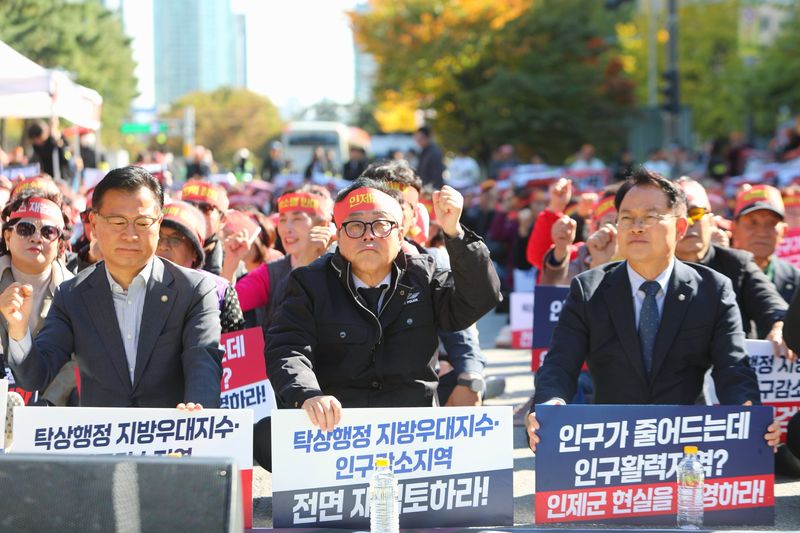
【Financial News, Inje = Kim Gi-seop, Staff Reporter】Angered by the government’s classification of Inje County in Tier 2 of the Local Preferential Treatment Index, residents staged a mass protest outside the National Assembly.
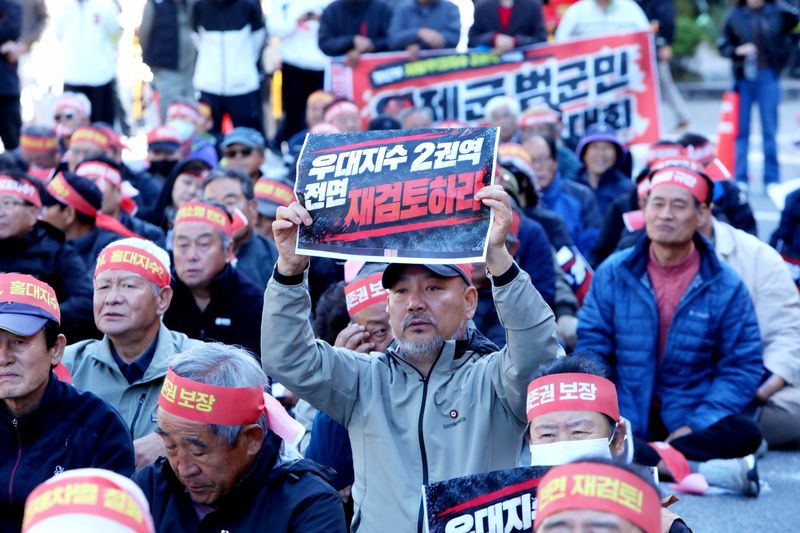
According to Inje County on the 27th, the emergency committee opposing the county’s designation in Tier 2 of the Local Preferential Treatment Index held a protest rally outside the National Assembly in Seoul that day. Residents first held a rally at Inje Grass Field at 9 a.m., with about 3,000 people gathering. Afterward, about 600 traveled to Seoul and, from 12:30 p.m., delivered a report on developments and protest remarks, read a resolution, and chanted slogans outside the National Assembly’s main gate. At the rally, Inje County Governor Choi Sang-gi, emergency committee chair Kim Do-hyeong, and Kim Geun-seong, head of the Inje County Village Heads’ Association, shaved their heads and called for the classification plan to be corrected. National Assembly member Lee Yang-su (Sokcho, Inje, Goseong and Yangyang) also attended.
The rally will continue on the 28th. At 1 p.m., about 200 people, including Governor Choi, Chair Kim, residents and members of civic groups, will gather again on the steps of the National Assembly building. Local civic group leaders will shave their heads, after which the group plans to deliver a protest letter to the chair of the National Assembly’s Special Committee on Budget and Accounts. The emergency committee plans to continue its long-term response after the rally, collecting a joint petition from residents and statements from civic groups and regularly submitting them to the government.
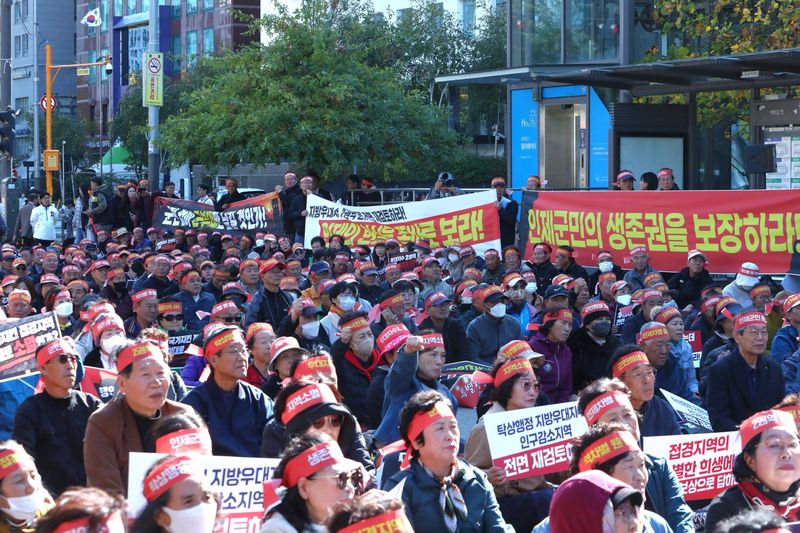
The backlash stems from a series of regional classification decisions by the Ministry of the Interior and Safety (MOIS). On the 7th, MOIS classified Inje County as a Population Vitality+ region in its re-designation of Depopulation Regions. Then, in the Local Preferential Treatment Index announced on the 20th, it placed Inje in Tier 2 alongside Chuncheon, Wonju, Gangneung and Sokcho. Inje County is the only county-level area in the province placed in Tier 2. When the index is fully implemented starting next year, government programs—including support for issuing Local Love Gift Certificates—will receive different levels of funding by tier. As new-child welcome grants could also be linked to the index in the future, the local community is concerned about disparities in financial support.
The county submitted a request for reconsideration of its Tier 2 designation in the Local Preferential Treatment Index that day, arguing that even the key indicator of distance from Seoul fails to account for actual accessibility. Inje County is 146 kilometers from Seoul in a straight line, similar to Cheongju (136 kilometers) and Sejong City (145 kilometers), but the trip takes 120 minutes by intercity bus, with no rail service. By contrast, those cities and Cheonan can reach Seoul in 40 to 80 minutes by high-speed rail, yet were classified in the same tier as Inje County.
The disparity is also clear when Inje is compared with areas of similar population size and conditions. Goesan County in North Chungcheong Province and Cheongyang County in South Chungcheong Province, each with a population of around 30,000, and Danyang County, with a population of 27,000, were all placed in Tier 3. Inje County ranks 151st among 167 cities and counties nationwide for regional underdevelopment, according to the KDI Public and Private Infrastructure Investment Management Center, the lowest ranking in the province. Its ranking is also worse than those of Hoengseong County (98th), Yeongwol County (107th), Hongcheon County (110th) and Yanggu County (121st), all designated Depopulation Regions.
Inje County argues that the populations of military personnel and their families create a statistical illusion that masks the actual risk of depopulation. Because moves into the county resulting from personnel transfers between military units are reflected in the net youth migration rate, Inje’s figure stood at 0.4%, far above Yanggu County’s -4.68% and Hwacheon County’s -4.28%.
However, the registered population fell by 1,529, from 32,165 at the end of 2021 to 30,636 this September. Over the same period, the annual average population change rate worsened from -0.79% to -1.03%, while the proportion of older residents rose from 18.8% to 24.1%.
The county also raised concerns about the design of the indicators. It said six population-related indicators are included in the Local Preferential Treatment Index’s balanced development indicators, while five are included in the Population Vitality Index used to designate Depopulation Regions, resulting in what is effectively a duplicate assessment. It also criticized the lack of transparency, noting that unlike the KDI Public and Private Infrastructure Investment Management Center, which discloses the weighting of each indicator when calculating regional underdevelopment, the balanced development indicators’ results and weights are not disclosed, making them difficult to verify.
Inje County recommended replacing the key indicators with regional social and economic indicators and incorporating transport infrastructure into the distance indicator. It also said overlapping restrictions—including military facilities, the Han River basin, Seoraksan National Park and forest protection zones—should be used as adjustment indicators.
In his protest remarks, emergency committee chair Kim Do-hyeong said, “If Inje ranks 151st nationwide for regional underdevelopment but is placed in the same tier as Chuncheon and Wonju, the government should come to Inje in person and explain the reason to county residents.” He demanded that the government “disclose all the data and scores used in the assessment, as well as every item that was included or excluded, and give us an answer on when and how it will correct the decision.”
In their resolution, residents said the administrative notice period had been set shorter than the standard 20 days, raising questions about whether local governments had been given sufficient opportunity to provide input. They called for the Tier 2 designation to be withdrawn, the calculation criteria to be comprehensively revised, scores for each indicator to be disclosed, and measures to prevent disadvantages to be implemented. Kim Geun-seong, who read the resolution, said, “Grouping Inje—which has no railway and requires a two-hour intercity bus ride to reach Seoul—with places that have urban infrastructure runs directly counter to the policy’s purpose of providing substantial support to underdeveloped areas.” He added, “We will use every lawful means to oppose this until the tier designation is corrected and the basis for the assessment is made public.”
[email protected] Kim Gi-seop Reporter