Kori Units 3 and 4 Approved for Continued Operation; to Operate Through 2034 and 2035
- Input
- 2026-10-27 16:45:57
- Updated
- 2026-10-27 16:45:57
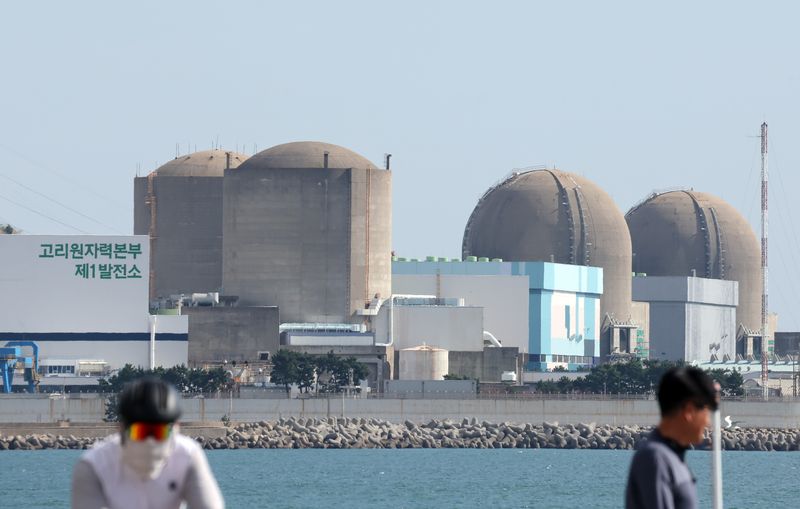
[Financial News] Gori Nuclear Power Plant Units 3 and 4 in Gijang County, Busan, which had shut down after reaching the end of their design lives, have received approval for continued operation. Unit 3 can operate until September 2034, and Unit 4 until August 2035.
The Nuclear Safety and Security Commission (NSSC) held its 17th meeting on the 27th and deliberated on and approved the plan to authorize continued operation of Gori Nuclear Power Plant Units 3 and 4. It reached a decision at its second meeting, following the first deliberation on the 15th. This is the second such approval, after Gori Unit 2, among the nuclear power plants for which Korea Hydro & Nuclear Power (KHNP) has applied for continued operation.
Gori Units 3 and 4 are 1,025-MW pressurized water reactors designed by Westinghouse Electric Company of the United States. They received construction permits in 1979; Unit 3 received an operating license in 1984 and Unit 4 in 1985. After their 40-year design lives expired, Unit 3 was shut down on September 28, 2024, and Unit 4 has been shut down since August 6 last year.
KHNP submitted a periodic safety review report for continued operation in September 2022 and applied for a license change to extend the operating period in November 2023, along with a radiation environmental impact assessment report prepared after gathering residents’ opinions. Although the two plants were built at the same site to the same design, their operating and maintenance histories differ, so the actual condition of the equipment, its degree of aging, and the assessments of its service life were reviewed separately for each unit.
The Korea Institute of Nuclear Safety (KINS), the regulatory expert body under the NSSC, conducted a safety review for about four years, from September 2022 through last month. The Nuclear Safety Expert Committee also conducted a preliminary review of KINS’s findings over six months starting in March this year and deemed them appropriate.
The NSSC said that, after reviewing the service-life assessments for structures, systems and components and the plans for equipment replacement and improvement, it found that an adequate safety margin would be maintained throughout the continued-operation period. The radiation environmental impact assessment also found that doses to residents would remain below the limits, meeting safety standards: up to 0.096 mSv during normal operation, compared with the limit of 0.25 mSv, and up to 103.3 mSv in major accidents, including severe accidents, compared with the limit of 250 mSv.
However, the units will not restart immediately. KHNP must replace equipment to ensure an adequate safety margin, and they can resume operation only after an NSSC on-site inspection confirms that the work is appropriate. Given that restarting will take several months, the actual operating period is expected to be only about seven years for Unit 3 and about eight years for Unit 4. Under the current system, which counts the 10-year continued-operation period from the date a unit’s design life expires, the actual operating period is reduced by the time the units are shut down for review and maintenance.
The NSSC has made KHNP’s license application documents available on the Nuclear Safety Information Sharing Portal. It also plans to publish the KINS review, the expert committee’s review, and the results of the NSSC’s deliberation.
NSSC Chair Choi Won-ho said, “We will thoroughly inspect the site to ensure that KHNP’s equipment improvements are carried out in accordance with safety standards, and do everything we can to ensure that Gori Units 3 and 4 can operate safely.”
[email protected] Lee You-beom Reporter