Prosecutors Seek 18-Month Prison Term for Former KCSC Chair Heelim Ryu at First Trial over False Testimony at National Assembly Audit
- Input
- 2026-10-27 17:42:59
- Updated
- 2026-10-27 17:42:59
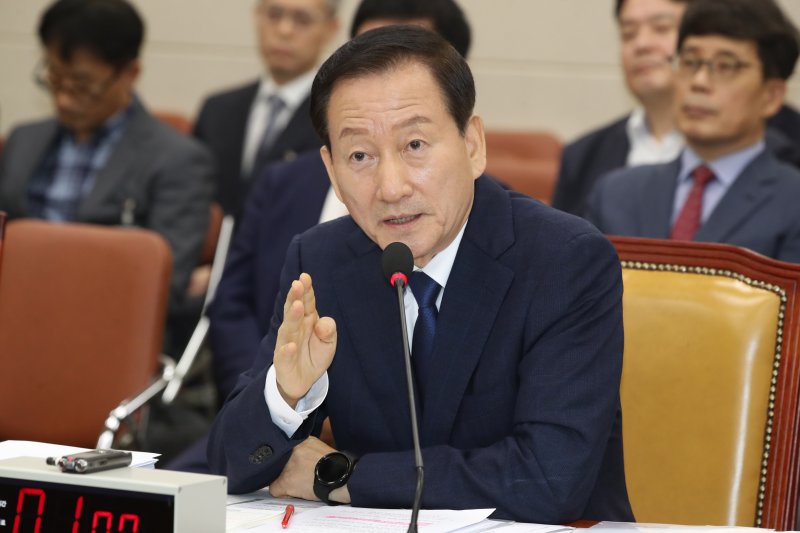
[Financial News] Prosecutors have sought a prison sentence for former Korea Communications Standards Commission chair Heelim Ryu, who was sent to trial on charges including giving false testimony to the National Assembly that Google had promised to promptly remove harmful YouTube content.
The Seoul Southern District Public Prosecution Office sought a sentence of one year and six months in prison at the closing hearing on Ryu’s charge of perjury under the Act on Testimony and Appraisal, etc. before the National Assembly. The hearing was held before the Seoul Southern District Court’s 13th Criminal Division, presided over by Judge Seo Bo-min.
Ryu was indicted on a charge of giving false testimony at a parliamentary audit by the National Assembly’s Science, ICT, Broadcasting, and Communications Committee on October 21, 2024, saying that Google Vice President Markham Erickson had promised to promptly remove illegal and harmful YouTube content.
He also faces a charge of falsely testifying at the audit that he had not been told by a KCSC employee that his younger sibling had filed a complaint over news reports concerning allegations that an investigation into Busan Savings Bank was suppressed when former President Yoon Suk Yeol was a prosecutor.
A prosecutor from the Public Prosecution Office said, “With an eye to securing another term, he used the media while inflating his personal achievements, and repeatedly told the public and the National Assembly that Google had made a promise to remove the content, even though no such promise existed.”
The prosecutor cited Erickson’s response to a question from then committee chair Choi Min-hee that he did not remember promising prompt removal, as well as the fact that employees who attended the meeting did not testify that they had heard such a promise. The prosecutor added, “Even the meeting transcript submitted as evidence shows that no such promise existed.”
The Public Prosecution Office’s position is that, during his meeting with Ryu, Erickson said only that he would look into the speed of the response and compliance with Korean law, and did not promise prompt removal.
The prosecutor cited as evidence of intent to commit perjury the fact that Ryu had been told before the meeting that an official in charge would also need to attend to discuss the YouTube issue, and that after the meeting he obtained and reviewed the recording to respond to questions raised by the media. The prosecutor also said that Ryu did not use the word “promised” in documents prepared for questions from the National Assembly.
On the report about his younger sibling’s complaint, the prosecutor said that, in addition to relevant testimony from Jang, then head of the KCSC’s General Programming and News Channel Team, building access records and testimony from an employee who drafted the report supported the fact that it had been made. The prosecutor also cited KakaoTalk messages that an employee shared with coworkers after hearing Jang say, “I completed the briefing successfully,” as well as records in the complaint-handling system showing that the complaint was withdrawn the day after the report.
The prosecutor also stressed that Ryu’s explanation that he did not remember receiving the report was difficult to believe, given that concerns about a conflict of interest involving his younger sibling’s complaint had been repeatedly raised within the organization and led to a report to the Anti-Corruption and Civil Rights Commission.
The prosecutor sharply criticized Ryu, saying, “Although it is clear that he received a report about his younger sibling’s complaint, he claimed he had not received one in order to avoid a conflict-of-interest issue.” The prosecutor added, “He showed an irresponsible attitude that left employees, who were wary of the defendant as their chairman, with no choice but to give false testimony.”
Ryu’s defense lawyers, meanwhile, argued that the complaint concerning his younger sibling’s case went beyond the scope of the National Assembly’s resolution and therefore warranted dismissal of the indictment. They said that when the Science, ICT, Broadcasting, and Communications Committee voted to file a complaint, it specified only the remarks concerning Erickson, and did not decide which testimony about the sibling’s complaint should be treated as perjury, discussing only the possibility of adding it to the complaint later.
The defense argued that Ryu had understood Erickson’s English remarks as a promise of prompt action. Erickson’s letter to the National Assembly said not that he “had not made a commitment,” but that he “did not remember”; employees who attended the meeting also testified that Ryu seemed to take Google’s response as a promise. The defense argued that, in these circumstances, the testimony could not be conclusively deemed intentional perjury.
The defense asked the court to “carefully consider whether interpreting the remarks as a promise of a prompt response was such an unreasonable reading of the language as to amount to perjury.”
The defense also countered that the allegation that Ryu had received and reviewed the recording before the audit had not been proven. Its argument was that it was difficult to trust a precise claim about when the file was delivered when Jang could not even clearly remember whether Jang had personally handed it over. The defense stressed that KakaoTalk messages from the time, Ryu’s schedule, and records of work on the recording file indicated that he received it after the audit.
The defense challenged the credibility of Jang’s testimony about the report on Ryu’s younger sibling’s complaint. It said Jang had repeatedly testified before the National Assembly and the Anti-Corruption and Civil Rights Commission that no report had been made, then reversed that account. The defense also said that Jang first told police that Ryu had never instructed Jang what to say, but changed the account during questioning by prosecutors, saying that shortly before testifying to the National Assembly, Ryu had said he had not received the report, and Jang had testified accordingly.
In his final statement, Ryu said, “I clearly understood Google’s response as a promise to promptly remove and block the content, and issued the press release in accordance with that principle.” He added, “As far as I know, Google never formally objected at the time to the press release’s use of the word ‘promise.’ The meeting transcript also contains ample grounds for interpreting Google’s response as a promise.”
He continued, “I strongly called on a global platform to take corrective action to protect the public, and explained the outcome to the National Assembly exactly as I understood it. It is truly regrettable and devastating to see how that could be intentional perjury.”
He continued, “I never intentionally gave false testimony about my younger sibling’s complaint. I have no memory of receiving such a report, either then or now.” He added, “Jang appeared before the National Assembly five times and testified repeatedly that no report had been made. I was deeply shocked to learn recently that Jang, after contacting Choi Min-hee’s office, suddenly reversed the testimony Jang had consistently given, and that no complaint was filed as a result without a separate vote.”
The ruling in Ryu’s case is scheduled for the afternoon of December 1.
[email protected] Seong-hyun Park Reporter