Cho Hyun “Fully Agrees” with Call to Warn U.S. Commander Brunson, Denies Breakdown in South Korea-U.S. Military Cooperation
- Input
- 2026-10-27 16:08:28
- Updated
- 2026-10-27 16:08:28
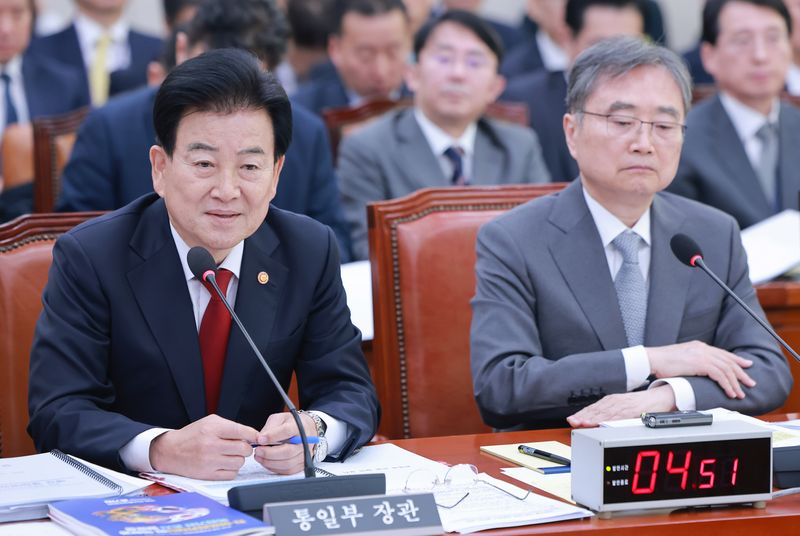
Foreign Minister Cho Hyun responded to a call by Lee Ki-hyun of the Democratic Party of Korea for a warning to Commander Brunson at a comprehensive audit of state affairs by the National Assembly’s Foreign Affairs and Unification Committee on the 27th, saying, “I fully agree.” He added, “Last week, we called in U.S. Ambassador to South Korea Michelle Park Steel to the Ministry of Foreign Affairs (MOFA) and conveyed our views,” and said, “We plan to convey them to the U.S. side again.” Cho is scheduled to leave the country this week and meet with U.S. Secretary of State Marco Rubio.
“I think wartime operational control should be transferred back as soon as possible,” Cho said, adding, “The U.S. secretary of state also affirmed this recently at the Shangri-La Dialogue (the Asia Security Conference).” He said, however, that military authorities were holding consultations on the timing of the transfer.
Defense Minister Kang Shin-cheol expressed a strong commitment to the transfer of wartime operational control at an audit by the National Defense Committee of the National Assembly of the Republic of Korea the previous day. Saying that South Korea could not rely solely on the U.S. military in the event of a war with North Korea, Kang upheld the principle of the transfer. However, criticism was voiced that his remarks had caused distrust of the U.S. military and a breakdown in South Korea-U.S. military cooperation.
Cho said, “There is no problem with military cooperation between South Korea and the U.S. There may be minor differences in South Korea-U.S. relations, but claims by some that the relationship has collapsed are absurd.” He added, “At breakfast with U.S. Ambassador Steel the previous day, I told the U.S. ambassador that when a plane passes through turbulence, there is no problem if you fasten your seat belt securely, and the U.S. ambassador agreed.”
The ruling party called for a letter from the foreign minister concerning the denial of a U.S. visa to Rep. Jeong Cheong-rae. Cho agreed to send a letter. However, the ruling and opposition parties disagreed over a proposal for the National Assembly’s Foreign Affairs and Unification Committee to send a letter to the U.S. regarding the visa denial.
At the committee’s audit that day, the ministers of the Ministry of Unification (MOU) and the Ministry of Foreign Affairs (MOFA) said it was possible that coordinating North Korea-U.S. talks was among the purposes of North Korean leader Kim Jong Un’s visit to Dandong, China, on the 24th, but that the possibility needed to be examined carefully.
“If he had visited the Memorial Hall of the War to Resist U.S. Aggression and Aid Korea, a military official should have accompanied him, but none did,” Chung said. “What stood out was that it was mainly the top diplomatic officials who turned out in full force.” During Kim’s visit to China, the appearance of even Executive Vice Foreign Minister Ma Zhaoxu, an expert on U.S. affairs, raised the possibility that North Korea-U.S. dialogue was being coordinated.
Foreign Minister Cho Hyun said of the possibility of coordination on North Korea-U.S. dialogue, “I think that is possible,” but added, “It is still difficult to make a definitive judgment. I think we need to consider various factors together.” Asked whether a North Korea-U.S. summit was within reach, Cho said, “It could be, but I don’t think we can necessarily be optimistic.”
Cho also dismissed concerns that, at a North Korea-U.S. summit, the U.S. might restrict only North Korea’s intercontinental ballistic missiles (ICBMs) while leaving in place nuclear weapons that could threaten South Korea. “We are closely coordinating with the U.S. to ensure that never happens,” he said.
At the audit that day, Minister Chung held to his existing position that it was difficult to determine intent regarding the landmine explosion involving North Korean troops. Independent lawmaker Han Dong-hoon countered that he could not agree with Chung’s claim, asking, “If someone crosses over someone else’s wall, isn’t that a landmine attack?” The dispute continued.
The lawmaker said, “If you plant landmines on your own land, you can call it defense, but if you cross someone else’s wall and plant them in their entryway or master bedroom, it’s an attack, and planting them secretly is deliberate. If I secretly entered Minister Chung’s home and planted a landmine, wouldn’t that be a landmine attack?” Chung nevertheless held to his position, saying, “At present, it is difficult to determine intent.”
[email protected] Kim Kyung-soo Reporter