“Which foot will they step with first?” ... AI developed to read the brains of people with Parkinson’s disease [Health LAB]
- Input
- 2026-10-28 05:00:00
- Updated
- 2026-10-28 05:00:00
[Financial News] An artificial intelligence (AI) system that analyzes brain activity in people with Parkinson’s disease (PD) has been developed. It is expected to make personalized treatment possible by gauging the effectiveness of PD treatments.
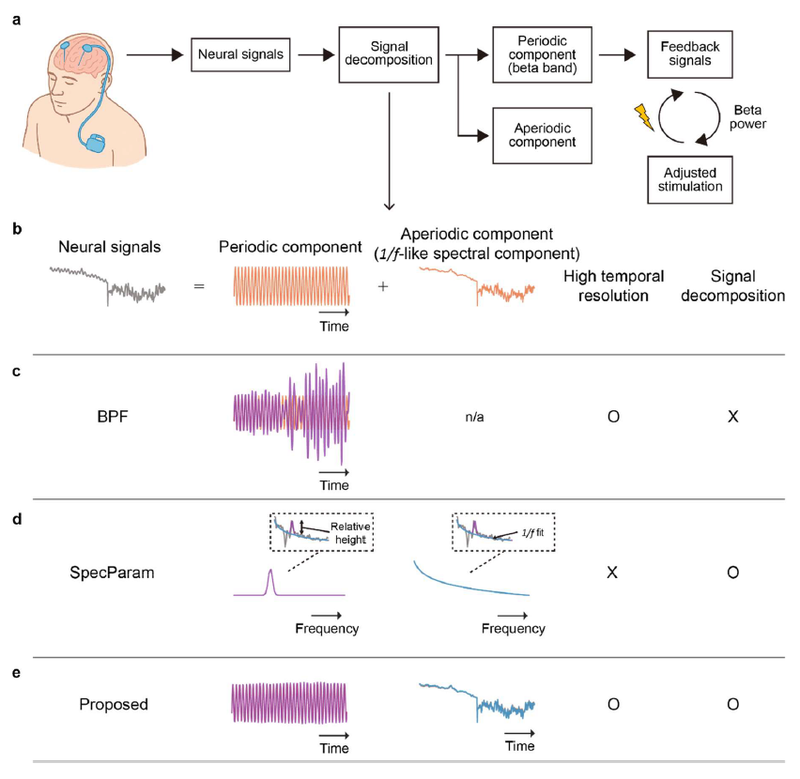
According to Daegu Gyeongbuk Institute of Science and Technology (DGIST) on the 28th, a research team led by Professor Jiwoong Choi of DGIST’s Department of Electrical, Electronic and Computer Engineering developed NONOS, a deep-learning analysis technology that precisely separates “rhythms” from the underlying “background signal” in brain signals with high temporal resolution. The team collaborated with research teams led by Professor Hanjun Kim of Kumoh National Institute of Technology, Professor Gyeong-hwan Jin of Korea University, and Dr Jong-cheol Ra of the Korea Brain Research Institute.
According to the research team, electrical signals generated in the brain contain a mixture of “rhythms (oscillatory components)” that repeat at regular intervals and the underlying “background signal (non-oscillatory component).” Selecting and analyzing only these rhythmic components in brain signals is like picking out one person’s voice from the hum of a crowded café. In particular, in the brains of people with PD, the strength of a rhythm called “beta waves,” which oscillate dozens of times per second, becomes abnormally high. This is associated with symptoms of slowed movement and is used as an indicator to gauge treatment effectiveness.
The problem is that existing analysis methods cannot properly distinguish the rapid changes in rhythms from those in the background signal. The research team focused on the fact that the background signal follows a function whose magnitude decays exponentially at higher frequencies. NONOS is an AI model trained to take brain signals recorded over time as input and extract only the background component that follows this function. Removing this extracted background signal from the original signal leaves only the pure rhythmic component, making it possible to capture rapid changes in both components without losing temporal resolution.
When the research team analyzed rhythms extracted by NONOS from the brain signals of people with PD, its performance in predicting which foot a patient would step with (with scores closer to 1 indicating greater accuracy) rose substantially to 0.98, compared with 0.54–0.79 for existing methods. In experiments with mice modeling PD, NONOS alone sensitively detected the sharp decrease in beta-wave strength caused by deep brain stimulation (electrical therapy), which existing methods had difficulty detecting.
Professor Jiwoong Choi of DGIST, director of the Brain Engineering Convergence Research Center, said, “The significance of this study is that it showed that rhythms and background signals mixed together in brain signals can be separated without losing temporal resolution.” He added, “If we reduce the computational load in the future and further develop the technology so it can operate in real time on brain-implantable devices, it will help improve the accuracy of personalized deep brain stimulation therapy, which adjusts electrical stimulation to the patient’s condition.”
Professor Hanjun Kim of Kumoh National Institute of Technology said, “NONOS’s strength is its ability to decompose periodic and aperiodic components of various biosignals that change rapidly over time, with high temporal resolution. This means it could help analyze a wide range of time-varying signals beyond the examples presented in the paper.”
The research was conducted with support from the National Research Foundation of Korea’s STEAM Research Program (BRIDGE Convergence Research and Development), the Leading Convergence Technology Development in Brain Science program, and the Ministry of Education’s Glocal Lab program, among others. The findings were published in NeuroImage, a top-tier international journal in the field of neuroimaging.
[email protected] Yeon Ji-an Reporter