Itaewon Special Investigation Commission: “Presidential directive went unrelayed for 55 minutes” ... to directly investigate Yoon Suk Yeol and Lee Sang-min
- Input
- 2026-10-27 15:07:23
- Updated
- 2026-10-27 15:07:23
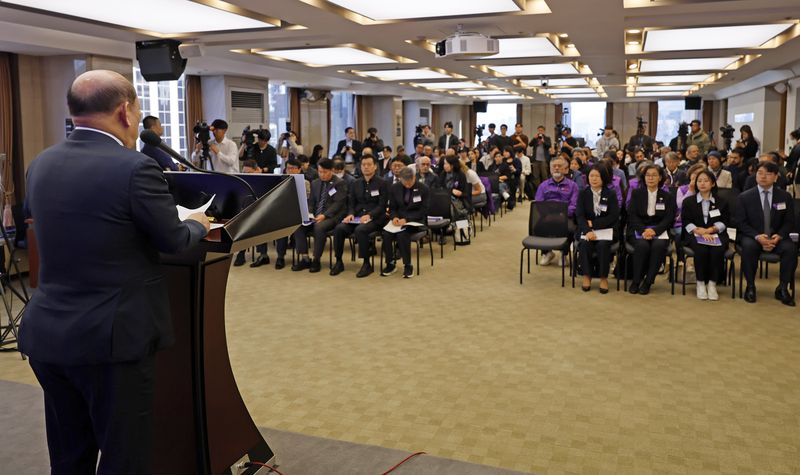
[Financial News] The Special Investigation Commission found that there were gaps in the national disaster-response command system during the 10.29 Itaewon Tragedy, including that a presidential directive went unrelayed to relevant agencies for 55 minutes. The commission plans to directly investigate former President Yoon Suk Yeol and former Minister of the Interior and Safety Lee Sang-min, among others.
On the 27th, the Special Investigation Commission for Identifying the Truth About the 10.29 Itaewon Tragedy and Preventing Its Recurrence held an interim briefing at the Korea Press Center in Jung-gu, Seoul, and announced these findings.
According to the commission, 120 police officers were deployed in the Itaewon area as of 10 p.m. on the day of the disaster. Of these, 49 were narcotics enforcement detectives, and not a single riot police officer was deployed to manage the crowds. It was also confirmed that no formal request had been made to deploy riot police.
Police were found not to have responded at the scene to any of the 11 calls to 112 warning of a risk of a deadly crush before the disaster. Police had previously said they responded to four of the calls, but after rechecking the relevant records, the commission determined that the actual number of responses was zero.
Gaps were also found in the Ministry of the Interior and Safety’s reporting and command process. The ministry became aware of the incident at 10:48 p.m., but the first report to the minister was not made until 11:31 p.m., 43 minutes later. A presidential directive issued at 11:21 p.m. was not relayed until 12:16 a.m. the following day, 55 minutes later.
While investigating ministry officials, the commission also found that remarks to the effect of “If we relay it, it seems the Ministry of the Interior and Safety will become the ministry in charge of disasters” were exchanged in the Central Disaster and Safety Situation Room on the day of the tragedy. The commission concluded that an ingrained tendency in public service to avoid taking the lead in disaster response contributed to the delay.
The findings also included that the presidential office sought to remove wording from the Basic Guidelines for National Crisis Management that explicitly assigned it the role of disaster control tower. According to the commission, plans for the related revision were drawn up in July 2022, before the tragedy, and the process continued after the tragedy on the premise that the wording would be deleted.
Other issues under investigation included the failure of Yongsan District’s disaster-response system, the dispersal of victims during transport, the government’s process of changing the terms “tragedy” to “accident” and “victim” to “deceased,” and limitations on support for victims.
The commission plans to directly investigate key officials responsible at the time, including former President Yoon and former Minister Lee, and pursue institutional reforms in five areas, including disaster-response manuals, the disaster safety communications network, and the operation of the Central Disaster and Safety Countermeasures Headquarters.
[email protected] Choi Seung-han Reporter