“3,000-won underwear, 5,000-won T-shirts” ... Shoppers head to Daiso instead of department stores to buy clothes
- Input
- 2026-10-28 10:31:18
- Updated
- 2026-10-28 10:31:18
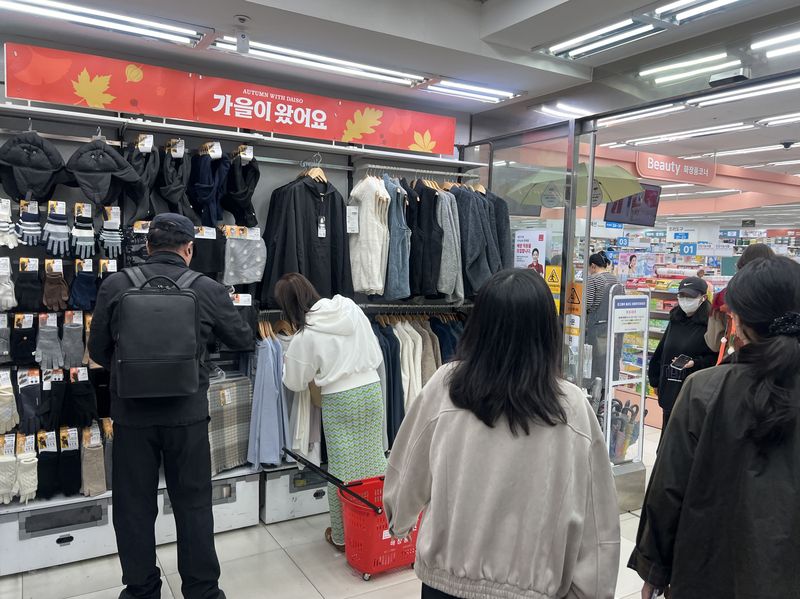
[Financial News] As high prices persist, consumers are diversifying where they shop for clothing. More consumers are looking for low-priced apparel at everyday retail outlets such as Daiso, big-box retailers and convenience stores, rather than department stores or specialty fashion stores, making ultra-low-priced clothing a new growth category.
According to the Ministry of Data and Statistics on the 28th, clothing prices have risen sharply over the past five years. Last year, the consumer price index for textile products stood at 116.59 (2020=100), with prices up about 17% from 2020, five years earlier. As clothing becomes more of a financial burden, consumers appear increasingly inclined to prioritize price over brand for basic items that are less affected by trends.
From January to August this year, Daiso’s apparel and accessories sales surged about 130% from the same period a year earlier. By category, sales of sportswear rose about 200%, loungewear 90% and innerwear 80%. Daiso’s annual sales of apparel and accessories grew 34% year over year in 2024 and 70% last year, and the pace of growth is accelerating further this year.
The range of products is also expanding rapidly. The number of apparel and accessory varieties carried by Daiso grew from around 300 at the end of 2024 to around 700 at the end of last year and around 1,100 at the end of August this year, at least tripling in just two years. By combining the competitive advantage of a uniform pricing system, with all products priced at 5,000 won or less, with improvements in quality and product selection, the household goods retailer has expanded its role to include clothing shopping. A Daiso spokesperson said, “Strengthening quality and product variety while keeping prices uniformly at 5,000 won or less is leading to positive responses from consumers.”
A similar trend is emerging at convenience stores. From January to September this year, apparel sales rose 12.5% year over year at CU, 33.4% at GS25 and 49% at 7-Eleven. GS25 expanded “MUSINSA STANDARD EXPRESS,” developed in collaboration with MUSINSA, to 17 product types and increased the number of locations carrying it from 3,000 to around 11,000. The company said more than 60% of customers are in their teens to 30s, with demand surging particularly among younger people.
Big-box retailers have also joined the competition in ultra-low-priced clothing. FRESH 365 has expanded its selection of clothing priced under 10,000 won this year and stepped up its focus on underwear in the 3,000-to-5,000-won range starting in August–September. From January to September this year, sales of value-for-money clothing rose 6.4% from the same period a year earlier; T-shirt sales increased 7% and underwear sales 8%. The retailer has also expanded the number of clothing products under its private label, “Oneuljoeun,” by about 10% annually over the past three years.
Experts say consumers’ clothing purchases are also shifting toward “value-based consumption.” Spending is becoming polarized: consumers pay more for items they consider worthwhile, such as outerwear, while seeking the lowest prices for basic clothing such as T-shirts and underwear.
Choi Cheol, a professor in the Department of Consumer Economics at Sookmyung Women’s University, said, “As the range of products carried by highly accessible offline channels such as Daiso expands, consumers can conveniently buy a variety of items in a single shopping trip. As so-called ‘economies of scope’ take hold around low-priced product ranges, demand may continue to grow, particularly for basic clothing, where consumers are relatively less inclined to prefer premium brands.”
Yi Jong-u, a professor in the Department of Distribution and Marketing at Namseoul University, added, “As the clothing market has recently shifted toward SPA retailers, the importance of brands is declining. As consumers spend money only on items they consider especially worthwhile and look for the lowest prices for the rest, demand for clothing is growing at sales channels that emphasize value for money.”
[email protected] Kim Hyun-ji Reporter