LucentBlock: “No resolution was passed on the ‘two-operator cap’ for fractional-investment exchanges; legal action also under consideration”
- Input
- 2026-10-27 14:45:27
- Updated
- 2026-10-27 14:45:27
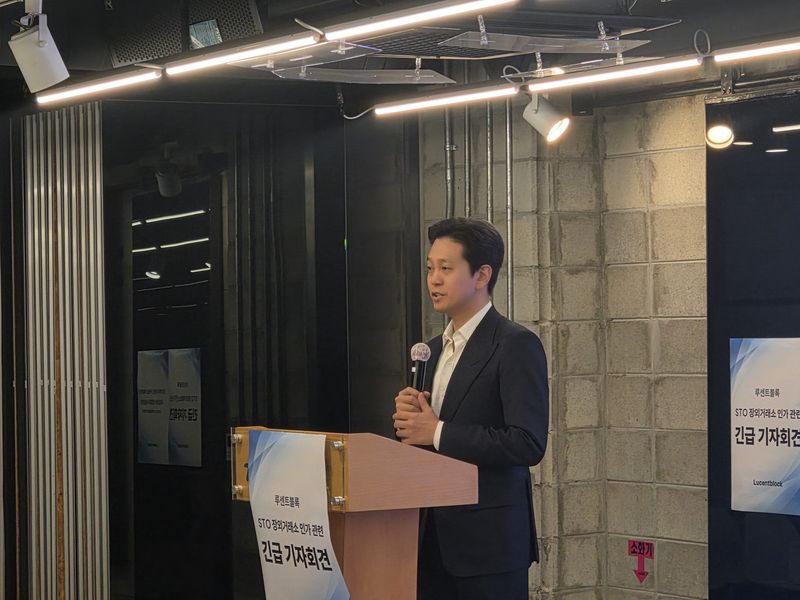
[Financial News] LucentBlock, which was disqualified in the preliminary approval review for an over-the-counter fractional-investment exchange, has again challenged the Financial Services Commission’s procedures. The company argues that no formal resolution was passed when the FSC limited the number of operators to a maximum of two. It said it is seeking additional approval from the financial authorities while also considering legal action.
LucentBlock CEO Heo Se-young held an emergency press conference at Maru180 in Seoul’s Gangnam District on the 27th and said, “I would like to ask whether this approval process was indeed conducted fairly and transparently.”
LucentBlock, which has operated the real estate fractional-investment platform “Soyu,” sought preliminary approval for an over-the-counter fractional-investment exchange but failed to pass the review. At the time, the FSC granted preliminary approval to only two applicants: KDX, led by the Korea Exchange (KRX), and the NXT Consortium, led by NextTrade.
CEO Heo pointed to procedural problems with the FSC’s decision to limit the number of approvals to a maximum of two. In materials submitted to the National Assembly on the 19th, the FSC said it had limited the number of approvals through a resolution at its regular meeting on September 3 last year. But on the 21st, it acknowledged an administrative error and corrected the description from “resolution” to “report and discussion.” The central issue in the objection is that the number of operators was limited to two based solely on a report, without a resolution. Heo argued, “The FSC is a collegiate administrative body comprising nine commissioners, and a decision by the commission means a resolution,” adding, “If the nine members did not decide it, then the FSC did not decide it, so it cannot be considered a decision of the commission.”
He also noted that the agenda item reported at the FSC’s regular meeting on September 3 last year contained only the phrase “(e.g., a principle of a maximum of two),” while a press release issued at 9 a.m. the following day stated that approval would be granted “for up to two.” He said, “It is unclear what happened between the agenda item being reported and the press release being issued,” and asked, “I wonder who was able to finalize this, and under what authority.”
He also questioned whether the process was consistent with past cases involving new approvals for internet-only banks and real estate trust businesses. In those cases, the number of approvals was limited after separate competition assessments and other reviews. For the over-the-counter fractional-investment exchange, however, the only reason given was “to prevent the fragmentation of investors and liquidity caused by a proliferation of trading platforms,” he said.
LucentBlock is seeking swift additional approval, not the revocation of approval for the existing preliminary-approval holders. FSC Chairman Lee Eok-won said at a comprehensive audit by the National Assembly’s National Policy Committee on the 22nd that he would review the need for additional approvals after assessing market conditions.
Heo said, “I worked for 2,537 days, as of the application date, to obtain approval, but one applicant took 44 days from announcing its bid, while the other took only 17 days,” adding, “All of this cannot be explained simply by a lack of ability on my part.”
He said LucentBlock was also considering legal action, but added that he would prefer the authorities to open up opportunities for competition. Heo emphasized, “We want fairness and transparency, not special treatment,” and said, “I don’t want LucentBlock’s precedent to remain a regrettable case of failure.”
[email protected] Im Sang-hyeok Reporter